
The Rise of Cats in England: Louis Wain and the Popularization of Cats in British Culture
Madison Fama, Spring 2025
"He has made the cat his own. He invented a cat style, a cat society, a whole cat world. English cats that do not look and live like Louis Wain cats are ashamed of themselves." - H.G. Wells
In the late 18th century into the early 19th century, cats were viewed in the media as “serious” or “mean” or “sneaky” animals. Puss in Boots- who originated as an Italian fairy tale- was manipulative and deceitful. The Cheshire Cat from Alice’s Adventures in Wonderland was mysterious and cryptic, often unsettling and startling. These portrayals reflected how the media viewed felines- discounting them as a smart but self- serving and sneaky. This perception switched significantly once Louis Wain started publishing his works.
Louis Wain was a British artist born in Clerkenwell, London in 1860. Wain attended the West London School of Art and went on to be a freelance artist. Wain had to pick up the responsibility of being the sole provider for his 5 sisters and his mother after his father passed away in 1880. This encouraged him to quit his freelancing work and sign on as an illustrator at The Illustrated London News. People loved his art and would often commission personal drawings. In 1884, Wain married a woman named Emily Richardson. Emily and Louis lived together with their black and white kitty named Peter. Unfortunately not long after the wedding, Emily was diagnosed with terminal breast cancer. In order to lift her spirits, Wain would do caricatures of Peter and Emily loved them. He kept drawing cats for her and realized just how much he enjoyed it- and his cat world kept growing. He drew cats on vacation, playing sports, and attending parties. Emily encouraged him to submit his cat art to The Illustrated London News. A piece featuring 100+ felines called “A Kitten’s Christmas Party” was published in the newspaper in 1886. A few days later, Emily passed away. Wain was devastated and channeled his grief into his art. He made thousands of pieces afterwards- all of them featuring friendly felines.
Wain’s art was an automatic hit. He drew cats in ways no one had ever perceived them before- characterizing them as silly and charming. English society fell in love with cats and he produced his art at an alarming rate. Despite the fans and popularity, Wain was not doing well financially or mentally. He was still supporting his family and they were forced to move in with him due to his terrible financial situation. He never copyrighted his works so they were all free for public use. He would sell original pieces for low prices because he wasn’t very business-savvy. He was still fresh off the heartbreak from the passing of his wife so he distracted himself by making art piece after art piece. People characterized Wain as strange or different and it is often thought that he had functioning autism. When his cat, Peter, died at 15 years old he was flung into a deeper state of grief. He fled to New York City to bring his cat art to America, but it wasn’t nearly as popular as it was in the UK. His trip was cut short when he got word that his mother passed away. He rushed home to find an already broken family break even further. Not long after, two of his sisters passed away signaling his breaking point.
Although he continued drawing happy and charismatic kitties, Wain’s temperament shifted exponentially. He became violent and hostile- scaring his sisters. On June 16, 1924, he was declared insane and moved into Springfield Hospital. Fans took notice of his hospitalization and started raising money for Wain’s care. People all over the UK pitched in- including Prime Minister Ramsay McDonald. Because of this funding, Wain was able to be transferred to Bethlem Royal Hospital where he was able to keep painting. He made an exhibit with 80 works and sold thousands of copies of his catalog including those pieces.
During Wain’s stay at the hospital, people started noticing alarming shifts in his artwork. What was once charismatic kitties turned into unrecognizable psychedelic shapes. It is often theorized that Wain had Schizophrenia but others argue he was clearly autistic with a hyper fixation on cats. It is a popular theory that as Wain’s mental health declined, his cats got more abstract.
Wain finished out his life at Napsbury Hospital which had a stray cat population. He kept drawing for the rest of his life and his main topic always stayed the same- cats. Although his later years were defined by illness and grief, his passions continued to show through. With Wain’s popularity and art, England picked up a new love for cats- he humanized them and helped reposition them as loving animals instead of sneaky tricksters. Today, he is still a household name in the UK and his art continues to inspire many. Wain passed away on July 4, 1939, at 78 years old. Wain left behind a legacy characterized by acceptance, imagination, and a deep love for kitties.
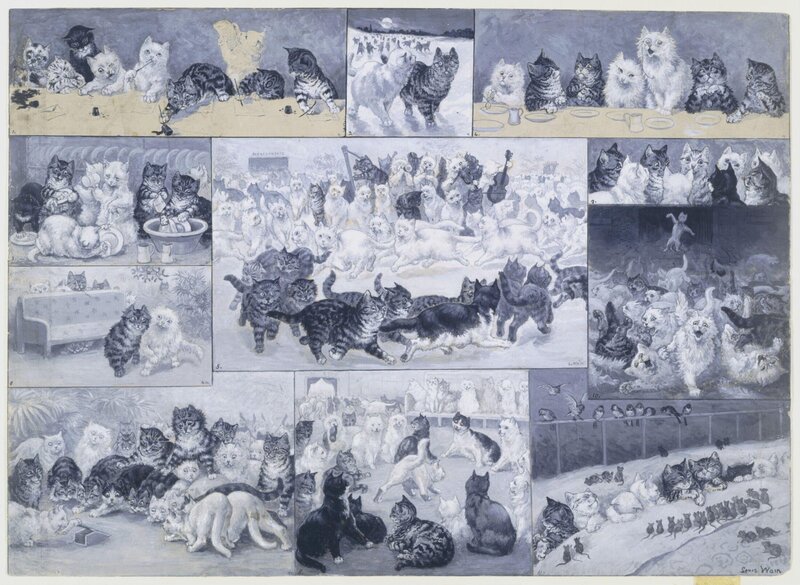 One of the first pieces of cat art published by Louis Wain. This piece features 100+ cats doing various activities to celebrate Christmas. Located at the Victoria and Albert Museum.
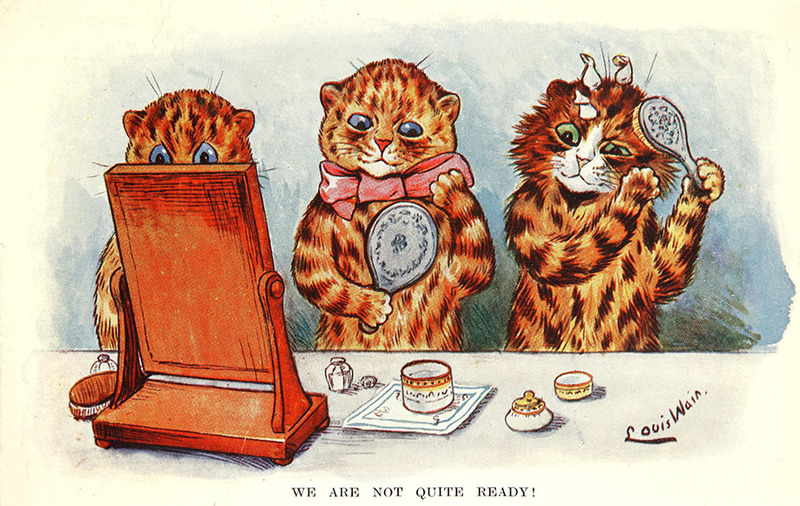 A painting of three cats getting ready with the discription "We are not quite ready". This piece is owned by the UK National Archives
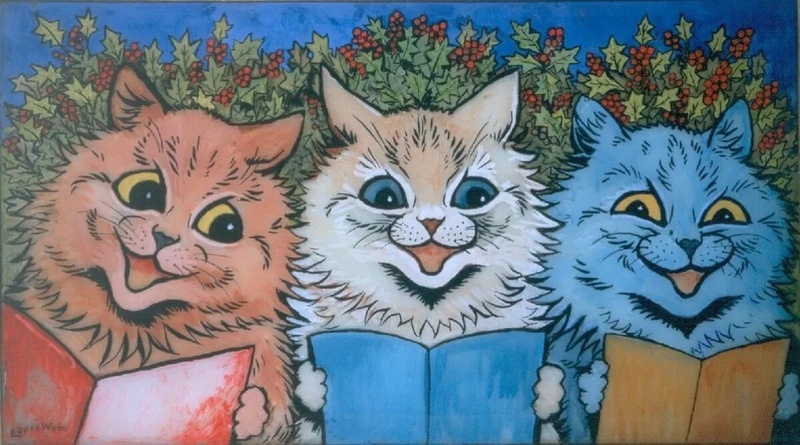 A painting on a window at the hospital Wain stayed at. Featuring kitties singing Christmas carols, this is one of many pieces hosted at Bethlem Hospital.
 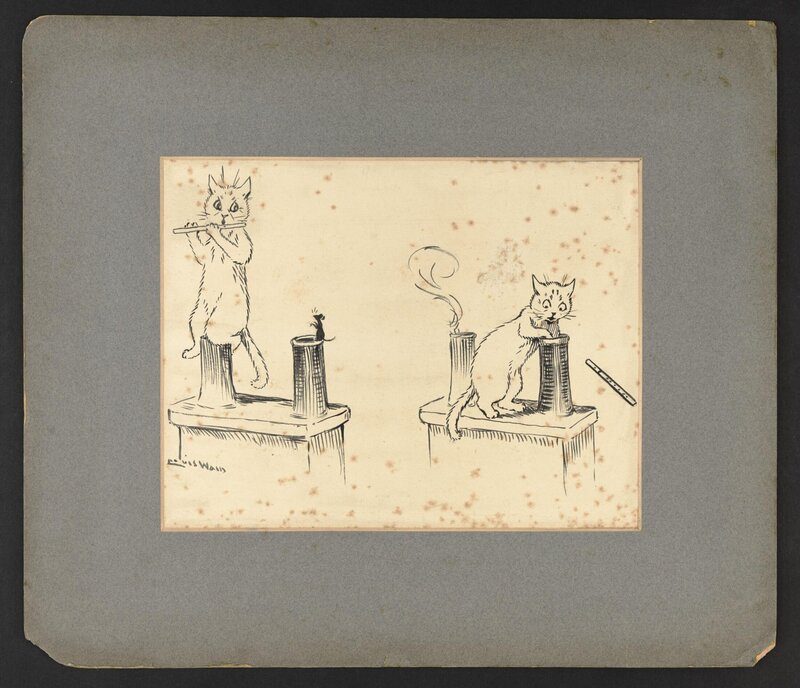 A sketch of a cat playing the flute before he notices a mouse. This is a perfect example of the way Wain personified the cats and made them very silly. It was said that Wain could sketch these drawings in 15 minutes. This piece is located at the Victoria and Albert museum.
 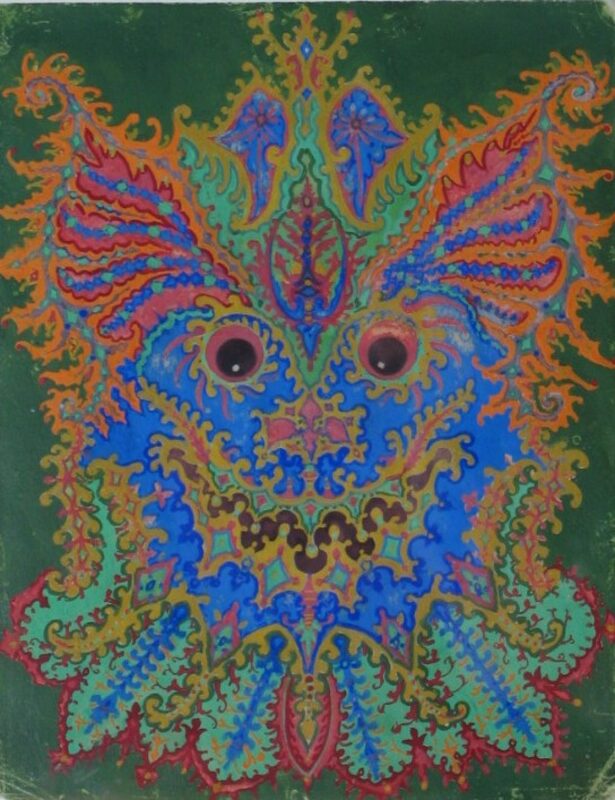 A psychedelic style cat painted by Louis Wain. Near the end of his life, his art got more and more abstract. Some theorize this is due to worsening schizophrenia.
Bibliography
- Howells, K. (2020, November 26). A celebration of cats: The creative brilliance of artist Louis Wain - The National Archives blog. The National Archives Blog. https://blog.nationalarchives.gov.uk/a-celebration-of-cats-the-creative-brilliance-of-artist-louis-wain/
- Introvert. (2024, June 5). Louis Wain: The Man Who Loved Cats - Weeds & Wildflowers - medium. Medium. https://medium.com/weeds-wildflowers/louis-wain-godfather-of-outsider-cat-art-fd806f8739dc
- Louis Wain. (n.d.). https://museumofthemind.org.uk/collections/gallery/artists/louis-william-wain
- Martinson, M. (n.d.). Louis Wain – and how he changed the world. The Wrangler. https://ylhsthewrangler.com/27846/features/louis-wain-and-how-he-changed-the-world/
- Museum, V. a. A. (n.d.-a). A Kitten’s Christmas Party | Louis wain | V&A Explore The Collections. Victoria and Albert Museum: Explore the Collections. https://collections.vam.ac.uk/item/O711119/a-kittens-christmas-party-drawing-louis-wain/
- Museum, V. a. A. (n.d.-b). By Road & Rail in Catland with Louis Wain | Wain, Louis William | V&A Explore The Collections. Victoria and Albert Museum: Explore the Collections. https://collections.vam.ac.uk/item/O701931/by-road--rail-in-drawing-wain-louis-william/
- Museum, V. a. A. (n.d.-c). “The Flute Player” | Wain, Louis William | Nister, Ernest | V&A Explore the collections. Victoria and Albert Museum: Explore the Collections. https://collections.vam.ac.uk/item/O147116/the-flute-player-illustration-nister-ernest/
- Stokes, B. T. (2021, December 28). Louis Wain: The artist who changed how we think about cats. https://www.bbc.com/news/uk-england-london-59518847
Acknowledgments
Thank you to the UAH honors college for providing this study abroad opportunity. Thank you to the UAH Last Mile Fund as well as the College of Business and the Boeing 24-hour challenge for providing funding for this trip. Thank you to Reagan Grimsley and Jennifer Staton for making this trip possible. I would like to thank “Step Back in Time” in Brighton, England for telling me about Louis Wain and inspiring this research.