
Practical Falconry in London
Davis McClure, Spring 2025
As any Londoner can tell you, pest birds are a serious nuisance in London. They roost in inconvenient places, they leave stains on beautiful monuments and buildings, and they dig through trash. Luckily, there are many ways to ward off these birds: reflective tape, scarecrows, noises, lasers, even falconry. Most non-falcon deterrents are effective, and cost a fraction the price of hiring a falconer. It seems that having falcons kill pigeons would be inhumane to the birds they kill, and unsettling to the people that witness the act. Another issue arises when the birds you are trying to scare away have demonstrated that they are perfectly fine raising their young next to trains and the like. Pigeons and other strong habit-forming birds can quickly adapt to most non-falcon deterrents, and the deterrents that they can’t adapt to are unsuitable for use in a crowded city. Hence Falconry is the more effective, and more natural, way of dealing with these birds.
Falconry seems at first glance to be an inhumane way to dispose of pest birds, while also being an unnecessary threat to small pets like dogs and cats. Falconers specifically train their birds to simply fly up, circle, and come back down, (8). They repeat this process frequently until the pigeons learn that there is a predator that has set up in the area, and move away(6,8). Falconers do train their birds to kill however, even if it’s only about one bird a day (5). One bird a day, per each falcon, added up over time still warrants research into deterrents that don’t kill at all.
Not only does falconry cause the death of birds, but some researchers argue that falcons are not even needed when non-falcon deterrents are less expensive, and sometimes more effective (1). They went even further, claiming that falcons are only really viable at airports, where other non-falcon deterrents would be infeasible (1). Lasers, reflective tape, and balloons would potentially blind pilots. One study examined the use of shotguns at airports, and found that shooting at the birds worked very well. Though birds with strong habituation abilities would soon learn to ignore the noise -even when their companions were killed. In addition, violently killing birds wouldn’t be very humane, especially using a weapon potentially capable of harming passengers or pilots. Loud noises to scare or ward away birds wouldn’t be as big of an issue for people/workers at the airport, but if there is a bird problem already present near an extremely loud aircraft, sound related deterrents wouldn’t be very effective. Techniques like reflective Mylar tape, flapping flags, balloons, scarecrows, and lasers were proven to all be effective at scaring birds away(6). The issue arose when these hazing techniques were tested on birds adapted to city life. Rock Doves, known as pigeons, are an extremely habit oriented bird, so much so that they can adapt to humans and raise their young practically anywhere: airports, train stations, and busy streets. To adapt to the constant noise and movement of city living, most urban birds are able to quickly distinguish between threats and nonthreats. The effectiveness of most of the non-falcon hazing techniques declined after the first or second time scaring these birds away, as the birds adapted to the fact that the threats never amounted to any real danger(6). Lasers can be programmed to be sporadic enough to get past city bird’s capacity for habituation, but they are not effective during the day, where the sun is too bright for them to be seen (6). Lasers in urban areas would also be dangerous to the eyes of passers-by. Broadcasting the warning or distress calls of birds over loud speakers has been proven to be effective (6), but would make walking the streets of London very unpleasant. Fortunately, there are effective methods at physically keeping birds out of unwanted areas, not just scaring them away.
Physical blockers/deterrants have had some success with restricting the movement of birds. Large overhead nets, with gaps ranging from five feet to twenty-five feet have been shown to both work. They work even if the bird would easily fit through the large gap in the netting, researchers saying it must be some psychological block or disorientation caused by the strange positioning of the nets that stops them. However these nets do occasionally cause birds to impact them, even killing the bird and causing it to drop down below(6). Not only would the bird’s corpses cause London to become more unsightly, massive nets above every street would restrict the view of the sky, and of tall buildings. Spikes or coils of metal placed in perching spots work to prevent nesting (6). This method is already in use all over London to prevent the birds from building colonies on important buildings or near crowded areas. Unfortunately, preventing nesting caused the birds to simply relocate to the tops of unimpeded buildings or roofs, and raise their young there (6). In addition, spikes adorning the heads of statues or lamposts would certainly look out of place in the beautiful city of London. Falconry seems to circumvent the issues that these hazing techniques experience.
Falconry, although costly at times, is the perfect solution to the problem habitual birds present. They are often deployed in the mornings on days where not many people are out, thus scaring pet owners less and remaining unseen by most city goers. They are highly trained to only ever go after pest birds, and only a few at that, killing on average one a day (8). It only takes a week or two of a pigeon seeing hawks in the area for the bird to realise that falcons have set up in the area, causing the pigeon to move to a location lacking these predators (6). Success has been demonstrated at many airports where other methods have failed to deter habitual birds (3) This is because most methods don’t harm the birds, thus allowing them to adapt, whereas falconry is a very real threat to the birds, who quickly leave (3). Even instances where you do harm the birds, like shotguns, the birds have trouble associating the weapons with threat, whereas falcons are ingrained in the instincts of the birds, thus they easily identify them as a threat (2).
Falconry is a very viable way of keeping monuments and buildings free of pest birds, even when other methods fail. Although more expensive, the use of falconry scares birds away, even those whose strong habituation allow them to adapt to most methods. Deterrents like lasers, sounds, and nets all also worked to deter habitual birds, but they each come with their unavoidable downsides: lasers only work at night and harm people’s eyes, sounds are incredibly unpleasant for city goers, and nets are unsightly and can kill birds mid flight, frightening citizens. Physically stopping the birds works as well: nets with holes as wide as 25 feet may prevent the birds from landing in an area. However, this is unsightly both because of the nets itself, and the potential harm caused to the birds upon impacting the nets. Spikes and coils used to prevent nesting are flawed in that they only are practical for use in very crowded areas, like the tube. Falconry has been criticised by many as an inhumane solution, however the birds actually end up killing fewer than one bird a day. The birds are incredibly well trained, and as such pose no threat to the pets in the city, with the exception of pet pigeons. Though falconry has its downsides compared to other methods of pest-bird deterrents, it is still widely used in London today for its ability to scare away birds with strong habit forming abilities.
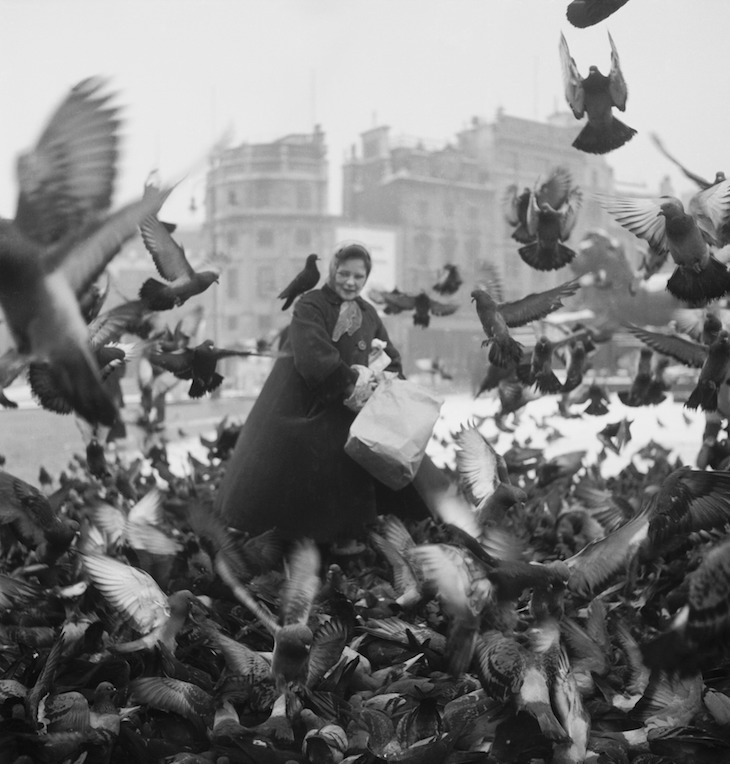 Woman Eagerly Feeds Horde of Pigeons in Trafalgar Square
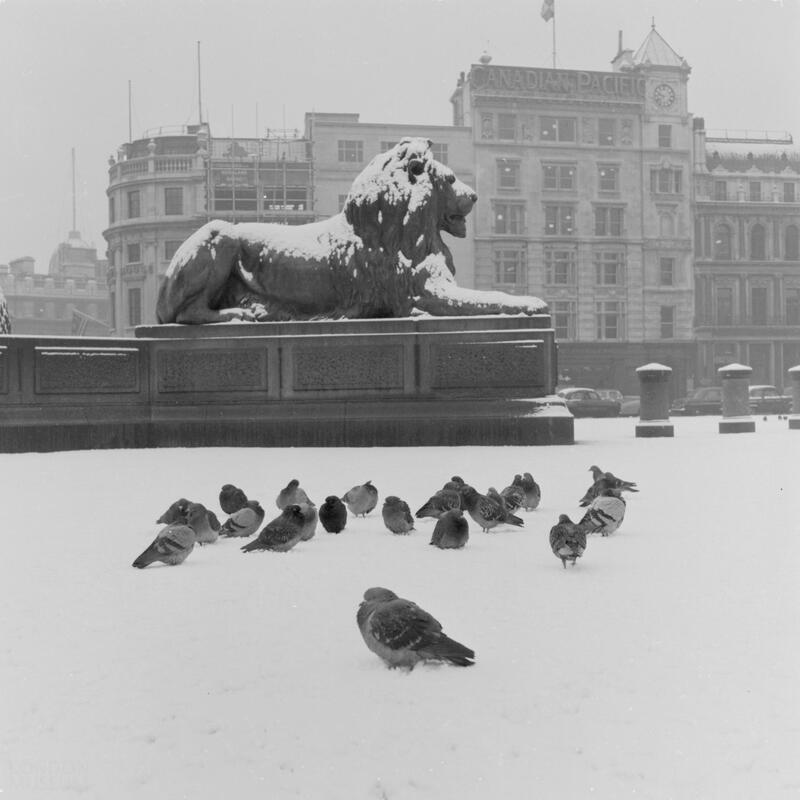 Pigeons resting in the snow infront of one of the Lion statues in Trafalgar Square
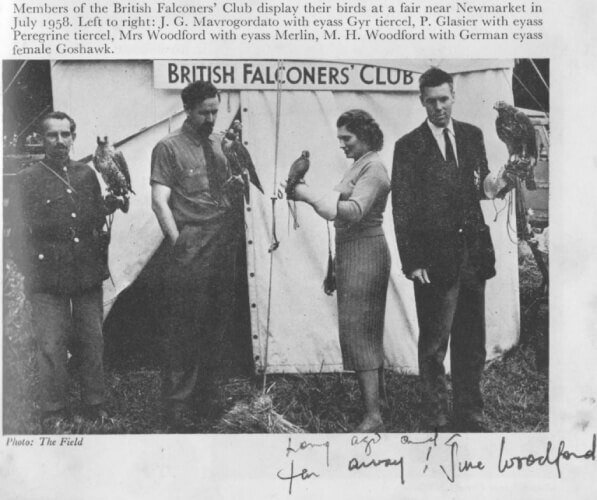 Falconry Club members show off their eyass's (downy, young falcon) to eachother
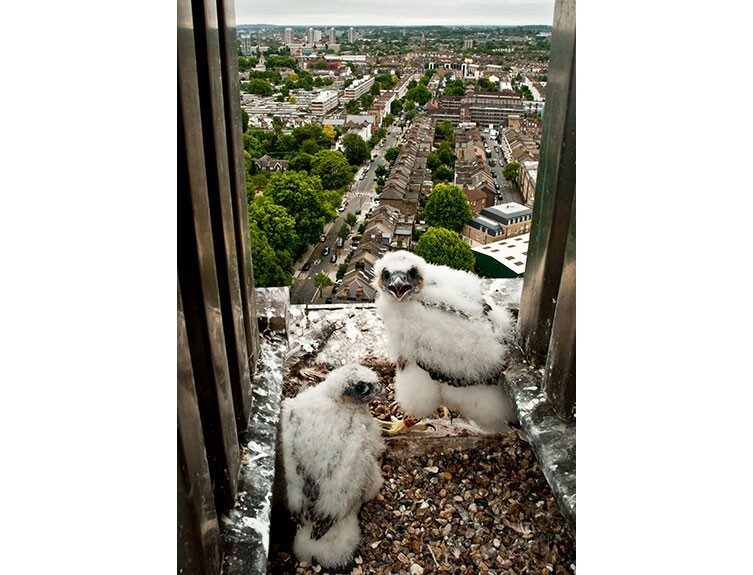 Peregrine falcon chicks nesting high ontop of a London high-rise
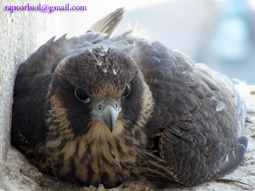 Juvenile Peregrine lying down
(1) Erickson, W. A, Marsh, R. E, & Salmon, T. P. (1990). A review of falconry as a bird-hazing technique. Proceedings of the Vertebrate Pest Conference, 14. Retrieved from https://escholarship.org/uc/item/4sp906r4
(2) Ralph, D. A., & Ross, H. E. (1998, March 31). EVALUATION OF THE EFFICACY OF PRODUCTS AND TECHNIQUES FOR AIRPORT BIRD CONTROL. Ottawa, Ontario; Aerodrome Safety Branch Transport Canada.
(3) Saad, A. E.-A. (2014). A Review of Bird Control Methods at Airports . Global Journals Inc.
(4) Grant, H. (2021). Lion Statue and Pigeons in Trafalgar Square. London Museum. photograph, Trafalgar Square. Retrieved 2025, from https://www.londonmuseum.org.uk/collections/v/object-795305/lion-statue-and-pigeons-in-trafalgar-square/.
(5) Wardell, J. (2002, November 17). London unleashes air raids to banish bothersome pigeons. Los Angeles Times. Retrieved August 6, 2025, from https://www.latimes.com/archives/la-xpm-2002-nov-17-adfg-pigeons17-story.html.
(6) Gorenzel, W. P., & Salmon, T. P. (2008). Bird Hazing Manual: Techniques and Strategies for Dispersing Birds from Spill Sites. Davis; Department of Wildlife, Fish, and Conservation Biology University of California.
(7) Long, Ben. (2020, June 06).The Falconry School.
(8) Blackwell, M. (2022, December 9). Bird control London: Falconry for Pest Pigeons & Seagulls. Project Multi Pest. https://pmpest.co.uk/services/bird-coawntrol-london/
(9) Grant, H. (1950). Hungry Pigeons. Londonist. Retrieved 2025, from https://londonist.com/london/art-and-photography/these-charming-black-and-white-photos.
(10) Lutz, D. (1961). Women in uniform in Trafalgar Square. London Museum. photograph. Retrieved 2025, from https://www.londonmuseum.org.uk/collections/v/object-767323/women-in-uniform-one-with-pigeons-on-her-head-and-on-her-arm/.
Acknowledgments
Reagan Grimsley and Jennifer Staton for helping me focus my curiosity for birds while in London
Michael Manasco (via Salmon library support) for his knowledge on how to find sources
The London Museum for making their online image resources easy to use