
Browse Items (8242 total)
Sort by:
-
"Test Laboratory monthly progress report" July.
Laboratory monthly progress report for the Saturn 1B program between dates July 1st through July 31st, 1967. -
"Test Laboratory monthly progress report" June.
Laboratory monthly progress report for the Saturn 1B program between dates June 1st through June 31st, 1967. -
"Test Laboratory monthly progress report" October.
Laboratory monthly progress report for the Saturn 1B program between dates October 1st through October 31st, 1967. Page 17 missing. -
"Test Laboratory monthly progress report" September.
Laboratory monthly progress report for the Saturn 1B program between dates September 1st through September 31st, 1967. -
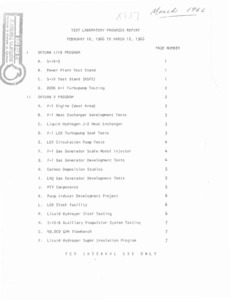
"Test Laboratory progress report" Febuary and March.
Monthly rogress report for the test laboratory regarding the Saturn 1B program between Feburary and March -
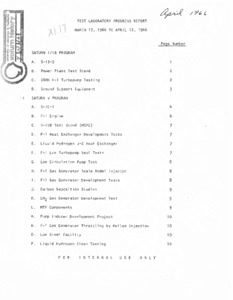
"Test Laboratory progress report" March and April.
Monthly rogress report for the test laboratory regarding the Saturn 1B program between March and April. -
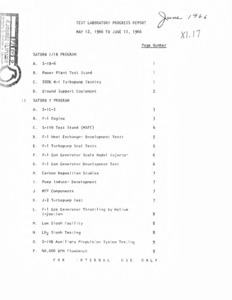
"Test Laboratory progress report" May and June.
Monthly rogress report for the test laboratory regarding the Saturn 1B program between Feburary and March -
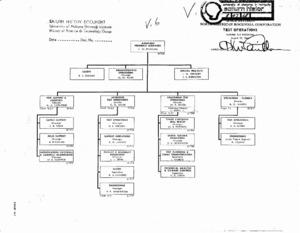
"Test operations:" Organization Chart.
Organization Chart of the North American Rockwell Test Operations. -
"Test procedure validation by computer simulation."
Digital computer simulation of the Saturn I Instrument Unit electrical networks was accomplished using the Discrete Network Simulation programs. The schematics were analyzed and a logic model prepared which consisted of a series of Boolean equations. The test procedures, which are written in the Acceptance, Test, or Launch Language (ATOLL), consist of a sequential set of computer instructions for the RCA llOA checkout computer to control the operation of the electrical networks. The procedures also contain the predicted results for each operation. The driving functions for the simulation of the model are generated from the ATOLL test tape by the Input Generator Program. The time sequenced operation of the networks is indicatedby the output from the simulation program in addition to the number of times each component in the system changes state. The results of the simulation are compared to the test procedure predictions on the ATOLL tape by the Comparator Program and any differences are listed. The Comparator Program also lists any component which did not change state at least once. -
-

"Thanksgiving 1971, Dallas - mostly Kerry."
The Dannenbergs visit a friend's house for Thanksgiving. Shown are Kerry and Klaus Dannenberg playing in the front yard of the house where the celebrations are. Fall 1971. -
"Thanksgiving 76 at Da's w/ K & B."
Betty, Klaus, Kerry, and Christie visit Konrad and Ingeborg for Thanksgiving. The four visiting members are shown walking into the house, followed by everyone sitting down for dinner. Monte Sano, Huntsville, Alabama, Fall 1976. -
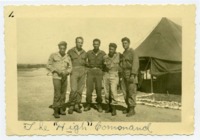
"The 'High' Command."
Salmon is pictured at center. -

-

"The Answer Is: Wrestling Over the Remote Control.; And the Question: How do potatoes get their exercise?"
Potatoes sitting on the couch drinking soda and eating popcorn in front of the TV -
"The Astrodynamicist's Role vis-a-vis the Systems Engineer."
By J. Reynolds Duncan, Jr., Aerospace Engineer, NASA Marshall Space Flight Center, Huntsville, Alabama. AIAA 7th Aerospace Sciences Meeting, New York City, New York, January 20 - 22, 1969. -
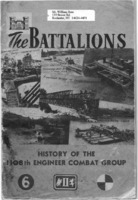
"The Battalions-History of the 1108th Engineer Combat Group".
This pamphlet was mailed to a Mr. William Rate. It includes photographs of the commanders, a list of "Those Who Are Still There" to chronicle who died overseas and where, and the history of the 1108th Engineer Combat Group. -
-
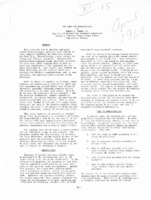
"The Case for Compatibility."
"The Case for Compatibility" is a paper by Robert L. Smith, Jr., who worked in Quality and Reliability Assurance Laboratory at George C. Marshall Space Flight Center. The summary states, "Ever since the use of missiles and space launch vehicles began, questions have existed in every program regarding the similarity between upstream (e.g., manufacturing, static firing ) and launch site checkout equipment. Programs have existed which utilized nearly identical equipment for both uses; other programs have existed in which any resemblance of the equipment was probably coincidental. Many factors have entered the final decisions, not the least of which were economic and schedule considerations, and, in some instances, the organizational structure of the developer." -
"The Challenge of Change vs the Control of the Process."
The introduction states, "This paper is designed to present the Rocketdyne engine program as it applies to the Saturn launch vehicles and will apply to the Apollo program of manned flight to the moon (Fig. 1). The vehicle that will launch this flight is the Saturn V, the largest and most powerful of the Saturn family. This vehicle, 362 feet tall and 33 feet in diameter, will be capable of sending a 45-ton payload to the moon or placing a 120-ton payload in earth orbit. Five F-1 engines power the first stage of the Saturn V; five J-2 engines, the second stage; and one J-2 engine, the third stage. The thrust of the first-stage engines alone will be equivalent to 160 million horsepower. Both of these engines, the F-1 and the J-2, were designed at, and are currently being produced by Rocketdyne."