
Browse Items (8242 total)
Sort by:
-
"List of Technical Papers and Articles 1958 Through 1962."
This report contains information on technical writings by Amy Missile Command personnel other than the formal reports compiled in "List of Technical Documents Published During the Years 1958 Through 1962." -
"List of Technical Documents, Papers and Articles Published in 1967."
This report lists the technical reports, papers, and articles published by the Research and Development Directorate during 1967. -
"List of Equipment, Components, Materials, and/or Services Now Being Developed, Fabricated or Performed."
Lists of different parts of rockets. -
"List of Academic Theses Since 1961 Related to the History of Aeronautics and Astronautics."
This preliminary listing of academic theses of interest to historians and social scientists is made available for general information, critical comments and related suggestions. The NASA Historical Advisory Committee suggested that such a listing might provide useful perspective on contemporary scholarship. Mr. Charles Atkins, a member of our Summer Seminar on "History, Social Science and Space" and graduate student in Political Science at M.I.T., kindly undertook this task. The NASA Historical Staff is also sponsoring preparation of a bibliography of bibliographies on the history of aeronautics and astronautics, and is undertaking a list of research resources available for academic scholarship. These will be available sometime this fall. Eugene M. Emme, NASA Historian.; NNH-61.; FOREWORD: This listing represents a first attempt to compile academic theses of relevance to the history of aeronautics and astronautics. It has been estimated that almost 70,000 doctoral dissertations have been completed in American universities since 1961, so this select compilation must be regarded as preliminary. In accord with the desire of the Historical Staff of the National Aeronautics and Space Administration to assist scholarly research, it is hoped that this list may be suggestive. It will, hopefully, stimulate a response which will permit additions to this listing of interest to historians and other scholars concerned with science, technology, and public policy in the twentieth century. -
"Listing of Historical Documents and Interview Tapes."
Archive copy is a poor photocopy.; Handwritten on the first page is "10/25/67".; Includes a letter dated Nov. 6, 1968 to Mr. Christensen from William D. Putnam. -
"Liquid Rocket Propellant Compatibility Testing."
Material-propellant compatibility as related to liquid rocket propulsion system design criteria is discussed and applicable test methods to derive usable design data are presented. Test methods, with emphasis on metallic materials, are discussed and the shortcomings of a number of these test methods are pointed out. These tests include static immersion tests, stress-corrosion tests, flow tests, impact tests, and tests to determine the effect of cracks and notches in metals on compatibility. A general outline for the evaluation of metallic and nonmetallic materials with respect to propellant compatibility is presented. -
"Liquid Rocket Engines."
This paper presents a discussion on liquid propellant rocket engines. The first part contains a discussion on liquid propellants, including a description of various propellant types such as cryogenic, storable,bipropellant, and monopropellant. This part also points out desirable physical properties and includes a section on performance outlining the methods by which performance is calculated and shows performance for various liquid rocket propellant combinations. -
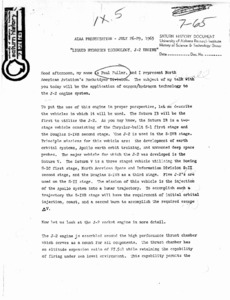
"Liquid Hydrogen Technology, J-2 Engine."
subject of the speech is the application of oxygen/hydrogen technology the 5-2 engine system. -
"Liquid Hydrogen."
Review detailing the use of liquid hydrogen in Saturn rockets. -
"Liquid Rockets."
This review indicates recent developments which have occurred in the liquid rocket engine field, special development areas associated with the liquid engines in current usage, and several trends which may be expected in the design of future advanced rocket engines. -
"Letter to the Vice President of the United States and White House."
This is an attempt to answer some of the questions about our national space program raised by The President in his memorandum to you dated April 20, 1961. I should like to emphasize that the following comments are strictly my own and do not necessarily reflect the official position of the National Aeronautics and Space Administration in which I have the honor to serve. -
"Letter to The President and White House."
Correspondance between the President and Hugh L. Dryden regarding administrative limitations of the President's power. -
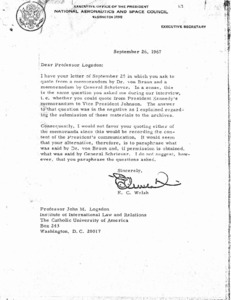
"Letter to Professor John M. Logsdon."
Correspondance between Professor Logsdon and Welsh regarding Logsdon quoting Wernher von Braun's memorandum. -
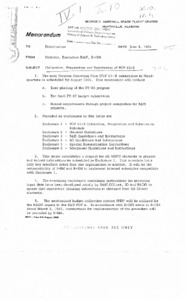
"Memorandum: collection, preparation and submission of POP 65-3."
This memo constitutes a request for all MSFC elements to prepare and submit information as scheduled in Enclosure 1. This schedule lists only key interface dates from one organization to another. It will be the responsibility of I-RM and R-RM to implement internal schedules compatible with Enclosure 1. -
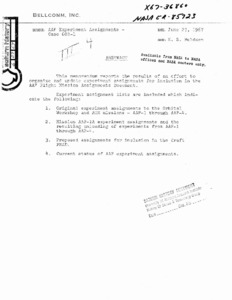
"Memorandum : AAP experiment assignments - Case 600-1."
This memorandum reports the results of an effort to organize and update experiment assignments for inclusion in the AAP Flight Mission Assignments Document. Experiment assignment lists are included which indicate the following: 1) Original experiment assignments to the Orbital Workshop and ATM missions - AAP-1 through AAP-4; 2) Mission AAP-1A experiment assignments and the resulting unloading of experiments from AAP-1 through AAP-4; 3) Proposed assignments for inclusion in the draft FMAD; 4) Current status of the AAP experiment assignments.; X67-36860.; NASA TR - 85723. -
"Meeting with Huntsville community leaders, Morris Auditorium."
Transcription of a conversation with Wernher von Braun. -
"Meeting with the Director, Development Operations Division, ABMA, Huntsville : Memorandum for the Associate Administrator."
The following people participated in an all day meeting at ABMA Huntsville on 6 January 1960: Dr. W. Von Braun, Mr. E. Rees, Mr. A. Hyatt, Mr. A. Siepert. Writer of the memorandum is Abraham Hyatt, Deputy Director, Launch Vehicle Programs. -
"Measuring instrumentation support."
Article refers to photographs, providing context to what is shown in them with formulas and measurements. -
"Measurements on the Saturn space vehicle."
The history of man might be considered as an ever increasing quantity and quality of measurements. Measurements related to space have been made by early astronomers, modern astronomers, and now by aerospace technologists. The manned lunar landing, a major national goal, has given us the means to measure in space. The space vehicle development itself has made heavy demands on instrumentation; this is discussed in some detail in this paper. The advantages of the International System of Units are mentioned. Some examples are used to illustrate the future of space measurement. -
"McDonnell Douglas S-IVB rocket for NASA's Saturn launch vehicle."
Press release detailing how a rocket is the top stage of both the Saturn IB and Saturn V launch vehicles.