
Browse Items (8242 total)
Sort by:
-
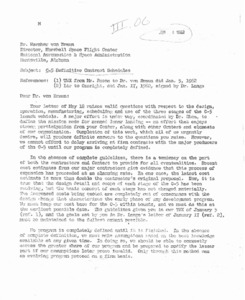
Letter to Dr. Wernher von Braun.
Letter to Wernher von Braun from D. Brainerd Holmes. Contains C-5 definitive contract schedules. -
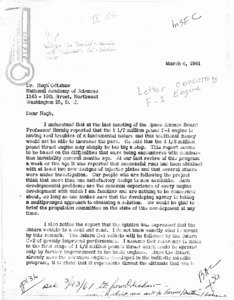
Letter to Dr. Hugh Odishaw.
Letter to Hugh Odishaw from Donald Hornig regarding a previous meeting as well as an F-1 engine report. -
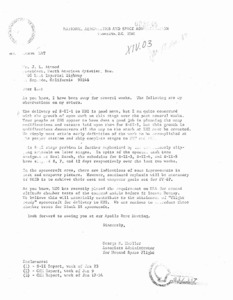
Letter to Mr. J. L. Atwood.
Letter to J. L. Atwood from George M. Mueller regarding the S-II stage. -
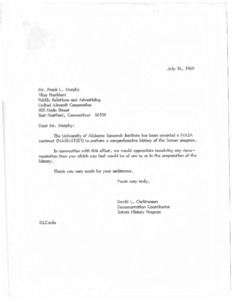
Letter to Mr. Frank L. Murphy.
Letter to Frank L. Murphy from David L. Christensen informing of an awarded contract. Also requests documents. -
"Launch Vehicle Engines Project Development Plan."
The primary mission objective of the 5-2 Engine Project is to continue development of a liquid oxygen/liquid hydrogen engine. capable of high-altitude restart. Both Saturn IB and Saturn V vehicles will use the J-2 engine; the S-IVB stage of Saturn IB vehicles and S-IVB stage of Saturn V vehicles will be equipped with a single J-2 engine. The S-I1 stage of Saturn V vehicles will use a cluster of five J-2 engines. Figure 1-3 illustrates these stages. -
"Launch Vehicle Recovery System Requirements."
The primary considerations in the design and development of a recovery system applicable to present expendable first stage launch vehicles are discussed. The general requirements that define the essential characteristics of a feasible recovery system are derived from three critical phases during flight. The degree of criticalness is primarily influenced by the conditions at stage cutoff and separation. The three critical phses of flight are broken down into the following: (1) conditions and requirements between stage separation to re-entry; (2) re-entry; and (3) terminal descent and landing. -
"Launch Vehicle Engines Project Development Plan."
This revised edition of the Launch Vehicle Engines Project Development Plan supersedes the issue dated July 1, 1965. Significant changes which have been made are:- Removal of classified data to permit publication as an unclassified document; - Removal of material applicable to the RL-10 Engine Project which was transferred to the Lewis Research Center effective May 1, 1966; - Elimination of detailed schedules which quickly become obsolete; - Punched for maintenance in loose-leaf 3-ring binders and for ease in updating material through issuance of replacement sheets. Binders are not furnished. The information in this document is current to January 1, 1967.; The Launch Vehicle Engines Project Development Plan is established in accordance with requirements of NASA General Management Instruction 4-1-1, Planning and Implementation of NASA Projects, and OMSF Instruction MP 9320.044, Preparation and Revision of Program/Project Development Plans (PDP's). The Plan, herein referred to as the PDP, has been developed within the scope of current Apollo Projects Approval Documents (PADS) and will be maintained by the Engine Program Manager to identify program requirements, responsibilities, tasks, and resources, and time phasing of major actions required to accomplish the Engine Program. -
"Launch Information: Saturn S-IV and the RL10 Engine."
The RL10, which powers the National Aeronautics and Space Administration' s Saturn S-IV, is the newest propulsion system to be put to work in advancing our nation's space effortr On November 27, 1963, a pair of RLlO's successfully powered a five-ton Centaur space vehicle in earth orbit in the first flight demonstration of the outer space powerplant which uses high-nenergy liquid hydrogen as fuel. A six-engine cluster of RLlO' s, generating a total of 90, 000 pounds of thrust, powers the Saturn S-IV stage. The 15, 000 pound-thrust engine was designed and developed for NASA's Mar shall Space Flight Center at Pratt & Whitney Aircraft's Florida Research and Development Center, 20 miles northwest of West Palm Beach. -
!["Launch Control and Checkout Equipment (LCCE) [photograph]."](https://digitalprojects.uah.edu/files/thumbnails/20/10938/launcont_030209160221.jpg)
"Launch Control and Checkout Equipment (LCCE) [photograph]."
Description of an 8 x 10 inch black and white photograph. -
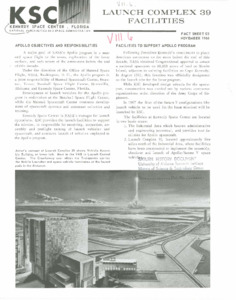
"Launch Complex 39 Facilities Fact Sheet 03."
Article detailing the different aspects of the Launch Complex 34 facilities. -
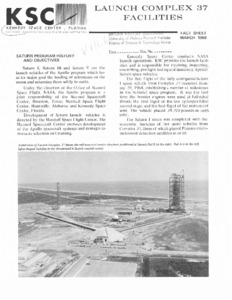
"Launch Complex 37 Facilities Fact Sheet."
Article detailing the different aspects of the Launch Complex 34 facilities. -
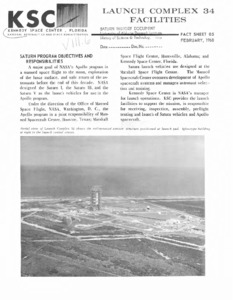
"Launch Complex 34 Facilities Fact Sheet 05."
Article detailing the different aspects of the Launch Complex 34 facilities. -
"KSC Apollo/Saturn V Master Test Plan."
The John F. Kennedy Space Center (KSC) Apollo/Saturn V Development/Operations Plan, K-PM-0, establislies the requirement for an Apollo/Saturn V Master Test Plan (MBP). This document, prepared by the Saturn Systems Office. -
"Key MSFC Personnel for Potential Interview Efforts."
Essay detailing potential candidates for potential interviews. -
-
"Juno V Space Vehicle Development Program."
This report io the second in a scrics of reports on the JUNO V Space I Vehicle Development Program and indicates the present status of the overall I program. The objective of the overall program is to provide a reliable, economical, and flexible carrier vehicle with relatively large payload capability for orbital and space missions at the earliest possible date. -
"Juno V Transportation Feasibility Study (U)."
The purpose of this report is to present an investigation to determine the feasible, practical and economical method of transporting the JUNO V thrust unit. This includes the first phase of transporting between Fabrication Laboratory, Systems Analysis and Reliability Laboratory and to the test stand, as well as the later phases, onto the Redstone Arsenal loading docks and from there down the Tennessee, Ohio and Mississippi Rivers to the Atlantic Missile Range, Florida.; Transportation and Packaging Section, Systems Support Equipment Laboratory. -
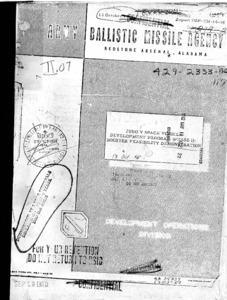
"Juno V Space Vehicle Development Program (Phase I): Booster Feasibility Demonstration."
The initial phase of the JUNO V space vehicle development program, as presented herein, provides for a static demonstration and a total of four flight feasibility tests. The latter two flights will give the U.S. its first payload capability in excess of 10,000 lb in mid 1961. The objective of the overall program is to provide a reliable, economical, and flexible carrier vehicle with relatively large payload capability for orbital and space missions at the earliest possible date. -
"John F. Kennedy Space Center: A Selective Bibliography."
This is primarily the bibliography of an organization located in an area which was once inhabited by more baasts and birds than people. The evolution of the Kennedy Space Center :LS :A .ceable from the Army Ballistic Missile Agency and Marshall Space Flight Center, Huntsville, Alabama. That period is fully covered by Historical Origins of NRSB's Launch epesons Center to July 1, 1962. However, because of the core working relationship between the Kennedy Space Center and the Air Force Eastern Test Range articies showing evolution of the Air Force Missile Test Center are included. -
"John F. Kennedy Space Center: A Selective Bibliography."
This is primarily the bibliography of an organization located in an area which was once inhabited by more beasts and birds than people. The evolution of the Kennedy Space Center cea be traced from the Army Ballistic Missile Agency and Marshall Space Flight Center, Huntsville, Alabama. That period is fully covered by Historical Origins of NASA's Launch Operations Center to July 1, 1962.