
Browse Items (8242 total)
Sort by:
-
"Ground Equipment to Support the Saturn Vehicle."
With the advent of the first large space vehicle, the SATURN, the ground support equipment and launch facility designer is faced with the necessity of conceiving and building an unprecedented launch system concurrent with the vehicle development. The paper intends to present a comprehensive picture of the problems involved and how they are solved. It follows the SATURN through the various modes of operation such as transportation over land and water, checkout, handling and erection, propellant loading, and describes the facilities at the launch site. -
"Government Grants & Contracts."
The Army medical contract, grant, and research interest in the bio-science area. -
"George C. Marshall Space Flight Center Telephone Directory October, 1969."
Information shown in the telephone directory is current as of September 12, 1969. -
General O'Connor's address to the Huntsville Rotary Club.
Address from General O'Conner to the Rotery Club bringing them up to date on organizational developments inside the George C. Marshall Center. -
"Future Projects Office."
The purpose of this brochure is to give interested readers, outside as well as within the agencies of the U.S. Government, information on the mission and activities of the Future Projects Office, George C. Marshall Space. -
"Furnace Brazing of Liquid Rocket Thrust Chambers."
Brazing as a technique for joining metal parts has been utilized for centuries. Industry, however, has only begun to use it on a wide scale in the last twenty years. The rapid growth of brazing has been a result of consumer and military demands Tor products of lighter weight, less expense, and higher performance. Today, brazing is one of the most widely used fabrication techniques in the production of liquid rockets, gas turbines, refrigerator and other types of heat exchangers, automobile parts, vacuum tubes, and many nuclear products. -
"Furnace Brazing the F-1 Thrust Chamber for Apollo."
This work described in this report was performed for the National Aeronautics and Space Administration under contract NASw-16. Rocketdyne is now building the F-1 engine for the Apollo lunar mission. Five F-1 engines, each capable of developing 1-1/2 million pounds of thrust will power the first stage of the launch vehicle of Saturn V. -
"Functional Management in NASA."
This is a Comment Edition of Historical Note No. 53 prepared by a summer employee of the NASA Historical Staff (APPH). The author has agreed to integrate comments and corrections submitted by critical readers, a normal process of validation for all historical reports and studies. -
"Fulfilling the Aerospace Engineer's Responsibility for Product Reliability."
The management techniques described in the paper support the Saturn S-IVB Program which is being conducted for the National Aeronautics and Space Administration, Marshall Space Flight Center. -
"From Now On -."
Interview with Dr. Wernher von Braun; Challenge, Winter(Dec) 1962, volume 1, number 3 -
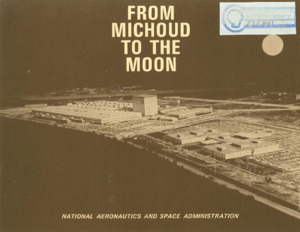
"From Michoud to the Moon."
A history and description of the Michoud Assembly Facility in New Orleans, Louisiana. -
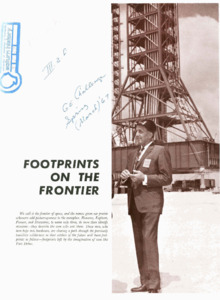
"Footprints on the Frontier."
An article regarding Doctor Kurt Debris, director of NASA's Kennedy Space Center. -
"Flight Software Development Laboratory."
A man-in-the-loop computer facility has been created using a digital computer, display terminal,and space vehicle flight computer to enable programmers to check out flight programs in a simulated space flight environment. The simulation requires a real time multi-programmed environment, which is supplied by a control system capable of scheduling programs on 32 levels of priority interrupt as well as answering demands for service at the display terminal. A special interface device permits visibility and control of the flight program as it executes in the flight computer. On-line inputs from the programmer at the display terminal and outputs from data collection and reduction routines to the display screen are executed in real time. The Flight Software Development Laboratory has proved to be very useful in reducing program preparation time and increasing flight program confidence. -
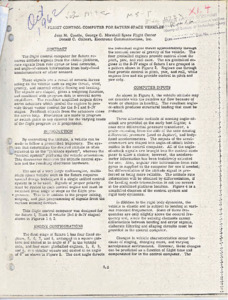
"Flight Control Computer for Saturn Space Vehicles."
The flight control computer for Saturn receives attitude signals from the stable platform, rate signals from rate gyros or lead networks, and angle-of-attack information from body-fixed accelerometers or other sensors. -
"Flight Evaluation of the Command and Communication System Aboard AS-501."
The first test of the command and communications system, a unified frequency S-band system, aboard AS-501 was successful. Compatibility of this system with the MSFN/USB sites was established. The onboard transponder and antenna system including antenna switching performed as predicted. The command performance was excellent with 5747 valid commands received onboard out of 5748 commands transmitted. Data reduction problems prevented a complete analysis of the tracking data. Telemetry system performance was satisfactory with a measured bit-error-rate of 4 x10⁻⁵ while over the Ascension Island station. This flight provided valuable data which can be used to define vehicle to-ground-station interfaces, to establish attitude constraints during translunar injection, and to improve operational procedures. One more test as successful as the AS-501 test would qualify the system as operational.; May 3,1968. -
"Flat Cable Engineering Studies for Saturn S-IVB Vehicles."
This paper describes the engineering approaches, investigations, results and conclusions of two National Aeronautics and Space Administration (NASA) flat-cable contracts from the George C. Marshall Space Flight Center (MSFC) to the Douglas Aircraft Company, Inc., for feasibility studies on the S-IVB stage of the Saturn Vehicle. In addition, the objectives and approaches for a third contract., "Flat-Cable Engineering Study", are discussed. A sister Douglas Paper No. 4186, to be presented by Dr. P. L. Hill, covers in detail the manufacturing aspects of the Flat-Cable Development Program.; Prepared by R.A. Klotz, Advance applications, Saturn Electronics, Missile and Space Systems Group, McDonnell Douglas Corporation for presentation at: IPC/EDN Flat-Cable Seminar, University of Southern California, Los Angeles, California, 20 June 1967. -
"IU Presentation and Dedication."
This is a note book that contains newspaper articles and photographs about the new IBM building in Huntsville, Alabama. It also has information about the Instrument Unit for the first Saturn IB flight. There is also information about the Saturn IB Instrument Unit being barged to Kennedy Space Center.; There are 2 pages that list the articles with the title, newspaper name, writer and date.; There are six color photographs that show the dedication of the IBM building and the Instrument Unit. One photograph has Dr. Wernher von Braun standing behind the ring. Two of the photographs show the Instrument Unit on a trailer being pulled by a truck.; Preferred Citation: [Identification of item] Saturn V Collection, Dept. of Archives/Special Collections, M. Louis Salmon Library, University of Alabama in Huntsville, Huntsville, AL. -
"An Iterative Guidance Scheme and Its Application to Lunar Landing."
A guidance scheme for vehicle flight from lunar orbit to a prescribed point on a spherical, non-rotating moon is presented. The equations of motion have been simplified only to perm it a closed solution for the thrust magnitude and thrust direction. The trajectory computations them selves are made under more realistic and accurate assumptions and are not included. -
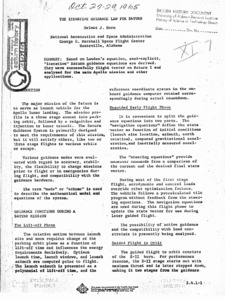
"The Iterative Guidance Law for Saturn."
Summary: "Based on Lawden's equation, semi-explicit,'iterative' Saturn guidance equations are derived, many were successfully flight tested on Saturn I and analyzed for the main Apollo mission and other applications applications." -
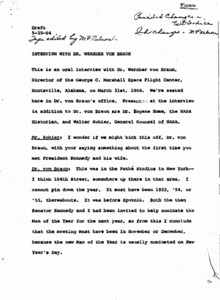
"Interview with Dr. Wernher von Braun."
Transcription of an interview with Wernher von Braun and Mr. Sohier.