
Browse Items (8242 total)
Sort by:
-
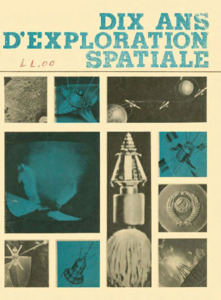
"Dix ans D'exploration Spatiale."
A series of french articles related to the space program. -
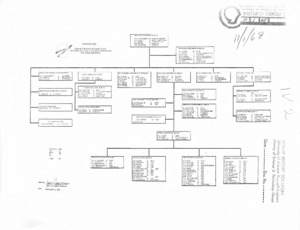
Directory Chart : NASA/MSFC Manager's Office.
Organizational chart of NASA/MSFC manager's office. -
"Digest of FY-66 Funded Advanced Studies: November 1966."
This publication is one of a planned series to summarize the advanced study program for each fiscal year beginning with FY-61.A separate report will cover the study program for each fiscal year. The purpose of these documents is to provide reference information which should be helpful in planning future study programs. The FY-65 funded studies are covered in this document. These investigations are covered under four major headings: Launch Vehicle Studies, Earth Orbital and Lunar Studies, Planetary/Nuclear Studies, and AAP Studies. The information presented on each studyincludes a brief description of the objectives and pertinent contract data. -
"Digest of FY-65 Funded Advanced Studies:July 1966."
This publication is one of a planned series to summarize the advanced study program for each fiscal year beginning with FY-61.A separate report will cover the study program for each fiscal year. The purpose of these documents is to provide reference information which should be helpful in planning future study programs. The FY-65 funded studies are covered in this document. These investigations are covered under four major headings: Launch Vehicle Studies, Earth Orbital and Lunar Studies, Planetary/Nuclear Studies, and AAP Studies. The information presented on each studyincludes a brief description of the objectives and pertinent contract data. -
"Digital Transducers."
This paper outlines the major advantages of digital transducers and describes the principles and features (1) direct digital transducers, (2) indirect digital transducers, (3) quasi-digital transducers, and (4) A to D transducers. -
"Digest of FY-64 Funded Advanced Studies: August 1966."
This paper outlines the major advantages of digital transducers and describes the principles and features (1) direct digital transducers, (2) indirect digital transducers, (3) quasi-digital transducers, and (4) A to D transducers. The mutual effect of transducers and systems will be discussed briefly, and some trends of transducer research and development will be presented. -
"First Hundred Seconds."
Keynote address at National Aeronautics and Space Administration to the American Rocket Society Conference on Launch Vehicle Structures and Materials. Speech focuses on problems facing the structure of Saturn rockets and other space vehicles. -
"First Annual Logistics Management Symposium: September 13 and 14, 1966."
The proceedings of the First Annual Logistics Management Symposium are forwarded with the hope that the information will be of assistance to attendees and their staffs in the planning and management of logistics support programs. I recognize that there is still much study required before all management techniques and procedures for support programs are known and understood, but I believe that support problems are made easier by exchange of knowledge. The Symposium was based on this belief and we plan to continue the search for ways to achieve better program support at a lower cost. Edmund F. O'Connor, Director, Industrial Operations. -
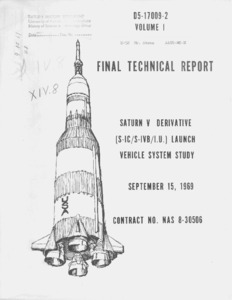
"Final Technical Report: Saturn V Derivative (S-IC/S-IVB/I.U.) Launch Vehicle System Study: Volume I."
Technical report for September 15th, 1969. -
"Final Script for Saturn I/IB Quarterly Film Report, No. 24 (covering April, May, June 1965)."
Film script for the Saturn Quarterly Film Report - April through June, 1965. -
"Final Script for Saturn IB Quarterly Film Report, No. 26 (covering October, November, December, 1965)."
Film script for the Saturn Quarterly Film Report - October through December, 1965. -
"Film Script for Saturn Quarterly Film Report, No. 19 (January, February, March) 1964."
Film script for the Saturn Quarterly Film Report - January through March, 1964. -
"Film Script for Saturn I/IB Quarterly Film Report, Nr. 23 (Covering January, February, March 1965)."
Film script for the Saturn Quarterly Film Report - January through March, 1965. -
"Film Script for Saturn I/IB Quarterly Film Report, Nr. 22 (Covering October, November, December 1964)."
Film script for the Saturn Quarterly Film Report - October through December, 1964. -
"Film Script for Saturn Quarterly Film Report, Nr. 20 (April, May, June) 1964."
Film script for the Saturn Quarterly Film Report - April through June, 1964. -
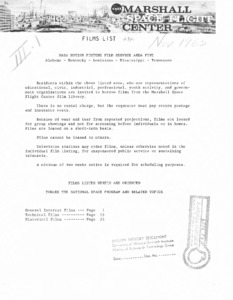
"Films List : NASA Motion Picture Film Service Area Five: Alabama - Kentucky - Louisiana - Mississippi - Tennessee."
A list of films oriented towards the National Space Program and other related topics. -
"Failure Investigations of Large Liquid Propelled Rocket Engine Components."
Case histories of seven typical failures in large liquid propelled rocket engines components have been prepared. Quite simple to complex investigations are presented covering a variety of failure modes in a variety of materials. Included are successful solutions to the failure problems investigated.; Archive copy is a poor photocopy. -
"Fact Sheet : IBM Computer Will Direct Saturn Orbital Test Flight."
Press release regarding a IBM digital computer directing a Saturn 1B orbital mission. -
"Facilities Engineering for the National Aeronautics and Space Administration."
Article makes references to a film. Centers around the idea that testing space vehicles extensively before launch is cost control. -
"Facility Design for Handling Liquid Hydrogen for Space Vehicle Applications."
Presented to German Society for Rocket Technology & Astronautics.Essay discussing the capabilities of liquid hydrogen as fuel.