
Browse Items (8242 total)
Sort by:
-
"Ground testing at MSFC : research achievements review series no 9"
In 1955, the team which has become the Marshall Space Flight Center (MSFC) began to organize a research program within its various laboratories and offices. The purpose of the program was two-fold: first, to support existing development projects by research studies and second, to prepare future development projects by advancing the state of the art of rockets and space flight. Funding for this program came from the Army, Air Force, and Advanced Research Projects Agency. The effort during the first year was modest and involved relatively few tasks. The communication of results was, therefore, comparatively easy.; Pages of handwritten notes on yellow legal paper. There is also a 3 x 5 inch card with this information. Article reference for Saturn History Files: Schuler, Albert E. (NASA-MSFC) Research and development in instrumentation for static testing. -
"A review of the research origins of the LANCE weapon system -- Project hindsight -- Task 1 supplement."
This report includes a discussion of 57 research and exploratory development events that have been identified as contributing significantly to LANCE. Forty-six of these are research events. Eight of the research events deal with LANCE aerodynamics, four with propulsion, 24 with solid-state components used in the guidance and control system,and 10 with the research origins of the materials and manufacturing processes used in LANCE. In addition, 11 exploratory development events are identified. The principal concern of this study has been the identification of further research origins of LANCE and the 46 documented events are its major product. A further concern and obligation of this study has been to provide HINDSIGHT with some additional data on the research phenomenon including some further observations on the nature and route of research utilization.; FOREWORD: The purpose of this report is to present a survey of fundamental research contributing to the successful development of the LANCE weapon system. Included in this report are discussions of research inputs to a number of LANCE systems and technology areas. The circumstances of these research contributions to LANCE are discussed. The implications of these examples of research utilization are analyzed and some general observations and conclusions on the research payoff phenomena are given. This report was requested by the Army Missile Command as a supplemental contribution to Project HINDSIGHT.; Contract No. DA-01-021-AMC-14693(Z).; Battle Memorial Institute ,Columbus Laboratories.; RSIC-627.; Includes letter from W. Metscher, Lt. Col. to Mr. David L. Christensen dated March 14, 1969. -
"Project Dynasoar (u): a report bibliography."
Projected by D.L. Christiansen, DLC- 5/2/69-Memo.; Search control No. 015416.; For Scientific and Technical Information, Cameron Station, Alexandria, Virginia.; Unclassified.; Pages in this bibliography are not numbered. -
"Project Thor (u): a report Bibliography."
Unclassified control No. 015415.; Requested by D.L. Christensen, DLC-5/2/69-Memo for Scientific and Technical Information, Cameron Station, Alexandria. -
"Propulsion and Vehicle Engineering Laboratory monthly progress report (July 1, 1966 through July 31,1966)."
A collection of progress reports covering a large number of projects within the month of July, 1966 -
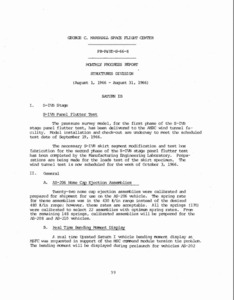
"Propulsion and Vehicle Engineering Laboratory monthly progress report (August 1, 1966 through August 31, 1966)."
A collection of progress reports covering a large number of projects within the month of August, 1966 -
"Propulsion and Vehicle Engineering Laboratory monthly progress report (November 1, 1966 through November 30, 1966)."
A collection of progress reports covering a large number of projects within the month of November, 1966 -
"Propulsion and Vehicle Engineering Laboratory monthly progress report (March 1, 1966 through March 31,1966)."
A collection of progress reports covering a large number of projects within the month of March, 1966 -
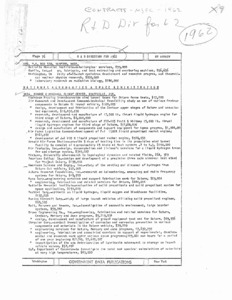
"R & D directory for 1962 (NASA-MSFC Contracts-1962)."
Excerpt of contracts MSFC 1962, pages 76-79. -
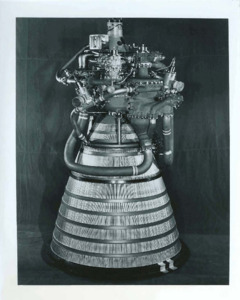
"Pratt & Whitney Aircraft RL10 liquid hydrogen rocket engine"
Photograph of a Pratt & Whitney rocket engine. -
"Preliminary skeletal operations plan for Apollo :" a systems engineering support document.
The Preliminary Skeletal Operations Plan is a statement of the operational concept for Apollo. This draft contains a description of the conduct of the Apollo LOR landing mission and a mission profile. It provides the basis for more detailed mission planning, for generating functional criteria for equipment design, and for measuring the adequacy of the current Apollo hardware for satisfying operational needs. -
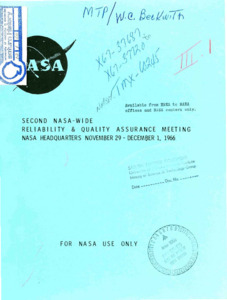
"Proceedings : second NASA-wide reliability & quality assurance meeting : NASA Headquarters, November 29 - December 1, 1966."
The papers presented at the second NASA-Wide Reliability and Quality Assurance Meeting are published to disseminate current experiences and information. These papers, presented at NASA Headquarters on November 29 - December 1, 1966, are one means of exchanging current NASA reliability and quality assurance knowledge between projects and programs. This publication has been marked "FOR NASA USE" since it contains management opinions and contract experiences. Publication of papers suitable for wide dissemination in the Government, industry and University community is expected to be made separately. John E. Condon, Director, Reliability & Quality Assurance. -
"Propulsion and Vehicle Engineering Laboratory monthly progress report (April 1, 1966 through April 30, 1966)."
Progress report for the month of April, 1966. -
"Outline of the capability of technical facilities and equipment at the George C. Marshall Space Flight Center."
Outline of the equipment present at George C. Marshall Space Flight Center. -
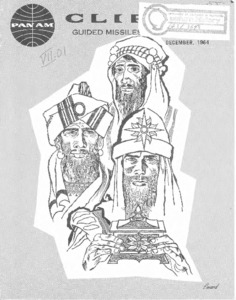
"Pan Am Clipper : Guided Missiles Range Division : December, 1964."
A collection of articles, one of which musing about the landing on/colonization of Mars in the future. -
"NEXUS concept of a large reusable earth launch vehicle."
Aspects of Earth-to-orbit delivery are discussed and a cost analysis of the logistic operation and the cost of orbital operations are presented. Probabilities of success of orbital delivery and the operational and economic aspects of establishing large orbital installations and maintaining a large transportation volume in the 1975/85 time period are compared for the two cases using a large number of Saturn V versus a smaller number of 1-stage chemical Post-Saturn launch vehicles. Performance parameters of chemical, chemonuclear and nuclear launch vehicles are compared. The concept of a blunt launch vehicle configuration referred to as NEXUS is presented in detail. Applications of this configuration to chemonuclear propulsion and to a 50 ft diameter version of Saturn V with recoverable first stage are discussed. -
"H-1 rocket engine: models H-1C and H-1D : technical manual engine data."
Poor jpeg of a screenshot of a word-document. -
"NASA management programs."
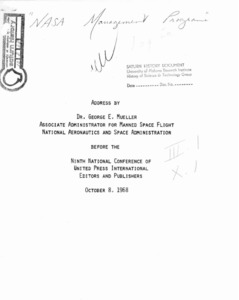
Address by Dr. George E. Mueller, Associate Administrator for Manned Space Flight, National Aeronautics and Space Administration before the Ninth National Conference of United Press International Editors and Publishers, October 8, 1968. -
"NASA management programs."
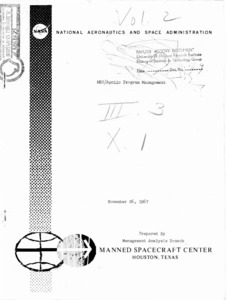
Address by Dr. George E. Mueller, Associate Administrator for Manned Space Flight, National Aeronautics and Space Administration; Joint AIAA/CASI Meeting, Montreal, Canada, July 8, 1968. AS DELIVERED.; Includes charts. -
"Methods for cleaning electronic components and subassemblies."
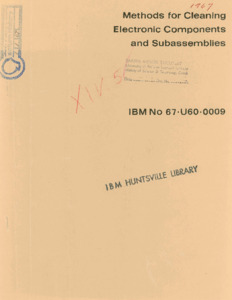
In describing the cleaning of electronic components and subassemblies, it must be taken into consideration that each part to be cleaned presents an individual problem. The method of cleaning must be tailored to the type of part to be cleaned as well as to the type of soil to be removed. This paper reviews some of the methods used in cleaning electronic arts, particularly printed circuits, as well as other critical hardware which is used in support of electronic assemblies. Some of the methods covered include the use of abrasives, acids, solvents and alkalies, and the employment of these in combination with ultrasonic and other automatic systems. The clean room in use at IBM Huntsville is described briefly, along with the solutions and solvents used in cleaning electronic and supporting parts. Cleanliness- requirements for the area and the materials, together with procedures for meeting them give added emphasis to the critical nature of today's contamination control programs. The paper concludes with a summary of the cleaning procedures and the cleanroom benefits to be obtained by using present day technologies to improve them.