
Browse Items (8242 total)
Sort by:
-
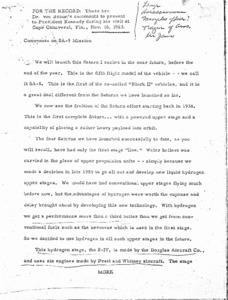
Comments on SA-5 mission.
A notation in the upper lefthand corner states "For the record: These are Dr. von Braun's comments to present to President Kennedy during his visit at Cape Canaveral, Fla., Nov. 16, 1963." A handwritten note is in the upper right corner. It appears that some of the pages to this document are missing. -
"Comments on Problems Relating to the Lunar-Landing Vehicle."
"This technical note concerns some of the problems encountered with the landing of a payload on the moon. The main problem areas such as guidance, velocity control and impact considerations are discussed. Although no final conclusions or designs are intended, it is hoped that the material presented will serve as a guide for future detailed work." -
"A Comparison of Advanced Cooling Techniques for Rocket Thrust Chambers".
The document is a technical paper for Astronautics and Aerospace Engineering Magazine.The copy has handwritten notes that appear to be for revisions. The abstract states "In the early days of rocket propulsion, two primary methods were employed for cooling the walls of thrust chambers. These were uncooled metal chambers where the heat sink capacity of the chamber and nozzle wall materials limited the operating duration, and regeneratively cooled chambers where one of the propellants was circulated in a cooling jacket which constituted the chamber wall. Today, there are at least fourteen different methods with variations for cooling the combustion devices and nozzles of liquid propellant, solid propellant, and/or nuclear rocket propulsion engines. It is the intent of this paper to examine these methods, to describe for each the useful range of operating conditions, as well as present and likely future applications, to define their limitations and associated problems. Emphasis is primarily placed on liquid rocket engines." -
"Computer Controlled Power Application for the Saturn Launch Vehicle".
This paper describes a real-time digital computer program that controls the application of electrical power to the S-IVB stage of the Saturn vehicle at Cape Kennedy, Florida. Douglas Aircraft Company, the S-IVB stage manufacturer, provided NASA with the program requirements relative to the energizing sequence, voltage and current measurement tolerances, and vehicle system operational tests. International Business Machines Corporation provided NASA with the computer program to satisfy the task requirements. The program conjoined the components of the Electrical Support Equipment (two RCA 110A computers and control and instrumentation devices) into a closed loop system. The supporting operating system program by IBM is described. -
"Component Failure Effect on Systems: An Analytical Model".
Prepared by R. L. Parkhill, Section Chief, Saturn S-IVB Reliability Analysis and J. Pauperas JR., Asst. Section Chief, Saturn S-IV Reliability Analysis. Presented to the 4th Annual Seminar on Reliability for Space Vehicles, Los Angeles, California, December 6, 1963. This paper presents techniques originated by Douglas Engineering working under NASA contract NAS7-1. Prepared as a record of the study conducted for the Administrative Engineer on the Department Overhead Account No. 9703.; SUMMARY: In today's complex systems, such as Saturn, many traditional reliability analysis concepts are not acceptable. Because of time and budget restrictions, and the requirement to provide a "man rated" space vehicle, the Douglas Saturn Engineering Reliability Section has developed a new analytical approach; it is called "criticality ranking". It is a "totem pole" of components whose single failure may lead to system loss. "Criticality ranking" is one of the results of an analytical model which encompasses failure effect and reliability prediction. This paper describes this analytical model, discusses some of the techniques and ground rules, and presents examples. A discussion of the application of the results is also included. -
"Computer Redundancy: Design, Performance, and Future".
Discusses the importance of redundancy as a safety measure in electronic systems. -
"Communication-System Blackout During Reentry of Large Vehicles".
This paper was published in the Proceedings of the IEEE, volume 55, number 5, May 1967.; ABSTRACT: Much of the theoretical research on reentry blackout is in a format difficult for the communications design engineer to use in his system analysis. This paper derives simplified equations for the average sheath power loss that may be added (in dB) to the usual space loss to obtain an approximate total propagation loss. The plasma and sheath properties are discussed in detail but largely without supporting mathematics, in order to give the design engineer a better understanding of the overall problem. For the same reason and to provide insight into the final results, the average radiated power is found, using both intuitive and rigorous techniques. Several graphs of plasma properties are included in the development as an aid to numerical computation, and results are compared with the work of other authors. -
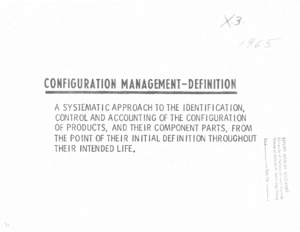
"Configuration Management-Definition".
Configuration management: Definition, requirements, organization, policy and procedure documents, contractual documents. -
Congressional inquiry regarding the S-II-T accident at the Mississippi Test Facility : letter to the honorable Clinton P. Anderson, Committee on Aeronautical and Space Science, United States Senate from James E. Webb, Administrator.
Archive copy is a photocopy.; Includes memorandum and information from George E. Mueller, Associate Administrator for Manned Space Flight. Letter contains handwritten editing and notes. -
Contract let for $8 million for work relating to upper stages of Saturn rockets : news release.
News release describing Saturn V contracts for various components, the companies awarded the contracts, and contract amounts. -
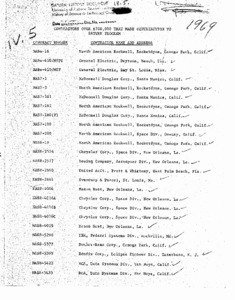
Contractors over $700,000 that made contribution to Saturn.
A list of the various contractors over $700,000 involved in the Saturn V production process, in addition to contract numbers and addresses. Archive copy is a photocopy. There are some handwritten notes in ink on some of the pages. -
Contact points within the NASA for exchange of information on lunar program matters.
Memorandum to Colonel J. W. O'Neill, Plans & Operations, Air Force Ballistic Missile Div. (ARDC).; Archive copy is a poor reproduction. -
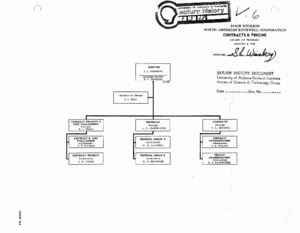
"Contracts & Pricing: Saturn S-II Program".
Indicates the various levels and responsibilities within the Saturn V pricing and contract personnel. September 3, 1968.; Approved S. L. Weinberg. -
"Contractor Program Procedures".
A collection of various procedures. Archive copy is a photocopy. There is no continuous numbering in this document. -
"Contractor Program Procedure".
Outlines various procedures for Saturn V contractors. -
"Contracts for Saturn Upper Stages S-IV and S-V".
Details contracts for upper stages of Saturn IV and Saturn V and includes illustrative appendixes. Archive copy is a photocopy. -
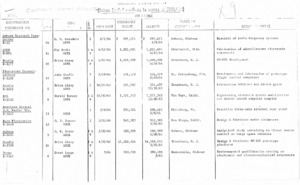
"Contract Status Report."
Saturn funded contracts in excess of $100,000. Lists contracts by contract numbers. Gives contractor, value, place of performance and scope of work.; There is a burned stripe across one page. -
Convective Energy Transport in Stellar Atmospheres: A Convective Cell Model.
One of the Orange Aid Preprint Series in Nuclear Astrophysics, September 1968.; Supported in part by the National Science Foundation [GP-7976], the Office of Naval Research [Nonr-220(47)]. ; ABSTRACT: The motion in a convectively unstable region is expanded into an ensemble of convective cells. Each of these cells interacts with the surrounding medium according to the semiempirical model proposed by Turner (1963 ). Possible detailed models of the flow patterns within each cell are presented. The radius and velocity of these cells are given as functions of distance moved. The convective flux and rms velocity are given as averages over the ensemble of cells. As in the standard mixing length theory the principle uncertainty remains the average initial radius of the cells. -
"Corrosion Problems Associated with Space Launch Vehicles".
A document reporting various space vehicle corrosion issues. Original is photocopy. -
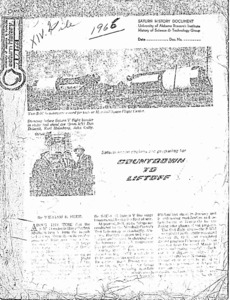
"Countdown to Liftoff".
This is an article from the Boeing Magazine. The Archive copy is a very poor photocopy and is difficult to read.; About the time the S-IC-1 booster is lifting the first Apollo/Saturn V from the launch pad on its maiden unmanned flight next year, a Boeing systems test crew will begin static testing the S-IC-4 at Devils Swamp, Mississippi (MTF). Starting with S-IC-4, all Saturn V first stage boosters will be captive fired at MTF. At present, S-IC firings are conducted by MSFC's test laboratory at Huntsville. The first flight stage, the S-IC-1, was placed in the static test stand on 24 January 1966 and completed its test program 25 Feb. It was removed from the stand March 14 and is undergoing post-firing checkout. it is due to be shipped this summer to KSC where it will be mated to the two upper stages of Saturn V, the IU and Dummy Apollo payload. The S-IC-2 went into the static stand on March 22 and is being tested during April The S-IC-3 also will be tested at Huntsville in 1966. The job of putting the world's largest and most powerful rocket together will be accomplished in the world's largest building, the 52-story vehicle assembly building.