
Browse Items (8242 total)
Sort by:
-
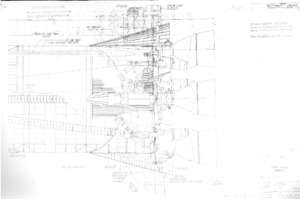
"Saturn V inboard profile : Launch escape system flight separation."
Diagram displaying the launch escape system flight separation in progress. -
"Saturn V ground winds program."
The concept on Saturn V was to "budget" an amount for the dynamic portion of the wind load as a factor on the steady state drag. Wind tunnel tests paralleled the development and fabrication phases. The results indicated that the system was unable to withstand the design winds; thus, a decision was made to implement a viscous damper "fix" on the facility vehicle at the Kennedy Space Center. Damping tests in the Vertical Assembly Building (VAB) will have been completed and response tests on the pad will be in progress at the time of this symposium. This paper will present the history and status of this program to date. -
"Saturn V First Stage Annual Progress Report: Fiscal Year 1968."
The report covers June 30, 1967 through June 27, 1968: Contract NAS8-5608, Schedules 1 and 1A, July 27, 1968. Prepared by J. P. Delaloye, Management Reporting and Analysis; Supervised by D. G. Valentine, Management Reporting and Analysis; Approved by R. F. Terry, Program Reports; D. H. Creim, Michoud, Program Planning and Reporting Manager; E. K. Cooper, S-IC Program Executive. -
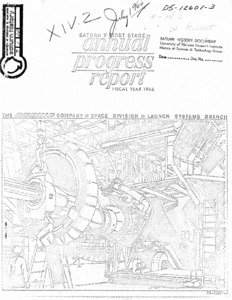
"Saturn V first stage annual progress report : fiscal year 1966."
This report is the consolidation of D5-11994, "Quarterly Technical Progress Report," for the fourth fiscal quarter and the fiscal year 1966 Annual Progress Report and places special emphasis on activities on the fourth fiscal quarter. -
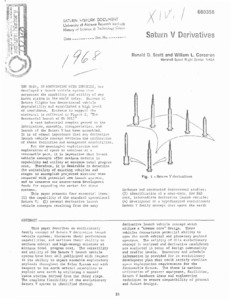
"Saturn V derivatives."
This paper desciibes an evolutionary family concept of !h turn V derivative launch vehicle systems, discusses their performance capabilities, and outlines their ability to perform orbital and hlgh-energy missions at minimum total program cost. -
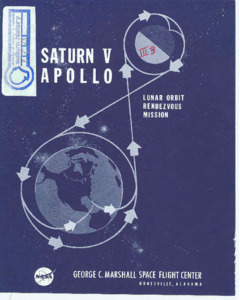
"Saturn V Apollo lunar orbit rendezvous mission."
Diagram explaining the process of a lunar mission from liftoff to recovery. -
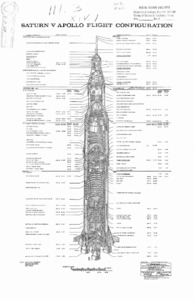
"Saturn V Apollo flight configuration."
Diagram displaying the internal rooms, pieces and functions of the Saturn V as well as the space-suits of the astronauts. -
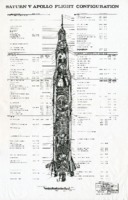
"Saturn V Apollo Flight Configuration."
Drawn by Don Sprague at the Huntsville Engineering section of Boeing. -
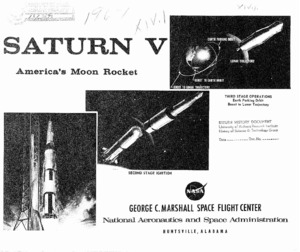
"Saturn V America's moon rocket."
Diagram that displays the Saturn V rocket with a page beneath detailing the function of each stage. -
"Saturn V : non-stage procured launch vehicle ground support equipment."
The functions, authority, management relationships, and responsibilities of the Launch Vehicle Ground Support Equipment Project Office are described. Functions and examples of non-stage procured Launch Vehicle Ground Support Equipment (LVGSE) are described and illustrated. -
"Saturn television system for SA-6."
The Saturn television system is an instrumentation device intended to provide visual information on vehicle performance in real time. The system covers the entire problem from the original image presented to the television camera to the presentation of the finished photographs for analyses. -
"Saturn technical information handbook. Volume III of four volumes : SA-203."
The "Saturn Technical Information Handbook" provides up-to-date reference material to the Launch Operations Center personnel. This material shows the assembly and operation of the Saturn Vehicle components for systems analysis.; Volume II is available on the NASA Technical Reports Server (NTRS) as a PDF. -
"Saturn system study II."
Study regarding the three-stage carrier vehicle E-1 engines. -
"Saturn stages S-II : July 7, 1961 : Minutes of the phase II pre-proposal conference for stage S-II procurement."
Transcription of a confrence aiming to propose ideas for new rocket designs. Includes references to slides. -
"Saturn ST-124-M inertial guidance platform."
a press release which focuses around the Apollo 9 flight and what role the ST-124-M inertial guidance platform has in it. -
"Saturn SA-1 flight and its instrumentation."
Presentation focusing on empahsising the importance of space programs such as Saturn. -
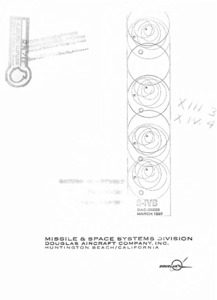
"Saturn S-IVB quarterly technical progress report."
Douglas Aircraft Company Report DAC-56533, Saturn S-IVB Quarterly Technical Progress Report, covers design and development progress on the Saturn IB and Saturn V configurations of the S-IVB stage during January, February, and March 1967. This report is prepared for the National Aeronautics and Space Administration under Contract NAS7-01.; Prepared for National Aeronautics and Space Administration under NASA contract NAS7-101.; Approved by A. P. O'Neal, Director, Saturn Development Engineering. -
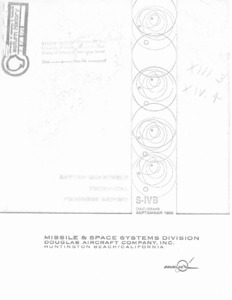
"Saturn S-IVB quarterly technical progress report."
Douglas Aircraft Company Report DAC-56445, Saturn S-IVB Quarterly Technical Progress Report, covers design and development progress on the Saturn IB and Saturn V configurations of the S-IVB stage during August and September 1966. This report is prepared for the National Aeronautics and Space Administration under Contract NAS7-101. -
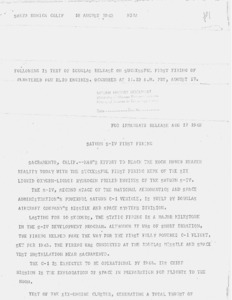
"Saturn S-IV first firing."
Press release detailing the firing of the Saturn S-IV in California. -
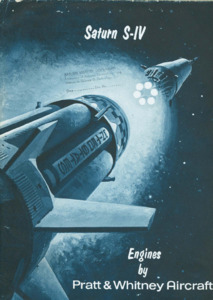
"Saturn S-IV engines."
Folder of information.