
Browse Items (8242 total)
Sort by:
-
"The use of wind shears in the design of aerospace vehicles."
Prepared for presentation at the 23rd Meeting of the Structures and Materials Panel, AGARD, October 4-11,1966, ONERA, Paris, France.; ABSTRACT: The relative influence of various wind profile properties and disturbances on launch vehicle flight dynamic response is studied. Particular emphasis is placed on the influence of wind shears and turbulence on dynamic response during the boost phase of the flight. Four hundred and seven individual detailed (Jimsphere) wind profiles are the primary wind inputs for this analysis. Time response of the vehicle to each profile is computed and a statistical evaluation of the results made. Results are obtained for the Saturn V space vehicle and conclusions drawn as to the relative influence of wind shears and turbulence vs the degree of refinement of the dynamic model of the space vehicle. -
"The uprated Saturn I - its growth potential & future role in space."
Remarks by Vaino J. Vehko, Director of Engineering, Chrysler Corporation Space Division at 30th Annual Meeting, Aviation/Space Writers Association, Las Vegas, Nevada -
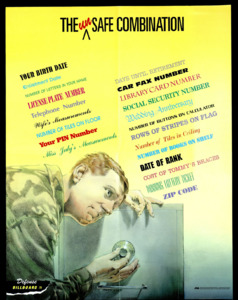
"The unSafe Combination"
Man unlocking a safe with bad safe combinations listed above him -
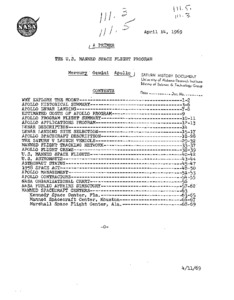
"The U.S. manned space flight program: Mercury, Gemini, Apollo."
Exerpt from George E. Mueller giving a statement to Congress. -
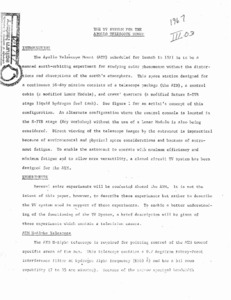
"The TV system for the Apollo telescope mount."
Focuses on the construction and future use of the Apollo space telescope. The components described in this paper except for those listed otherwise were designed by the Space Support Division of Sperry Rand Corporation to specifications established by NASA's Marshall Space Flight Center in Huntsville, Alabama. Appreciation is extended to MSFC for permission to publish this paper and for data and help provided for its preparation. -
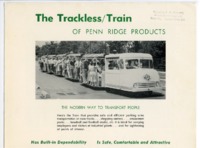
"The Trackless/Train-Of Penn Ridge Products."
This leaflet contains photographs, descriptions, and specifications of the Trackless/Train. -
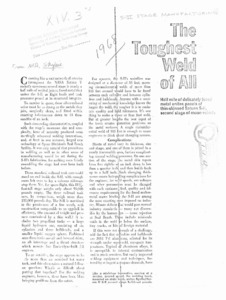
"The toughest weld of all" S-II stage manufacturing.
Article explores the outer layer of the Saturn S-II along side its benefits and complications. Contains poorly rendered images displaying the process. -

"The Tetons - Yellowstone Park - Mud Volcano - Dragon's Mouth."
Konrad, Ingeborg, and Klaus Dannenberg see Teton National Park and Yellowstone National Park. In Yellowstone, Konrad captured footage of the "mud volcano" and the "dragon's mouth" as well as some local wildlife. Summer 1956. -
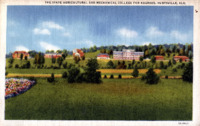
"The State Agricultural and Mechanical College for Negroes"
Front: The State Agricultural and Mechanical College for Negroes, Huntsville, Ala. -
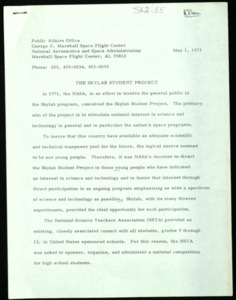
"The Skylab Student Project."
Students involved in the student experiment selection are: Bochsler, Daniel C., Converse, Vincent W., Crites, Troy A., Dunlap, W. Brian, Hamilton, John C., Hopfield, Alison, Jackson, Kathy L., Johnston, Roger G., Leventhal, Jeanne L., Meister, Todd A., Miles, Judith S., Peltz, Cheryl A., Quist, Terry C., Reihs, Joe W., Schlack, Donald W., Wordekemper, Joel G., Shannon, Neal W., Staehle, Robert L., Zmolek, Joe B. Students whose experiments were held in consideration for future programs are Stein, Keith L., Brandt, Kent M., McGee, Keith, Sherhart, Kirk M., Merkel, Gregory A., Healy, James E. -
"The significance of parameters affecting the heat transfer to the liquid hydrogen in the Saturn S-IVB stage for the lunar orbit rendezvous mission."
The Saturn S-IVB stage has a requirement for orbiting around the earth for up to 4.5 hours with approximately 60 percent of its initial propellant remaining at the end of the coast (prior to restart) . Extensive analyses must be performed to insure that this requirement is met. Both the maximum and minimum heat transfer rates are important because the maximum rates affect the hydrogen boiloff losses and thus the initial propellant loading requirements. The minimum rates are important because the boil off gases are used to maintain a minimum axial thrust level by venting the gases continuously through aft facing nozzles. This provides for a settling of the propellant throughout the orbital coast and alleviates the need for periodically venting the tank under zero gravity. -

"The Season's Greetings."
This greeting card was sent from M. Louis Salmon in Vienna, Austria to his parents in Mobile, Alabama at Christmas 1945. The inscription reads, "Your devoted son, Louis." -
"The Saturn V mission and Alabama."
Speech that covers the topics of the Saturn V lunar mission and the basics of a lunar mission in general. -
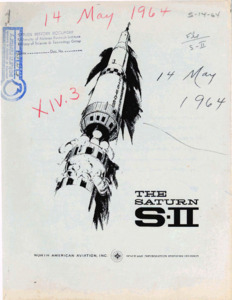
"The Saturn S-II."
The S-II is the second stage of NASA's Apollo moon-landing rocket - the giant Saturn V. The most powerful hydrogen-fueled booster under production, the S-II is destined for Apollo manned lunar missions and will help power three Americans to the moon. The S-II is being developed and manufactured at Seal Beach, Calif., by North American's Space and Information Systems Division, Downey, Calif., under the technical direction of NASA's Marshall Space Flight Center, Huntsville, Ala. -
"The Saturn launch vehicles."
General O'Connor's presentation to the American Institute of Aeronautics and Astronautics. Centers around saturn space vehicles and makes references to slides. -
"The Saturn launch vehicle family."
Presentation focusing on the history of Saturn V's engineering history and crew. -
"The Saturn IB launch vehicle system."
Speech containing information regarding Crystler's role in the Saturn Project as contracted builders of the stages of three space vehicles. -
"The role of weighing in the development and firing of missile and spaceships."
Speech regarding the importance of developing and upgrading space ships and space technology. -
"The role of the S-IVB in the Apollo and past Apollo programs."
Douglas Paper No. 4396.; Prepared by Ludwig Roth, Director, Saturn/Apollo Program Extension, Douglas Aircraft Company.; Presented to 16th Annual Conference of the Hermann Oberth Society. Discusses the role of the Apollo rocket after the Apollo program has concluded. -
"The role of the NASA-MSFC Manufacturing Engineering Laboratory in the development of space projects."
For presentation at the Aerospace Industries Association of America (AIA) Manufacturing Engineering Committee Meeting. Discusses the role the NASA Engineering Laboratory has had on NASA projects in the form of vehicles and smaller projects.