
Browse Items (8242 total)
Sort by:
-
Letter to Carl A. Elliott from Robert K. Bell with a reply from secretary Cora B. Marlowe.
Bell writes to Elliott in Washington D.C. on behalf of the defense counsel in an attempt to change Nickerson's case from trial by court-martial to a non-judicial punishment. Marlowe writes to Bell on behalf of Congressman Elliott who is out of town and will respond to Bell's May 8 letter upon his return. -
Correspondence between Senator Lister Hill and Robert K. Bell.
Bell writes to Hill in Washington D.C. on behalf of the defense counsel in an attempt to change Nickerson's case from trial by court-martial to a non-judicial punishment. Hill responds by thanking Bell for the letter and will do anything to help "along the lines of your suggestion." -
Correspondence between John J. Sparkman and Robert K. Bell.
Bell writes to Sparkman in Washinton D.C. on behalf of the defense counsel in an attempt to change Nickerson's case from trial by court-martial to a non-judicial punishment. Sparkman thanks Bell for his letter from May 8 and responds that he has already been "dropping some suggestions" regarding Bell's hope to give Nickerson a non-judicial punishment rather than trial by court-martial. -
Letters to senators in Washington D.C. from Ray Jenkins.
Ray Jenkins sends the same letter to various senators in Washington D.C. in an effort to speed up the approval of top secret clearance for the defense counsel and advocate for non-judicial punishment for Colonel Nickerson rather than court-martial. He summarizes Nickerson's efficiency reports as well. Jenkins concludes by asking if the senator would convey the message and thinking of the defense counsel to the Secretary of Defense, Mr. Wilson. -
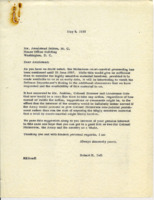
Letter to Armistead Selden from Robert K. Bell.
Bell writes to Selden in Washington D.C. on behalf of the defense counsel in an attempt to change Nickerson's case from trial by court-martial to a non-judicial punishment. Selden replies stating he will pass the information "if the opportunity present[s] itself." -
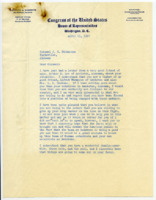
Letter to Colonel John C. Nickerson, Jr. from Kenneth A. Roberts.
Roberts writes to Nickerson about his case, expressing interest and stating that by knowing Nickerson's relatives, he is sure Nickerson is anything but disloyal. Roberts also writes that he will be in Huntsville sometime and hopes to arrange to talk with Nickerson. -
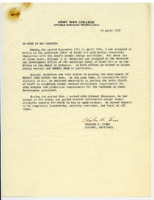
Letter from Col. Charles B. Hines.
This letter is written to testify of Colonel John C. Nickerson, Jr.'s character. Hines writes that Nickerson showed himself to be "completely trustworth, security conscious, and loyal at all times." -
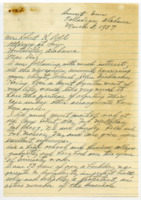
Correspondence between Robert K. Bell and R. H. Cox.
Cox writes to Bell asking if he could have the priviledge of reporting Nickerson's case, "unless other arrangements have been made." Cox includes his previous experience with court-martials. Bell responds by explaining that the defense counsel has little influence in the matters of appointing a court reporter. -
Correspondence between Robert K. Bell and Judge L. C. Walker.
L. C. Walker, Nickerson's uncle by marriage, asks Bell if he and another uncle by marriage could be permitted to sit in on the hearing. Bell responds that they will have seating space for Walker and Mr. Scott. -
Letter to Robert K. Bell from Robert Smith.
Editor-in-Chief of Sagamore Press Inc., Publishers, Robert Smith, writes to Bell to say that his publishing company would be interested in Bell and Nickerson's story if they ever wish to write a book on it and the guided missles program. -
Letter to Ed Willis, Jr. from Robert K. Bell.
Bell writes to thank Willis for his support in the Nickerson case. -
Correspondence between Robert K. Bell and Carl C. Brown.
Brown wishes Bell the best in the Nickerson case and expresses support for the Colonel. Bell's response thanks Brown for his support. -
Correspondence between Robert K. Bell and James L. Lawson.
Lawson writes a brief letter to Bell wishing him luck in the Nickerson case and saying he is the right person for the job. Bell responds calls the case a "Herculean one" and hopes he can fulfill the responsibility. -
"Summary of JCN Efficiency Reports."
Written by John F. Roehm, this report covers a summary of reports of Colonel John C. Nickerson, Jr.'s efficiency from his former Battery Executive Officer and regimental basketball boach. -
Letter from James A. Pickering.
Pickering writes a general letter about Colonel John c. Nickerson, Jr.'s character, stating that Nickerson was a man of "sterling character" and an "intelligent and highly valuable officer." -
Drafts of letter to the Commanding General, Third Army from the Third Army Advisory Committee.
In response to the "problem created at the Army Ballistic Missile Agency" that would eventually lead to Colonel Nickerson's referral to a court-martial, the Third Army Advisory Committee writes this letter to inform the Commanding General that one of them, Robert K. Bell, had consented to being Nickerson's attorney as they see Nickerson's actions as being in the best interest of the national defense and Army. -
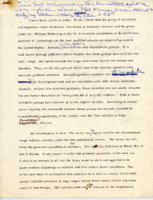
Colonel John C. Nickerson, Jr. clarification of actions took.
To clarify his intentions of the actions he took that led him to be court-martial, John C. Nickerson, Jr. writes a detailed document outlining three points. This set of documents includes two drafts of his message. -
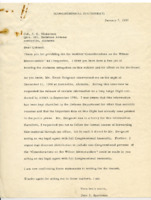
Letter to Colonel John C. Nickerson, Jr. from John J. Sparkman.
Sparkman thanks Nickerson for sending a booklet he had requested. He also requests Nickerson to send information on a long range flight conducted by ABMA directly to Erik Bergaust for an interview Bergaust did on Sparkman. -
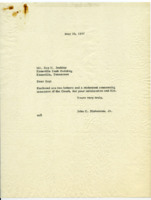
Letter to Ray H. Jenkins from Colonel John C. Nickerson, Jr.
This letter states that Nickerson sent two letters and a statement concerning member of the Court. However, this is the only letter in the collection. -
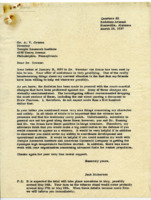
Letter to Dr. A. V. Grosse from Colonel John C. Nickerson, Jr.
In response to Grosse's letter to Dr. Wernher von Braun that had been sent to him, Nickerson thanks him for his offer of assistance in the case and asks if he would consent to appearing as a witness.