
Browse Items (8242 total)
Sort by:
-
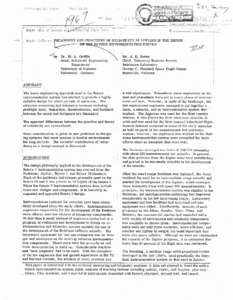
"Philosophy and practices of reliability as applied in the design of the Saturn Instrumentation System."
The basic engineering approach used in the Saturn instrumentation system has evolved to provide a highly reliable design for short periods of operation. The airborne measuring and telemetry systems including preflight tests, inspection, documentation, and feedback between the users and designers are discussed. The apparent differences between the practice and theory of reliability are rationalized. Some consideration is given to new problems in designing systems that must operate in hostile environments for long periods. The potential contribution of redundancy as a design concept is discussed.; This paper is concerned with the airborne measuring and telemetry systems; it does not attempt to treat the entire Saturn instrumentation system which consists of tracking devices including optical, radar, and Doppler, plus television, film cameras, and a myriad of instruments connected with factory checkout, ground test, and launch. -

Oral History Interview With Bran Griffin
Bran Griffin was born in Medford, Oregon. His father was in the military, so they moved around a lot. Bran went to the University of Texas his first year of college, and he studied Architecture. Then, he graduated college with a degree in Architecture from Washington State University. He then went to graduate scholl in Southern California, and he received a fine arts degree. After this, Bran wanted to get a degree in something a little more stable, so he went back to school to get his master's degree in Architecture. After this, Bran was on a shuttleship for a couple of years in Rome, and then he came back to start his career in teaching Architecture. Even though he was teaching Architecture, he had an intense passion for space. Because of this passion, he started to become involved with the Johnson Space Center with a faculty fellowship. Bran was in their Spacecraft Design Division. Since he wanted to be closer to be a part of the Space Industry, he decided to move to Washington State. After a while of working in Washington State, he received a job offer from Boeing in Hunstville, AL and began his career there being involved with the space station.Tags Oral History -
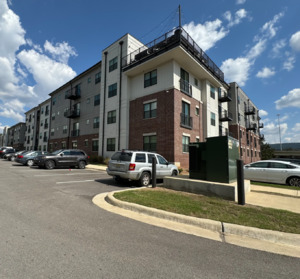
The Lofts at Dallas Mills, Huntsville AL.
A photo of the Lofts apartment complex at Dallas mills. Occupies the space formerly taken by the Dallas Mill textile factory. -
-
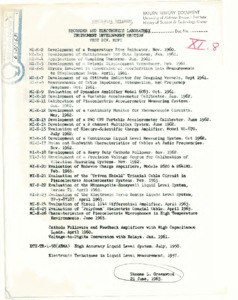
Technical Reports" Bibliography.
Bibliography of technical reports from 1957-1963 -
"Payload integration for space experimentation."
Space experimentation requires an increasingly complex planning and systems engineering effort to meet the demand for highest precision and reliability of all measurements and observations. A companion paper discusses the interfaces between the scientific/technical areas of space experimentation and the instruments, subsystems and support systems within the spacecraft. This paper deals with the organization and the procedures which are needed to perform the difficult payload integration process for space experimentation. In the course of this process it is necessary to define the experiments completely, to describe all instruments in terms of engineering specifications, to investigate the commonality of equipment, to group the experiments into mission compatible payloads, to specify acceptable loads on all subsystems and astronauts (when present) and to plan for all contingencies during the flight. -
-
-
"Minimax control of large launch boosters."
Keith D. Graham is principal mathematician, Systems and Research Center, Honeywell, Inc., 2345 Walnut Street, St. Paul, Minnesota.; Work done under NASA contract NAS 8-11206 from the George C. Marshall Space Flight Center.; ABSTRACT: A method of specifying the gains of a linear controller for a large launch booster using a new application of optimal control theory is described in this paper. Results for a specific example are included. An important control requirement is to maintain cost variables (such as bending moment, engine gimbal deflection, and lateral deviation from desired trajectory) within specified limits in the presence of load disturbances. This requirement is met by using a performance index which depends explicitly on maximum achievable values of the cost variables in a finite time interval. -
"Evolutionary Steps in S-IVB Development."
The injection stage of a multistage launch vehicle must be partially a velocity stage and partially a spacecraft; it must not only boost the payload, it must also perform cooperative mission operations with the payload after orbital insertion. These hybrid requirements result in intrinsic stage versatility which permits consideration of new and challenging missions for the stage which were unanticipated during initial design.; Prepared by T. J. Gordon, Director, Advance Space Stations and Planetary Systems, Space Systems Center, Douglas Aircraft Company, Huntington Beach, California. -
"High Energy Missions for Saturn."
Presented to Society of Automotive Engineers, Advanced Launch Vehicle & Propulsion Systems. When the Apollo lunar landing project is complete, the Saturn and Apollo hardware will only have begun to realize their ultimate potential for space exploration. The immense reserve of Apollo technology, facilities, and booster capability can then be directed to the achievement of national goals which lie far beyond the initial lunar landing. In achieving the Apollo lunar objectives, large investments will have been made in launch facilities, tracking systems, propulsion techniques, reentry systems, lunar landing systems and rendezvous technologies. Although developnent in these specialized areas has been tailored to the needs of Apollo, numerous studies by NASA and industry have demonstrated the feasibility of using the spacecraft, launch vehicles, and operating techniques for missions far more complex than lunar landings. Amortization of this hardware will prove cost-effective for missions of more sophisticated applications. -
"Opportunities for European Payloads on the Saturn Vehicle."
Prepared for presentation to the Eurospace Conference. In this paper, we will not deal with the first two questions, which must be of interest to every potential experimenter, but only with the last question of vehicle availability. -
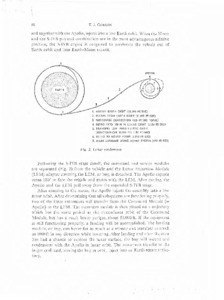
"A survey of propulsion problems as related to space vehicle design."
Incomplete document. Displays errors in space-vehicle design as they relate to space travel. -
"Uses of Saturn."
Saturn and Apollo hardware will not have realized their ultimate potential for space exploration after the project lunar landing is complete. To accomplish the Apollo lunar landing program, an immense backlog of technology, facilities, and booster capability will have been built up, and we believe proper utilization of this resource will fill the needs for planetary, lunar and earth orbital space exploration for years to come. -
"Engineering Safety Into Missile-Space Systems."
Safety Engineering, as applied to complex missile and space systems, has developed a new methodology referred to as "System Safety Engineering." The requirement for a comprehensive approach to safety which is included as a contractually covered adjunct to the design, development, and operational phases of a systems life cycle has become apparent from costly missile mishap experience. The general concepts and accomplishments of this new engineering discipline are described along with possible beneficial relationships with Reliability and other recognized organizational elements engaged in safety related activities. -
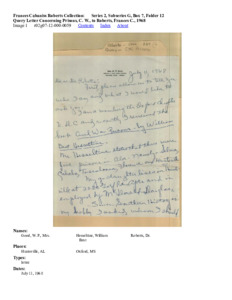
-
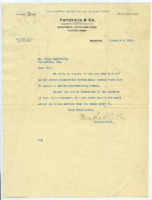
Correspondence between Hotchkin and Co. and Oscar Goldsmith.
The letters detail information about Dallas Manufacturing Co. stocks being sold. This set of documents also includes a check for the forty shares. -
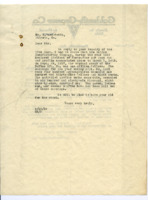
Letter to K. Ward-Smith from Oscar Goldsmith.
A letter from Oscar Goldsmith to K. Ward-Smith regarding capital stock of the Dallas Mfg. Co. -
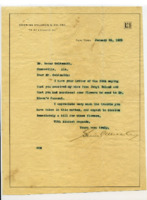
Correspondence between G. H. Milliken, W. E. Winchester, and Oscar Goldsmith.
Correspondence between G. H. Milliken, W. E. Winchester, and Oscar Goldsmith regarding flowers bought for the funeral of Mr. Rison. -
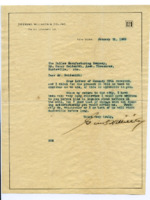
Correspondence between G. H. Milliken and Oscar Goldsmith about a visit to the mill in Huntsville from Milliken and Mr. Winchester.
Milliken writes to Oscar Goldsmith in the first letter stating that he hopes to visit the Huntsville mill with Mr. Winchester soon. Goldsmith responds that he would be glad to have them visit.