
Browse Items (8242 total)
Sort by:
-
"The production of large tanks for cryogenic fuels"
Archive copy is a poor photocopy. Prepared for presentation at Deutsche Gesellschaft fur Raketentechnik und Raumfahrt. (German Society for Rocket Technology and Astronautics). Given by E. Harpoothian, Chief Engineer, Structures Department, Development Engineering.; Tanks for cryogenic fluids, as used in the Saturn space vehicles, have reached an advanced stage of design and development. Many of the structural features of the NASA/Douglas Saturn tanks, fabricated of 2014-T6 aluminum alloy, were first developed for the booster of the Thor ballistic missile, which later found extensive use in putting space vehicles into orbit. There is a mutual dependence of important factors related to design concepts, selection of materials, processing techniques, and fabrication methods. It is shown that this mutual dependence must be considered if a successful vehicle is to emerge from design and development. Details of vehicle structure, provision for insulation, and manufacturing methods are presented. Criteria for the selection of materials is shown to be dependent on strength, ductility, weldability, toughness, fabricability, behavior at cryogenic temperatures, and on manufacturing methods and inspection techniques. -
Phone message to Robert K. Bell from Walter Harper.
In this transcript of the phone message to Bell from Walter Harper of Reynolds Metals, Bell is informed that Mr. Hunt will be arriving the following day and will try to land at the air strip at Redstone Arsenal. This information was asked to be passed on to Colonel Nickerson. -
-
"Saturn and its mission."
Presentation from Harper, discussing the Saturn Project's then-status, background and plans. -
-
-
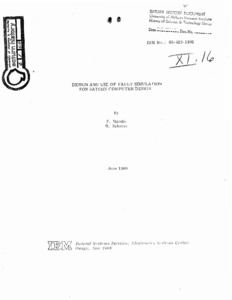
"Design and Use of Fault Simulation for Saturn Computer Design."
Describes different aspect of the Fault Simulation for Saturn computer design. -
-
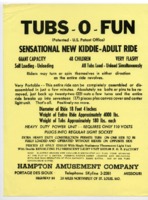
"Tubs-O-Fun"
The advertisement gives a features and specifications of the ride, its shipping weight, and its price. -
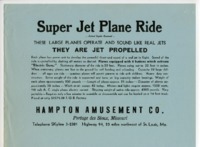
"Super Jet Plane Ride."
The advertisement gives a description of the ride, its shipping weight, and its price. -
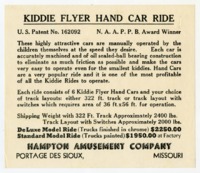
"Kiddie Flyer Hand Car Ride."
The advertisement gives a description of the ride, its shipping weight, and its price. -
-
-
-
-
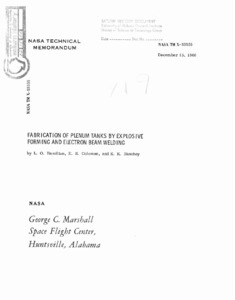
"Fabrication of Plenum Tanks by Explosive Forming and Electron Beam Welding."
This report presents the results of a program initiated to study the use of explosive forming and electron beam fusion welding techniques in the fabrication of pressurized cryogenic materials containers. Using these techniques, vessels were successfully formed from 304 stainless steel and X7106 aluminum alloy in the T63 condition.; Manufacturing Research and Technology Division.; Manufacturing Engineering Laboratory.; Research and Development Operations. -
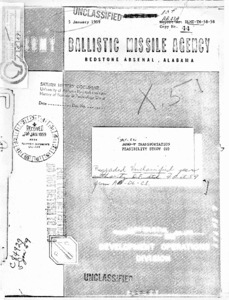
"Juno V Transportation Feasibility Study (U)."
The purpose of this report is to present an investigation to determine the feasible, practical and economical method of transporting the JUNO V thrust unit. This includes the first phase of transporting between Fabrication Laboratory, Systems Analysis and Reliability Laboratory and to the test stand, as well as the later phases, onto the Redstone Arsenal loading docks and from there down the Tennessee, Ohio and Mississippi Rivers to the Atlantic Missile Range, Florida.; Transportation and Packaging Section, Systems Support Equipment Laboratory. -

Oral History Interview With George Hamilton
George Hamilton has lived in Huntsville, Alabama all of his life, and his father was a Charter Marshall Member in Huntsville. When he was working, George's father was chosen as a "guinea pig" to go up in the Pregnant Guppy, which was a large, wide-bodied cargo aircraft. Because of George's father's career and interest with NASA, it made George interested in the career as well. George has a lot of family stories like this, which all have inspired him to take on his career that he has now. After high school, George went to The University of South Alabama in Mobile to study Marine Biology. Over the summer he had a change of heart, so he decided to transfer to Auburn University for Mechanical Engineering. After he finished up with his degree, he started working in small, manufacturing spare parts for missiles. After this career, he started to work at Avco Electronics in Huntsville where he worked at the plant on the design side. After this, Avco started looking for people to go overseas on the construction side of the house, so George went overseas with them. Then he came back, got married, and received his Phd in Biomedical Engineering at The University of Alabama in Birmingham.Tags Oral History -
-
Oral History Interview With Steven Hall
Steven Hall was born in a small town in the north central part of Indiana. This town has about a population of 2,000 people. Steven graduated from Eastern High School in 1963, and then he enrolled in Aeronautical/Neurospace Engineering at Purdue University. There, he received his bachelor's degree in 1968. Steven originally became interested in man space-flight when he was just about 10 years old. At this age, he had no clue how he could get involved with the space station, but he knew that he wanted to get involved one day. After he graduated college, he was so ready to work at NASA, that he left his home town immediately to move down to Huntsville, AL to start working. When he began working at the Marshall Space Flight Center, he was shown how Human Factors Engineering worked. One of the first projects that Steven was able to work on was "Skylab" where they built a lot of the equipment that probed how humans responded to space, and how the body changes in space. He also worked on a program to design a vehicle to drive around the surface of the moon.Tags Oral History