
Browse Items (8242 total)
Sort by:
-
"Flat Cable Engineering Studies for Saturn S-IVB Vehicles."
This paper describes the engineering approaches, investigations, results and conclusions of two National Aeronautics and Space Administration (NASA) flat-cable contracts from the George C. Marshall Space Flight Center (MSFC) to the Douglas Aircraft Company, Inc., for feasibility studies on the S-IVB stage of the Saturn Vehicle. In addition, the objectives and approaches for a third contract., "Flat-Cable Engineering Study", are discussed. A sister Douglas Paper No. 4186, to be presented by Dr. P. L. Hill, covers in detail the manufacturing aspects of the Flat-Cable Development Program.; Prepared by R.A. Klotz, Advance applications, Saturn Electronics, Missile and Space Systems Group, McDonnell Douglas Corporation for presentation at: IPC/EDN Flat-Cable Seminar, University of Southern California, Los Angeles, California, 20 June 1967. -
"Flight Control Computer for Saturn Space Vehicles."
The flight control computer for Saturn receives attitude signals from the stable platform, rate signals from rate gyros or lead networks, and angle-of-attack information from body-fixed accelerometers or other sensors. -
"Flight Evaluation of the Command and Communication System Aboard AS-501."
The first test of the command and communications system, a unified frequency S-band system, aboard AS-501 was successful. Compatibility of this system with the MSFN/USB sites was established. The onboard transponder and antenna system including antenna switching performed as predicted. The command performance was excellent with 5747 valid commands received onboard out of 5748 commands transmitted. Data reduction problems prevented a complete analysis of the tracking data. Telemetry system performance was satisfactory with a measured bit-error-rate of 4 x10⁻⁵ while over the Ascension Island station. This flight provided valuable data which can be used to define vehicle to-ground-station interfaces, to establish attitude constraints during translunar injection, and to improve operational procedures. One more test as successful as the AS-501 test would qualify the system as operational.; May 3,1968. -
"Flight Software Development Laboratory."
A man-in-the-loop computer facility has been created using a digital computer, display terminal,and space vehicle flight computer to enable programmers to check out flight programs in a simulated space flight environment. The simulation requires a real time multi-programmed environment, which is supplied by a control system capable of scheduling programs on 32 levels of priority interrupt as well as answering demands for service at the display terminal. A special interface device permits visibility and control of the flight program as it executes in the flight computer. On-line inputs from the programmer at the display terminal and outputs from data collection and reduction routines to the display screen are executed in real time. The Flight Software Development Laboratory has proved to be very useful in reducing program preparation time and increasing flight program confidence. -
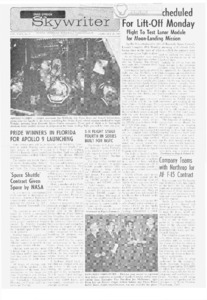
"Flight to test lunar module for moon landing."
News article detailing a test for the lunar module to see if it is able to land properly. -
-

"Florida June 1959 - New York July 16th 1959 MS Berlin."
First half of film shows Konrad, Klaus, and Ingeborg Dannenberg enjoying lunch by the pool at the Tradewinds Club outside of Cape Canaveral, Florida. The second half shows Ingeborg and Klaus departing by ship. June 1959. -
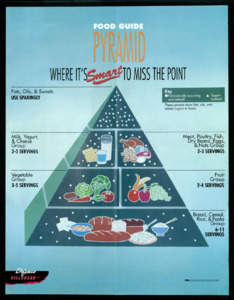
"Food Guide Pyramid; Where It's Smart To Miss The Point"
Serving sizes for food categories in food pyramid, illustrates food examples in each food category -
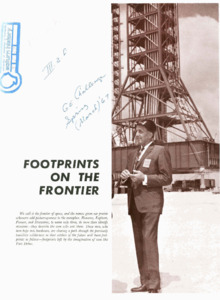
"Footprints on the Frontier."
An article regarding Doctor Kurt Debris, director of NASA's Kennedy Space Center. -
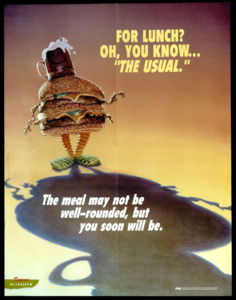
"For Lunch? Oh, you know..."The Usual."; The meal may not be well-rounded, but you soon will be."
Burger, soda and fries man with a fat shadow -
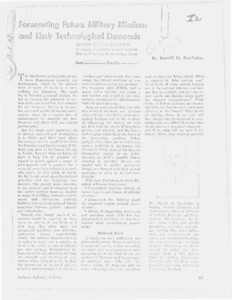
"Forecasting future military missions and their technological demands."
Archive copy is a poor photocopy.; Article is from Defense Industry Bulletin, October 1959, pages 21 to 24. -
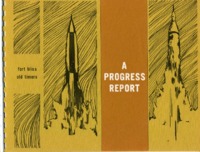
"Fort Bliss Old Timers: A Progress Report."
Subtitled "Some of the Old Timers' Contributions to the Science of Space," this booklet commemorates the accomplishments of the group of engineers posted at Fort Bliss, Texas, beginning in 1945. It includes a brief history of rocket development in Germany from 1929 through 1944, photographs of the 1965 Old Timers Reunion, and a directory of the oldtimers. It also includes a transcript of a speech given by Wernher von Braun in honor of Walter Dornberger's retirement. -
-
"Frances Cabaniss Roberts: Her Life and Legacy."
This virtual talk includes a lecture from Dr. Tom Reidy, editor of the 2020 edition of Frances Roberts' 1956 dissertation, with comments and moderation by UAH Head of Archives and Special Collections Reagan Grimsley and History Department Chair Stephen Waring. The talk was given as part of an Alabama Humanities Alliance grant, in partnership with the UAH M. Louis Salmon Library, the UAH Humanities Center, and the UAH History Department. -
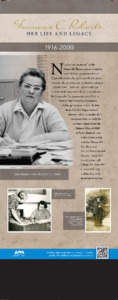
"Frances Roberts: Her Life and Legacy" exhibit panels.
This exhibit was made possible by a grant from the Alabama Humanities Alliance in collaboration with the UAH History Department and the UAH Humanities Center. -
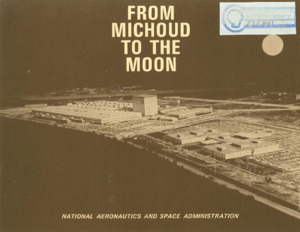
"From Michoud to the Moon."
A history and description of the Michoud Assembly Facility in New Orleans, Louisiana. -
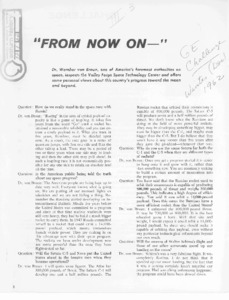
"From Now On -."
Interview with Dr. Wernher von Braun; Challenge, Winter(Dec) 1962, volume 1, number 3 -

"Fry Now Pay Later!; Going For The Bronze Today Could Mean Losing To Cancer Tomorrow"
Man and woman in the sun getting tan -
"Ft. Sutter - Donner Lake."
Firt portion shows Ingeborg and Klaus Dannenberg touring Sutter's Fort in Sacramento. Second portion shows the view from a vista overlooking Donner Lake in Tahoe National Forest. Summer 1956. -
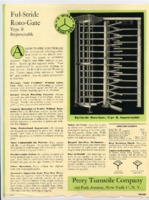
"Ful-Stride Roto-Gate."
This advertisement provides images, features, and specifications for the "Type B Impenetrable" gate. The back of the flier has two illustrations, one of children being prevented from sneaking into the park, and one focusing on the ease of the gate's use.