
Browse Items (8242 total)
Sort by:
-
"A review of the research origins of the LANCE weapon system -- Project hindsight -- Task 1 supplement."
This report includes a discussion of 57 research and exploratory development events that have been identified as contributing significantly to LANCE. Forty-six of these are research events. Eight of the research events deal with LANCE aerodynamics, four with propulsion, 24 with solid-state components used in the guidance and control system,and 10 with the research origins of the materials and manufacturing processes used in LANCE. In addition, 11 exploratory development events are identified. The principal concern of this study has been the identification of further research origins of LANCE and the 46 documented events are its major product. A further concern and obligation of this study has been to provide HINDSIGHT with some additional data on the research phenomenon including some further observations on the nature and route of research utilization.; FOREWORD: The purpose of this report is to present a survey of fundamental research contributing to the successful development of the LANCE weapon system. Included in this report are discussions of research inputs to a number of LANCE systems and technology areas. The circumstances of these research contributions to LANCE are discussed. The implications of these examples of research utilization are analyzed and some general observations and conclusions on the research payoff phenomena are given. This report was requested by the Army Missile Command as a supplemental contribution to Project HINDSIGHT.; Contract No. DA-01-021-AMC-14693(Z).; Battle Memorial Institute ,Columbus Laboratories.; RSIC-627.; Includes letter from W. Metscher, Lt. Col. to Mr. David L. Christensen dated March 14, 1969. -
-
"The potential bio-medical applications of Saturn nondestructive test methods."
A brief history and purpose of nondestructive methods followed by a discussion of those methods. -
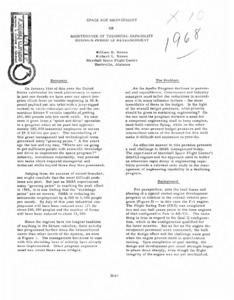
"Space age management or maintenance of technical capability during a period of retrenchment."
On January 3Ist of this year the United States celebrated its tenth anniversary in Space. In just one decade we have seen our space program climb from an humble beginning (a 30.8-pound payload put into orbit with a jury-rigged rocket) to extra-vehicular-activity and the tremendous Saturn V vehicle capable, of putting 250,000 pounds into low earth orbit. We have seen it grow from a "quick and dirty" operation to a program which at its peak had approximately 380,000 industrial employees in excess of {dollar}5.O billion per year. The marshalling of this great management and technological team generated many "growing pains". A few years ago the hue and cry was, "Where are we going to get sufficient people with scientific knowledge and drive to implement the space program?" Industry, sometimes reluctantly, was pressed into tasks which required managerial and technical skills beyond those they then possessed. -

-
-
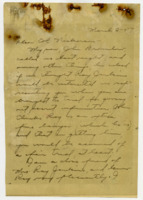
Correspondence between Colonel John C. Nickerson, Jr. and Margaret C. Brownlow.
Brownlow writes to give Nickerson the name of someone that would be interested in his case, Ray Jenkins, who would eventually join Nickerson's defense counsel with Robert K. Bell, along with two others. Nickerson responds, thanking Brownlow for the information. He expresses concern over financially securing Jenkins for his defense but hopes that Brownlow could still arrange a meeting in Knoxville, Tennessee. The third letter is a rough draft of Nickerson's response. Brownlow's second letter responds that she was able to get in touch with Ray Jenkins and left him with materials to read on Nickerson's case. Brownlow states she would get back to Nickerson as soon as he says "yes". -
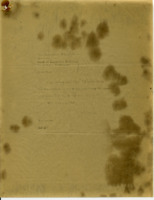
Letter to Ray H. Jenkins from Estes Kefauver and enclosed copies of letters.
Kefauver writes to Jenkins stating that he has enclosed the letter from the Department of the Army regarding the Nickerson case. The following letter addressed to Senator Kefauver is from Major General J. H. Michaelis. In it Michaelis writes that after consideration, the disclosure of certain documents is "too minimal to justify directing or advising the convening authority to drop the charges." He also writes that non-judicial punishment would be "legally objectionable" as Nickerson's offense is not minor. The last letter states the same regarding the dropping of the charges. -

Photograph of Allan, Mary, and Morton Hutchens.
On back: "Allan, Mary, and Morton Hutchens. Mary and their sister Maud died in childhood. Allan was the first person in Madison County to be killed in an automobile wreck. He was in his 20's." -

Photograph of Willie Armstrong Hutchens and baby.
The back shows decorative design advertising D. W. Buchanan's studio and handwritten at the botton reads, "Willie Armstrong Hutchens & baby." -
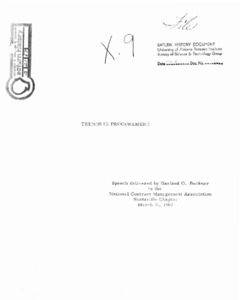
"Trends in procurement" by Garland Buckner.
Speech delivered by Garland G. Buckner to the National Contract Management Association, Huntsville Chapter. Discusses the outdated procurement process, how its changing and how to track the trends of how its changing. -
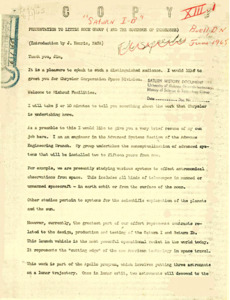
"Saturn IB : presentation to Little Rock Group."
Speech by H.D. Lowrey, SAE Meeting, Detroit, Michigan. Focuses on the Apollo project, the technology involved and what the goals of the project are. -
-
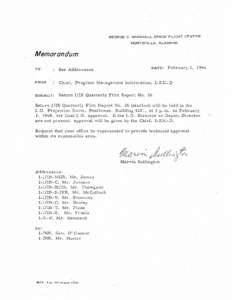
"Saturn I/IB quarterly film report no. 26."
Memo is from Chief, Program Management Information, I-RM-D.; The date and time of the interlock for the final I.O. approval is given. -
Utilities brochures
Utilities and Services -
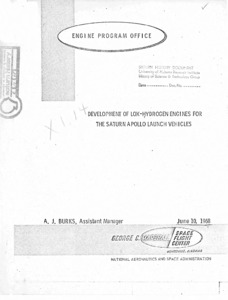
"Development of LOX-Hydrogen Engines for the Saturn Apollo Launch Vehicles."
During the development of the RL-10 and J-2 engines, many problems were encountered. Solutions to the significant problems are contained. A description of these LOX-Hydrogen engines, outlining the unique features of each will be given. Performance parameters for both engine systems are tabulated. Specific applications to various stages are shown. -
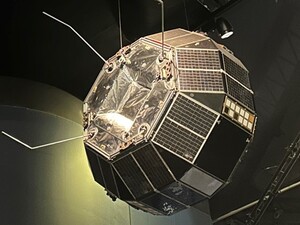
Replica of X3-Prospero
The backup satellite of the Prospero vehicle that R3 launched, slated for launch aboard R4 before it was scrapped and eventually hung in the London Science Museum as a partner to the R4. -
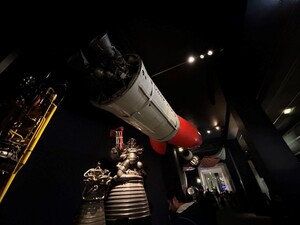
Black Arrow R4 Vehicle Second Stage
A photograph of the Black Arrow R4 vehicle's second stage, as photographed in the London Science Museum. It shows clearly the vehicle's Gamma-304 Type 2 Engine, along with the bright red payload faring. -
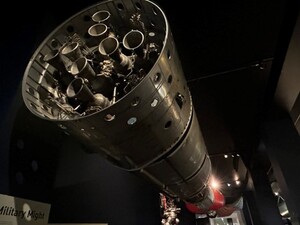
R4 Vehicle First Stage
A view of the Black Arrow R4 vehicle on display at the London Science Museum, including the Gamma-304 Type 8 engine that powered it. -
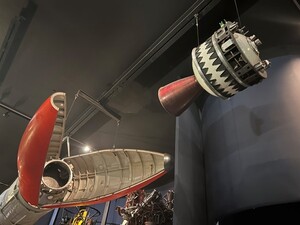
Waxwing 3rd Stage & Payload Faring (Black Arrow R4)
A photograph of the Waxwing SRM (solid rocket motor) used as the 3rd stage on the Black Arrow rocket. Hung in the London Science Museum as it would appear moments after separating from the second stage.