
Browse Items (8242 total)
Sort by:
-
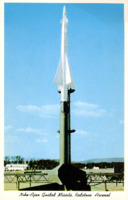
Nike-Ajax Guided Missile
Front: Nike-Ajax Guided Missile, Redstone Arsenal
Back: NIKE-AJAX GUIDED MISSILE, REDSTONE ARSENAL, HUNTSVILLE, ALABAMA
The Army's first supersonic anti-aircraft guided missile designed to follow and destroy the enemy target, regardless of evasive action. The Nike-Ajax system consists essentially of two parts First, an expendable missile; second, an elaborate and highly complex control system requiring approximately 1,400,000 individual parts. It is the first guided missile system to defend American cities against attack. -
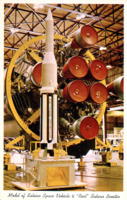
Model of Saturn Space Vehicle & "Real" Saturn Booster
Front: Model of Saturn Space Vehicle & "Real" Saturn Booster.
Back: SCALE MODEL, SATURN SPACE VEHICLE AND "REAL" SATURN BOOSTER
A one-tenth scale model of the Saturn Space vehicle is shown here behind a "real" Saturn booster at the assembly area of the NASA Marshall Space Flight Center, Huntsville, Alabama. The big booster is capable of developing 1.5 million pounds thrust. An assembled vehicle stands 162 feet high. -
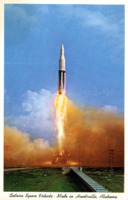
Space Vehicle - Made in Huntsville
Front: Saturn Space Vehicle - Made in Huntsville, Alabama.
Back: NATIONAL AERONAUTICS AND SPACE ADMINISTRATION'S "SATURN" - WORLD'S LARGEST KNOWN ROCKET LAUNCHED FROM CAPE CANAVERAL, FLORIDA ON OCTOBER 27, 1961. -
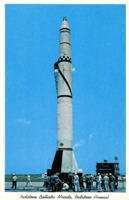
Redstone Ballistic Missile
Front: Redstone Ballistic Missile, Redstone Arsenal
Back: REDSTONE BALLISTIC MISSILE REDSTONE ARSENAL, HUNTSVILLE. ALABAMA
The Army's "Sunday Punch", the Redstone, is a liquid-propelled, surface-to-surface ballistic missile, which can place a nuclear or conventional warhead, with extreme accuracy, on targets up to 200 miles away. The missile is 69 feet long and 70 inches in diameter. -
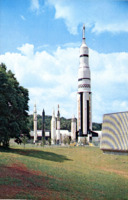
Alabama Space and Rocket Center
Back: ALABAMA SPACE AND ROCKET CENTER
America's Largest Missile and Space Exhibit, Tranquility Base Huntsville, Alabama 35807.
The Alabama Space and Rocket Center is the largest missile and space exhibit in the world. It was dedicated by the citizens of Alabama to those Americans who made it possible for man to walk on the moon and to explore the universe; and to the youth of America who will utilize space technology for the benefit of mankind. -
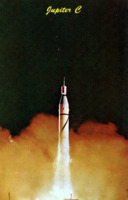
Jupiter C
Front: Jupiter C
Back: JUPITER-C. Huntsville, Ala. This missile was developed in Huntsville, Ala. at the Redstone Arsenal, home of the Army Ballistic Missile Agency. -
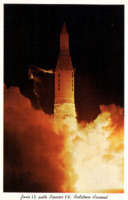
Juno II with Pioneer IV
Front: Juno II, with Pioneer IV, Redstone Arsenal
Back: JUNO II. WITH PIONEER IV, REDSTONE ARSENAL, HUNTSVILLE. ALABAMA
This space-probing vehicle became the first made-in-the-U.S.A. satellite of the sun. Just 40 hours after launching, Pioneer IV sped past the moon and continued on its journey to the sun. Signals were received until it reached a distance of 416,000 miles - farther than any other man-made object had been tracked. -
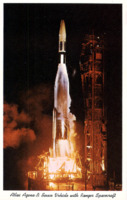
Atlas Agena-B Space Vehicle with Range Spacecraft
Front: Atlas Agena-B Space Vehicle with Ranger Spacecraft
Back: ATLAS AGENA-B SPACE VEHICLE WITH RANGER SPACECRAFT
The Atlas Agena-B space vehicle it shown here with its Ranger spacecraft payload on the pad at Cape Canaveral. Fla. The Atlas Agena-B is being used by NASA to launch the 750-pound Ranger lunar impact missions. The Atlas Agena-B program is managed by the NASA Marshall Space Flight Center, Huntsville, Alabama. -
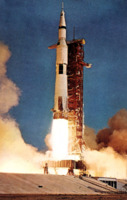
Saturn V Launch
Back: This Is the National Aeronautics and Space Administration's Apollo/Saturn V vehicle, used to place man on the moon. The Saturn V vehicle, developing 7.6 million pounds thrust, was developed under the direction of the NASA-Marshall Space Flight Center, Huntsville, Ala. -
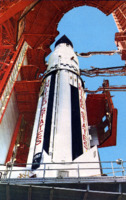
"NASA'S SA-5 undergoing pre-lounch check-out."
Back: NASA'S SA-5 undergoing pre-launch check-out. The Saturn is the free-world's largest space booster. It develops a million and a half pounds thrust. The NASA Marshall Space Flight Center at Huntsville. Alabama, has been developing and providing rockets for our space achievements since the very beginning of our entry into this field. -
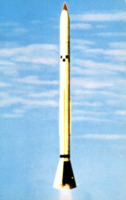
Corporal Guided Missile
Back: CORPORAL GUIDED MISSILE REDSTONE ARSENAL, HUNTSVILLE, ALABAMA
A member of the Army missile family used in support of ground combat operations, the Corporal, equipped with either an atomic or conventional type warhead, is a surface-to-surface guided missile capable of engaging tactical targets far beyond the range of conventional artillery. A powerful rocket motor propels the missile through space, at several times the speed of sound. -
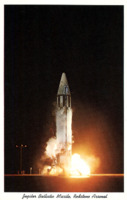
Jupiter Ballistic Missile
Front: Jupiter Ballistic Missile, Redstone Arsenal
Back: JUPITER BALLISTIC MISSILE, REDSTONE ARSENAL, HUNTSVILLE, ALABAMA
The largest weapon, for which the Army has development responsibility, the Jupiter has pin-point accuracy against targets at ranges up to 1,500 nautical miles. The missile is 58 feet in length, and 105 inches in diameter. -
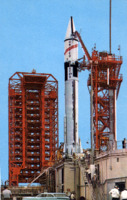
Centaur II undergoes pre-launch tests
Back: Centaur II, our first space vehicle to use liquid hydrogen as a propellent, undergoes pre-launch tests.
The NASA Marshall Space Flight Center at Huntsville, Alabama, has been developing and providing rockets for our space achievements since the very beginning of our entry into this field. -
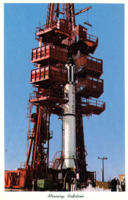
Mercury Redstone
Front: Mercury Redstone
Back: National Aeronautics and Space Administration's "Mercury-Redstone" being readied for launch at the Cape Kennedy launch site. The rocket was provided by the NASA George C. Marshall Space Flight Center, Huntsville, Alabama. -
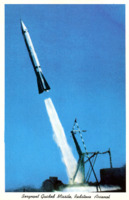
Sergeant Guided Missile
Front: Sergeant Guided Missile, Redstone Arsenal.
Back: SERGEANT GUIDED MISSILE, REDSTONE ARSENAL, HUNTSVILLE, ALABAMA.
Measuring about 30 feet in length, the Army's Sergeant is a surface-to-surface, solid propellant, ballistic guided missile possessing a very high degree of reliability and accuracy. Also highly mobile, it can be quickly emplaced and fired by a very small crew, under all conditions of weather and terrain, delivering a nuclear blow far behind enomy lines. Its highly accurate guidance system is invulnerable to any known means of enemy counter-measures. -
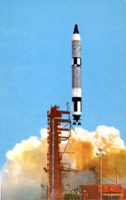
Gemini - Titan I Lifting Off Launching Pad
Back: Gemini-Titan 1 lifting off launching pad on its maiden voyage, testing spacecraft and vehicle. The Gemini is the first of NASA's two-man spacecrafts. The NASA Marshall Space Flight Center at Huntsville, Alabama, has been developing and providing rockets for our space achievements since the very beginning of our entry into this field. -
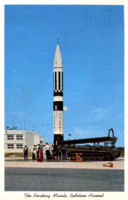
The Pershing Missile
Front: The Pershing Missile, Redstone Arsenal
Back: THE PERSHING MISSILE, REDSTONE ARSENAL, HUNTSVILLE, ALABAMA
This Pershing surface to surface missile can deliver an atomic warhead deep into enemy territory. The Army missile is a solid propellant ballistic missile under development by the Army Ballistic Missile Agency to replace the old reliable Redstone. The missile is named for General of the Armies John J. Pershing, World War I hero. -
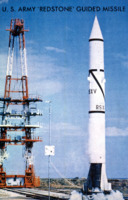
U.S. Army Redstone Guided Missile
Front: U. S. Army 'Redstone' Guided Missile
Back: U. S. Army 'Redstone' Guided Missile
Huntsville, Alabama, Home of Army Ballistics Missile Agency. Named after Redstone Arsenal, the Redstone is the Army's largest surface-to-surface guided missile. Capable of carrying a nuclear warhead, this weapon has proven to be very accurate at supersonic speeds. This photo is actual color made by U. S. Army. -
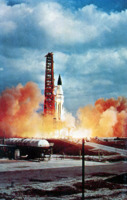
Saturn I Space Vehicle
Back: A Saturn I space vehicle, developed by the National Aeronautics and Space Administration's Marshall Space Flight Center. Huntsville, Ala., is launched from Cape Kennedy, Fla. The Saturn I weighs more than a million pounds at liftoff, and generates a maximum of 32,000,000 horsepower. It is a fore-runner of the Saturn V moon rocket being developed by MSFC. Huntsville. -

Alabama Space and Rocket Center
Back: ALABAMA SPACE AND ROCKET CENTER, Earth's Largest Space Exhibit. Tranquility Base, Huntsville. Alabama 35807.
This moon rock sample is displayed at Earth's largest space exhibit. It was collected on the moon by Apollo II astronauts. It is believed to be over 3 billion years old, and weighs 4.9 ounces.