
Browse Items (8242 total)
Sort by:
-
-
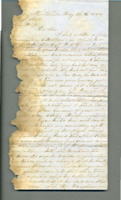
Letter Regarding the Case and Barbora Hazle's Statements.
This letter, written on May 12, 1856, has several names that are illegible, including the author's. It is addressed to two men, the first being [Daniel] P. Pool, and is a lengthy letter in response to a letter received from Abner C. Wellborn and in particular, the supporting testimony of Barbara Hazel accusing Abner Tate of at least two murders. The author states that the credibility of Hazel's words should be questioned due to the several reasons he goes on to detail. Following the original letter, the author pens an amendment to include changes that occured since the original letter was written as Tate had made a recent publication during that time. -
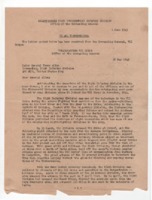
Letter from William V. Ochs to Major Edwin D. Burwell Jr.
The letter describes the administration of the Organized Reserve Corps. -
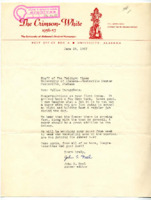
Letter from the editor of the Crimson-White to the staff of the Twilight Times.
In this letter, John S. Neel, the summer editor of the Crimson-White, the University of Alabama's student newspaper, congratulates the staff of the student-led Twilight Times on their first issue. Neel mentions in the letter how impressive it is that these students are able to produce their paper when they "are just going to school at night and holding down a regular job during the day." -
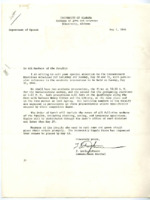
Letter from T. Earle Johnson to the University of Alabama faculty.
The letter concerns "the Commencement Excercises scheduled for Saturday and Sunday, May 30 and 31." It provides information about the times and places of the ceremonies and processions and reminds the faculty that their participation is required. -
-
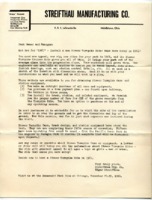
Letter from Streifthau Manufactoring Co. to the park owner.
The letter advertises the "new Streco Turnpike Ride" and discusses the methods the park owner could take to obtain the ride. -
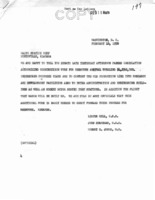
Letter from Sen. Lister Hill, Sen. John Sparkman, and Rep. Bob Jones to Huntsville radio stations.
Addressed to stations WBHP and WFUN, the letter announces that the U. S. Senate passed "legislation authorizing construction work for Redstone Arsenal totaling $4,250,000." The letter also mentions building rocket test stations and a flight test range. -
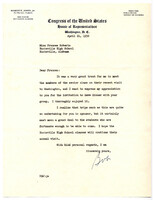
Letter from Rep. Bob Jones in Washington, D.C. to Frances Roberts in Huntsville, Alabama.
In this letter, Jones thanks Roberts, then a history teacher at Huntsville High School, for the opportunity to meet her students on their recent trip to Washington, D.C. -
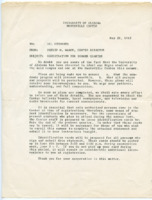
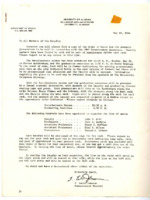
Letter from Philip M. Mason, Huntsville Center director, to all students.
UAH, then known as the University of Alabama Huntsville Center, circulated this letter in preparation for class registration and the center's integration in June 1963. Mason addresses the impending arrival of the first Black student, Dave Mack McGlathery, though he is not named in the letter. Mason emphasizes "that the academic program will proceed smoothly" and that "all persons and property will be protected," namely through a new student identification card system. Dave Mack McGlathery integrated the Huntsville Center on June 13, 1963, as he walked into Morton Hall to register for classes. His arrival proceeded uneventfully, though National Guardsmen were present to maintain order. Along with Vivian Malone, McGlathery was a plaintiff in the lawsuit to desegregate the University of Alabama. -
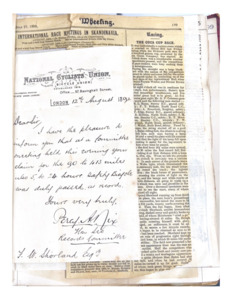
Letter from National Cyclists' Union with Shoreland's Record
One of the sources on this document is a letter from the National Cyclists' Union addressed to Frank Shorland to recognize him for his 24 hour safety bicycle record. -
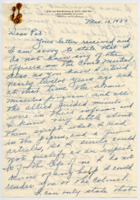
Letter from Michael G. Smith.
Smith writes to "Pat" with information as the former president of the court-martial, that would be beneficial to the defense counsel. "Pat" most likely is one of the members of the defense counsel as Smith refers to "you and Buster" several times throughout his letter, "Buster" being the nickname for Robert K. Bell, defense attorney. -
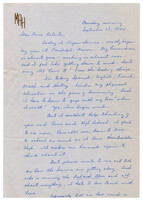
Letter from Martha Holliman in Lynchburg, Virginia, to Frances Roberts in Huntsville, Alabama.
Holliman was one of Roberts' students at Huntsville High School. She describes her first days at Randolph-Macon College and thanks Roberts for her excellent teaching. -
-
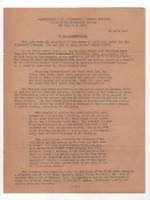
Letter from Maj. Gen. Terry Allen to the 104th Infantry "Timberwolf" Division.
In this letter, Allen describes the division's achievements in "six months of continuous combat," detailing its role in the liberation of the Netherlands and the capture of the Ruhr region and Cologne. Allen includes an excerpt from a letter from J. Lawton Collins. -
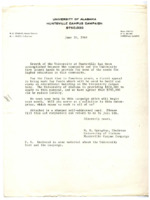
Letter from M. B. Spragins advertising the University of Alabama Huntsville Campus fundraising campaign.
The letter states that the fundraising goal is $750, 000. -
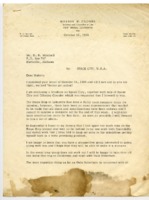
Letter from Lt. Gen. J. Lawton Collins commending the 104th Infantry "Timberwolf" Division for its role in capturing German territory at the end of World War II.
The letter was forwarded to all members of the division by Maj. Gen. Terry Allen of the 104th Infantry Division. Collins chronicles the Timberwolves' accomplishments in campaigns in western Germany, including the capture of Cologne and the Ruhr region. -
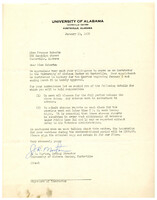
Letter from John R. Morton to Frances C. Roberts in Huntsville, Alabama.
The letter notifies Roberts of her appointment as an instructor in history at the University of Alabama Huntsville Center. Morton notes that Roberts was to receive an honorarium of $200 for teaching January 6-March 20, 1950. -
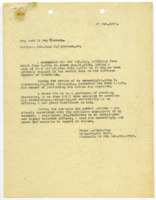
Letter from James A. Pickering.
Pickering writes a general letter about Colonel John c. Nickerson, Jr.'s character, stating that Nickerson was a man of "sterling character" and an "intelligent and highly valuable officer." -
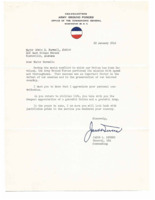
Letter from Jacob L. Devers to Major Edwin D. Burwell Jr.
The letter thanks Burwell for his service in the Army during the war.