
Browse Items (8242 total)
Sort by:
-
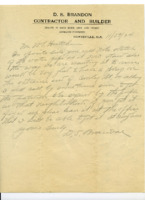
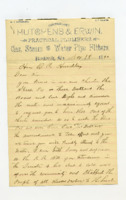
Letter to W. T. Hutchens from D. S. Brandon.
Brandon, contractor and builder, writes to Hutchens about a petition to be signed by the people in the neighborhood that will allow a water pipe to stretch to the end of Conley Street. The letter includes an illustration of the proposal. -
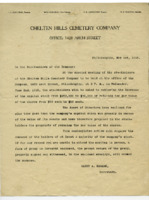
Letter to the stockholders of the Chelten Hills Cemetery Company.
Company secretary, Harry A. Newman, writes to the stockholders informing them of a special meeting where stockholders will be asked to authorize changes in per value to the capital stock. -
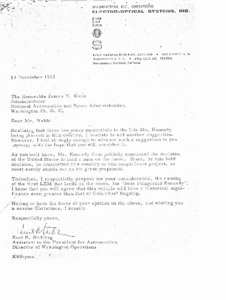
Letter to the Honorable James E. Webb, Administrator, National Aeronautics and Space Administration from Kurt R. Stehling.
A letter to Jame E. Webb proposing that the first LEM that lands on the moon to be named after President Kennedy." -
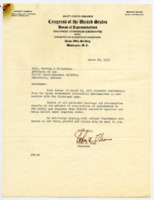
Letter to the defense counsel from John E. Moss.
Moss writes in response to the defense counsel's request of March 25, 1957 for information from the House Government Information Subcommittee. Moss states that all published hearings and reports on the subject are being mailed separately. -
Letter to the Commanding General, Third United States Army, from the Defense Counsel.
This letter is the first request of a continuance of the trial of Colonel John C. Nickerson, Jr. by the defense counsel due to waiting on top secret clearance for information pertinent to the case and other various reasons. -
Letter to the Commanding General, Third United States Army, from the defense counsel.
The Defense Counsel writes to the Commanding General, Third United States Army, requesting a continuance of trial of Colonel John C. Nickerson, Jr., citing the failure of the government to approve their request for top secret clearance as the reason. The defense counsel details how the clearance is vital to Nickerson's defense. -
Letter to the Commanding General, Third United States Army, from Ray H. Jenkins.
Jenkins writes to Major General Crump Gavin citing his personal reasons why the Commanding General should approve the defense counsel's request for a continuance. -
Letter to the Commanding General, Third United States Army from the Defense Counsel.
This letter from the Defense Counsel requests a continuance of the trial of Colonel John C. Nickerson due to the counsel still waiting on a response to their request for top secret clearance for access to pertinent information for the trial and the delay of the release of the pre-trial investigation to the civilian defense counsel. A letter from John Nickerson follows, detailing how without top secret clearance, he is unable to provide his civilian counsel with "essential components of the real issues in my defense without divulging information that is now classified." Multiple copies are included. -
Letter to the Commanding General, Third United States Army from the Defense Counsel.
The Defense Counsel writes to the Commanding General, Third United States Army requesting "top secret clearance for all members of the General Court Martial, the Court Reporter, and the Civilian Counsel n the case of Colonel John C. Nickerson, Jr." -
Letter to the Commanding General, Third Army.
In this letter, it is requested that May 13-17, 1957 be set as the dates of the Nickerson trial. It then details the reasons for these specific dates. -
Letter to the Commanding General, Third Army, from the Third Army Advisory Committee.
This letter details the committee's agreement with Nickerson's actions, believing he was acting "for what he thought was the best interest of the national defense." They advocate for the inclusion of the Army Ballistic Missile Agency team on the intermediate-range ballistic missile program. The committee states that trial by court-martial would not reflect the many accomplishments Nickerson has made for the Army weapon program and feel it unnecessary. -
Letter to the Chief of Manpower Office from Colonel John C. Nickerson, Jr.
Nickerson writes to the Chief of Manpower requesting a re-assignment on a temporary basis following his recent trial by court-martial at Redstone Arsenal in Huntsville, Alabama. Nickerson reported back to duty on July 11, 1957 and writes that his newly assigned duties are "of relatively no importance to the Army of to ABMA." Nickerson requests a new assignment that allows him back at Redstone Arsenal. -
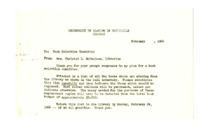
Letter to the Book Selection Committee to give notice of a list of books missing from the library.
The letter notes that the books were deemed missing by consulting the fall inventory and that the recipient should carefully examine the list to determine what items should be replaced. -
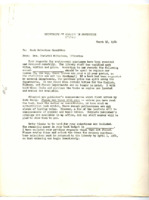
Letter to the Book Selection Committee from Christel L. McCanless concerning book replacement purchases.
In the letter, McCanless writes that the book replacement purchase requests have been received and reviewed, and that publisher's announcements and order forms have been attached to the letter. -
Letter to Senator Oscar Richard Hundley from William Thomas Hutchens.
This letter to Senator Hundley discusses Hutchens' thoughts of Hundley's political actions and also tells Hundley that the board unanimously agreed to request Hundley to have the part of their new charter. -
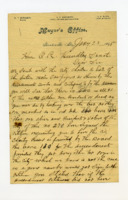
Letter to Senator Oscar Richard Hundley from William Thomas Hutchens.
This letter to Senator Hundley discusses a list of male taxpayers that was sent and certified by the assessor. Through the details of this list, Hutchens appears to argue about an amendment that is up for consideration in the Senate. Hutchens served as the president of Huntsville, Alabama from 1893 to 1897 and eventually Huntsville mayor from 1920 to 1922. Before 1916, the office of mayor was known as "president". Hutchens was the third to hold the title of mayor. -
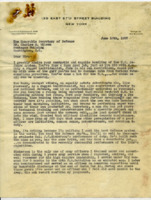
Letter to Secretary of Defense Charles E. Wilson from J. Bancroft Webster.
Webster writes saying he thinks Wilson does a good job running the nation's defense system and because of that, Webster asks Wilson to evaluate Nickerson's performance of duty and would feel "thoroughly disillusioned to see such a 1st class officer sacked." -
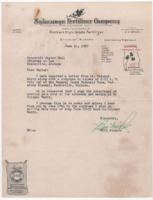
Letter to Robert K. Bell from William Nichols.
Nichols writes to Bell to inform him of the supoena he received to appear in court on July 2nd. He states that he will proceed as requested unless he hears from Bell with other instructions. -
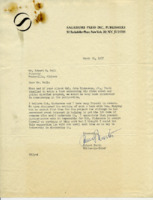
Letter to Robert K. Bell from Robert Smith.
Editor-in-Chief of Sagamore Press Inc., Publishers, Robert Smith, writes to Bell to say that his publishing company would be interested in Bell and Nickerson's story if they ever wish to write a book on it and the guided missles program. -
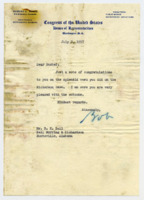
Letter to Robert K. Bell from Robert E. Jones.
Bob Jones writes to Bell to congratulate him on the "splendid work" he did on the Nickerson case.