
Browse Items (8242 total)
Sort by:
-

"Hispanic Heritage Month; Sept. 15-Oct. 15; Hispanic-Americans have distinguished themselves "above and beyond the call of duty" since the Civil War, earning this nation's highest award for military valor-The Medal of Honor-37 times."
Medals and list of names of Medal of Honor recipients that are Hispanic-American -
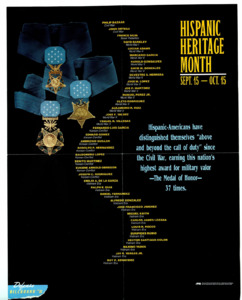
"Hispanic Heritage Month; Sept. 15-Oct. 15; Hispanic-Americans have distinguished themselves "above and beyond the call of duty" since the Civil War, earning this nation's highest award for military valor-The Medal of Honor-37 times."
Medals and list of names of Medal of Honor recipients that are Hispanic-American -
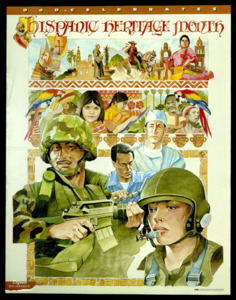
"Hispanic Heritage Month"
Various hispanic historical figures -
-
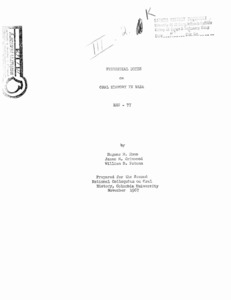
"Historical Notes on Oral History in NASA."
Prepared for the Second National Colloquium on Oral History, Columbia University. Contains notes on the oral history of NASA. -
"Historical Profile: North American Aviation, Inc."
Paper written as a study of functional management in NASA. -
"Historical Sketch of MSFC."
A rocket from the George C. Marshall Space Flight Center will carry the first American to the moon, and the deadline is 1970. Because of the Center's expanding role in space, there are increasing requests for information about our activities. This brief historical sketch should help to answer questions about our past, our present, and our hopes for the future. Marshall Space Flight Center (MSFC) is the largest installation of the National Aeronautics and Space Administration (NASA). The Marshall Center is NASA's agency responsible for large space rockets and related research. MSFC employs about 7500 civil service employees with an annual payroll of more than {dollar}82 million. In addition approximately 4300 contractor employees work for MSFC on the Arsenal, earning an estimated {dollar}43 million. The Center occupies about 1800 acres near Huntsville, Alabama; in this large area are 270 buildings with floor space totalling about 4,000,000 square feet for a real estate and property value of about {dollar}325 million. MSFC's 1966 fiscal year budget was {dollar}1.8 billion. Obviously MSFC has much human and monetary worth behind United States round trips to the moon and beyond. In addition to its size, MSFC is unique because it has a large rocket development team with more than three decades of experience. Prior to the rocket work that dates back to Peenemuende [sic] the world heard little and cared less concerning rockets and space. As a group Marshall has always thought big. It has worked together as a group, and equally well with fellow scientists throughout the Free World, to get the most into space soonest. This is why there is increasing interest in larger and larger rockets and rocket programs from our Center, a fact generating more and more questions about our Center, and in turn generating a "workload" request for this sketch by the Historical Office. We hope that you enjoy our historical sketch, which could as well be entitled "Closer and Closer Views of the Moon and Beyond." David S. Akens, MSFC Historian. -
-
"Historical Summary: S & ID Apollo Program."
Four and a half years have passed since President Kennedy and the United States Congress established a national goal of landing a man on the moon, before the end of the decade. This brief history is designed to be a working tool for use during the second half of this great adventure. It is expected that by presenting the events of the past in perspective this document will become a handy reference to accomplishments of the first half of the program. It is hoped that this volume will be of value to those directly and indirectly concerned with North American's portion of the Apollo program. This history contains a chronology of significant events, as well as material on the management of the program, a record of some of the breakthroughs in technology, a report of the hardware produced to date, and the many tests performed to man-rate the equipment. -
"History of MSFC Reliability Philosophy."
Paper given to North East Chapter , Mississippi Society of Professional Engineers. Essay discussing the history of the MSFC Reliability Philosophy. -
"History of Rocket Development Division."
A document recounting the history of the Rocketdyne Development Division -
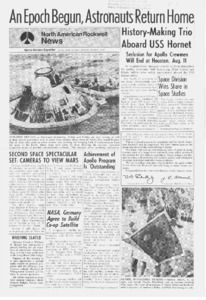
"History-making trio aboard USS Hornet."
A news article detailing the recovery of the Apollo 11 crew by the USS Hornet. -

"Holiday Stress Can Tie You Up in Knots; But, exercise, a balanced diet, and adequate rest can keep you from reaching the end of your rope"
Military man doll with rope knots on top of his head and in his stomach -
-
-

"Horvath, Daddy, Klaus; Plane trip, Guntersville 1958."
Konrad and Klaus Dannenberg go for a plane trip in a Cessna 172. Shown are aerial shots of their neighborhood on Monte Sano in Huntsville, Alabama as well as Lake Guntersville. 1958. -
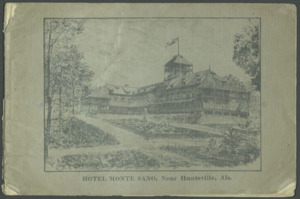
"HOTEL MONTE SANO, Near Huntsville, Ala."
This pamphlet announces the opening of the Hotel Monte Sano on June 1, 1887 and lists the manager as "Mr. S.E. Bates." The first section of the pamphlet includes a brief history of Huntsville and a description of the city's amenities. The author extolls the health advantages of Huntsville as "most healthfully situated at the base of Monte Sano" and describes the city's lack of recent disease outbreaks. The second section of the pamphlet details the Hotel Monte Sano's furnishings and amenities. The author emphasizes the "healthful" environs of the mountain and the hotel and includes letters from Huntsville's "eminent physicians" as testimonials. The pamphlet includes illustrations of scenes from Huntsville and Monte Sano. -
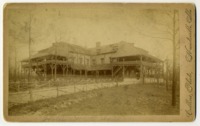
"Hotel Monte Sano."
The hotel opened on June 1, 1887 as a luxury health resort. It was built by the North Alabama Improvement Company with funding from Michael and James O'Shaughnessy. The hotel closed in 1900 and was demolished in 1944. -
"House - roof joists & girders carport not yet up."
The film shows the Dannenbergs' new house well under construction. The principle activities shown are the crafting of the roof joists and some of the bricklaying. Summer 1958. -
"House Film."
The work depicted in this film is the laying of the foundation and basement as well as the delivery and erection of the lumber for use in the floor and first story walls of the Dannenbergs' new home.Konrad Dannenberg's notes on the film box read, "1) The lumber arrives w/the Vick's Lumber Co, Hamilton 2) OD Porter moves bricks 3) Laying the subfloor frame (Newton + T. Walker) 4) Newton smirks w/satisfaction 5) Kids on house [illegible] 6) View of house struts walls. Summer 1958.