
Browse Items (8242 total)
Sort by:
-
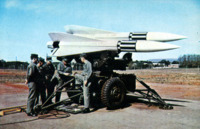
Hawk Anti-Aircraft Missile
Back: Field exercise maintainance of Hawk anti-aircraft missile at Missile and Munitions Center and School at Redstone Arsenal near Huntsville, Ala. -
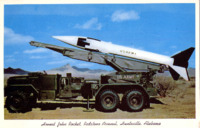
Honest John Rocket
Front: Honest John Rocket, Redstone Arsenal, Huntsville, Alabama.
Back: HONEST JOHN ROCKET, REDSTONE ARSENAL
Capable of carrying both atomic and high explosive warheads, this long-range Army artillery rocket is used tactically to provide close fire support to ground combat operations. The weapon has considerably more battlefield mobility than conventional artillery and one high explosive round can deliver on the target, the demolition effect of hundreds of artillery shells. -
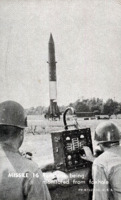
Missile 16 Redstone
Front: Missile 16 Redstone being monitored from foxhole. -
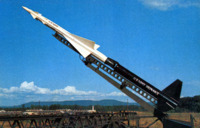
U.S. Army Ordnance "Nike" Guided Missile
Back: U.S. ARMY ORDNANCE "NIKE" GUIDED MISSILE, HUNTSVILLE, ALABAMA
Home of Redstone Arsenal, the Army Ordnance Rocket and Guided Missile Center. The Nike was America's first operational guided missile. Named after the Goddess of Victory, this weapon provides the first line of defense against atomic attack. -
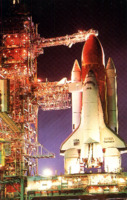
Space Shuttle Challenger Prior to Launch
Back: Kennedy Space Center, FL. Space Shuttle Challenger, Mission 41-B, on pad prior to launch. -
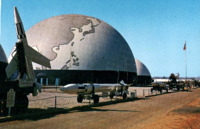
U.S. Army Missile Display Area
Back: U.S. ARMY MISSILE DISPLAY AREA, Redstone Arsenal, Alabama
The massive domes house innumerable displays, individual listening devices describe and explain the functions of various Rockets and Missiles. Buttons and levers operate miniature models and allow visitors to play Astronaut. The large dome is 150' in diameter and 85' tall. It is made of vinyl coated nylon, and is kept erect by air pressure. The nylon in this one dome weighs 92,000 lbs. -
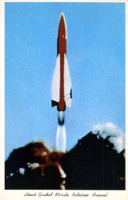
Hawk Guided Missle
Front: Hawk Guided Missile, Redstone Arsenal.
Back: HAWK GUIDED MISSILE, REDSTONE ARSENAL, HUNTSVILLE, ALABAMA
This it the Army's versatile surface-to-air guided missile, designed for protection against low altitude attack. Carrying a lethal warhead, this air defense weapon system is capable of destroying attackers flying at the lowest altitudes, at ranges insuring effective protection of defended areas. Highly mobile, the system is capable of being transported with a minimum number of vehicles on the highway, by helicopter, and by aircraft. -
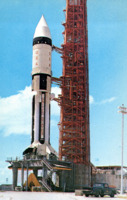
Uprated Saturn I Launch at Cape Kennedy
Back: The second Uprated Saturn I launch vehicle (designated AS-203) stands on the launch pad at Cape Kennedy. Blunt nosecone replaced the Apollo spacecraft for this special flight. This was a liquid hydrogen test to determine how liquid hydrogen reacted in space. Television comeras were in the top of the second stage's liquid hydrogen tank. The Saturn was developed at MSFC, Huntsville, AIabama. -
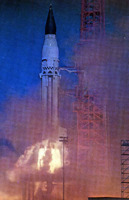
Fifth Saturn I Launch at Cape Kennedy
Back: The fifth Saturn I launch vehicle (SA-5) leaves the launch pad at Cape Kennedy, Fla., on Jan. 29, 1964. Nose cone painted black for special thermal experiment. -
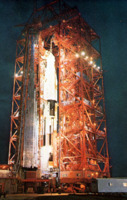
Uprated Saturn I Launch Vehicle
Back: The Uprated Saturn I launch vehicle (SA-202) is surrounded by the service structure on the launch pad at the NASA - Kennedy Space Center, Fla. The Marshall Center, Huntsville, Ala., developed the Saturn launch vehicle. -
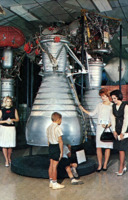
Marshall Space Flight Center's Space Orientation Center
Back: HUNTSVILLE, ALABAMA. NASA - Marshall Space Flight Center's Space Orientation Center. Rocket engine exhibits and other space-age displays are exhibited at the MSFC Space Orientation Center. -
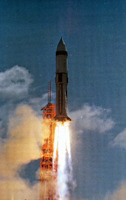
Launch of Saturn I
Back: The second Uprated Saturn I launch vehicle (designated AS-203) leaves the launch pod at Cape Kennedy, Fla., on July 5, 1966. Saturn was developed at MSFC, Huntsville, Alabama. -
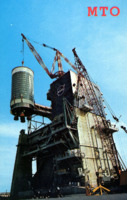
Mississippi Test Operations Test Stand
Front: MTO
Back: A ground test modal of the Saturn V second stage (S-ll ) is lifted into a recently completed captive test stand at the Mississippi Test Operations in Hancock County, Miss. The NASA-Marshall Space Flight Center's Mississippi Test Operations will be used for captive firing the S-ll flight stages. Ground test stage was manufactured to test out S-ll systems and the ground test facilities. -
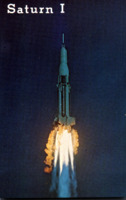
Saturn I Launch
Front: Saturn I
Back: The eighth Saturn I launch vehicle launched from the NASA-Kennedy Space Center, Fla., (vehicle designated SA-9) is shown leaving the launch pad on Feb. 16,1965. The Saturn was developed at Marshall Space Center, HuntsviIle, Alabama. -
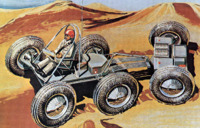
Artist's Drawing of Proposed Lunar Vehicle
Back: This is on artist's drawing of the six wheel General Motors built Mobility Test Article. The vehicle is being built by GM and tested by NASA. The concept will be used to design a vehicle for use on the moon. MSFC, at Redstone Arsenal, directs the work. -
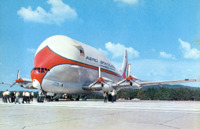
Super Guppy Aircraft
Back: Super Guppy aircraft, operated under NASA contract and owned by Aero-Space Lines, Inc., Van Nuys, Calif. Used to haul Saturn S-IVB stage from West Coast to Cape Kennedy. Also used to carry other large rocket stages and components. -
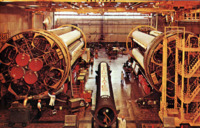
Michoud Assembly Facility
Back: This is the assembly floor at the NASA - Michoud Assembly facility at New Orleans, La. The large assembly building has some 40 acres under one roof. Boosters shown here are first stages for the Uprated Saturn I launch vehicle. The Saturn was developed at Marshall Space Center, Huntsville, Alabama. -
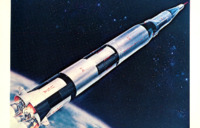
Artist's Conception of Saturn V Flight
Back: This is on artist's conception of the Apollo/Saturn V vehicle leaving on the first leg of the moon journey. The three stage vehicle will be launched from Cape Kennedy, Fla. and will carry three astronauts to the moon and back. The Saturn was developed at MSFC, Huntsville, Alabama. -
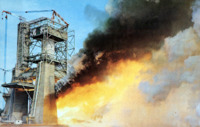
Static Test of Saturn V First Stage
Back: The 7.5 million pound thrust Saturn V first stage is static tested at the NASA-Marshall Space Flight Center in Huntsville, Ala. Five F-l engines power the stage. The stage will be the booster for the first Saturn V launched. This vehicle is scheduled for launch this year (1967). -
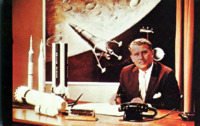
Dr. Wernher von Braun
Back: Dr. Wernher von Braun, director of the NASA - Marshall Space Flight Center, is shown with rocket models and hardware at the Huntsville, Alabama space installation.