
Browse Items (8242 total)
Sort by:
-

German state health insurance book and cards belonging to William August Schulze.
This booklet, "Sammelbuch der Bescheinigung über die Endzahlen aus der Aufrechnung der Versicherungskarten für August Schulze," documents Schulze's government health insurance while he was employed in Germany from 1930 through 1944. Each page serves as an insurance card for each year of employment. Page seven marks Schulze's first insurance record as an employee at Peenemünde. -

1946 day book.
Written by William A. Schulze, this day book includes notes from his activities at Army Proving Ground at Aberdeen, Maryland in early 1946. Schulze was transported from Germany to Aberdeen in late 1945 as part of the first group of German engineers sent to the United States. During the week of March 17-23, Schulze records his travel from Aberdeen to El Paso, Texas, leaving on Monday, March 18, and arriving in Texas on Thursday, March 21. The day book includes entries on shopping, leisure activities, birthdays, and mail. Schulze's notes reference H. N. Toftoy, Konrad Dannenberg, Wilhelm Jungert, Hannes Luehrsen, Theo Poppel, Erich Neubert, Walter Schwidetski, and others. -
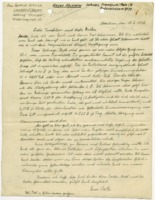
Letter from August Schulze in Aberdeen, Maryland to Trude and Erika Schulze in Landshut, Bavaria, Germany.
Schulze wrote this letter to his wife, Trude, and daughter, Erika, on the back of a photostat copy of his War Department Notification of Personnel Action. In the letter, he discusses his pay and accommodations with the U. S. Army. -
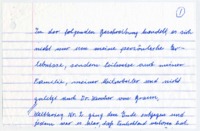
Autobiography and résumé of William August Schulze.
In this partial autobiography, Schulze describes his experiences growing up in Neulaubusch, Germany and training and working as an engineer. He notes that he began working for Wernher von Braun at Kummersdorf in 1936 and then moved to Peenemünde, where he worked on the A-3, A-5, A-7, and V-3 rockets. The documents also include a lengthy handwritten excerpt from Schulze's 1945 day book and a résumé. Includes a transcription and a partial English translation. -
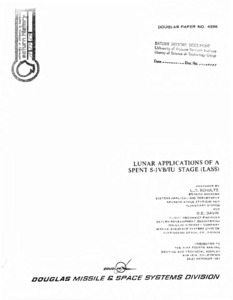
"Lunar Applications of a Spent S-IVB/IU stage (LASS)."
Support of lunar exploration missions is a major consideration in future space program planning. The spent Saturn v/S-IVB/IU can support both lunar - orbit and lunar -landing operations. This paper investigates lunar applications of the spent stage, and incorporates data generated during Company-funded studies. Investigated here is the feasibility of using a launch vehicle employing standard S-IC and S-I1 boost stages to deliver a modified S-IVB/IU and large discretionary payloads to a lunar orbit (LASSO) and/or the lunar surface (LASS). Operations in Earth orbit and direct-ascent trajectories are examined, and consideration is given to the use of the spent stage as a shelter in a manner similar to the presently planned Earth orbital workshop operations. Both the LASSO and LASS concepts are recommended for consideration in future lunar exploration plans. These concepts are capable of placing a gross wet weight of 101,400 lb in lunar orbit or landing 63,580 lb on the lunar surface respectively. The effective payload capability can be enhanced by proper integration of translunar mission subsystems with the subsystems required for lunar orbit or surface operations. The vehicles can be available within 3 years, with current-technology hardware sufficient for performing the missions described.; Douglas Paper No. 4256. -
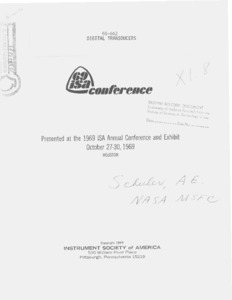
"Digital Transducers."
This paper outlines the major advantages of digital transducers and describes the principles and features (1) direct digital transducers, (2) indirect digital transducers, (3) quasi-digital transducers, and (4) A to D transducers. -
"Automatic Pressure Transducer Calibration System."
The abstract notes, "The development of an automatic pressure transducer calibration system is discussed in this report. Evolution from past practices and systems into an automatic calibration system with computerized data handling is described." -
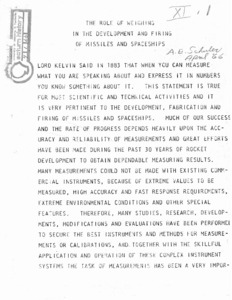
"The role of weighing in the development and firing of missile and spaceships."
Speech regarding the importance of developing and upgrading space ships and space technology. -
"Standard procedure for using units of mass, weight, force, pressure and acceleration."
Report No. DT-TM-1-60. ; FORWARD: The field of missiles and rockets deals with quantities of matter at various locations with different accelerations of gravity. The weight of these masses changes with gravity and the measurements of liftoff weight, fuel weight, etc., result in different values, depending on whether mass or weight units are used. Pressure and thrust are independent of the acceleration of gravity, but the instruments for measuring these values are calibrated with standard masses, producing different weight forces and calibration curves at different locations. Most sections of ABMA and other agencies or companies use pounds or kilograms as units of mass, weight or force, and the influences of different accelerations of gravity are often disregarded or treated incorrectly. These discrepancies become increasingly unacceptable with larger missiles and greater distances between operation sites. Therefore, the following Standard Procedure has been prepared to insure consistent and uniform terms and units of mass, weight, force, pressure and acceleration. All sections and individuals concerned are urged to use these units andprocedures. This is signed by Dr. Wernher von Braun, Director Development Operations Division. -
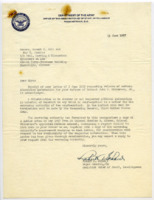
Letter to Robert K. Bell and Ray H. Jenkins from Major General Robert A. Schow, Assistant Chief of Staff, Intelligence.
Schow writes this letter in response to Bell and Jenkins request for classified information. Schow states that the convening authority will determine the relevance of the material before allowing access. -
Survey of Automatic Checkout Systems for Saturn V Stages.
The Abstract states "The four checkout systems developed and utilized by the National Aeronautics and Space Administration (NASA) for acceptance checkout of the Saturn V launch vehicle stages and instrument unit are described. The vehicle's characteristics, test policies, equipment design criteria, and operational factors are reviewed. Following a general description of each checkout system, this paper presents a brief definitive description of each major subsystem test station. These test systems are used for post-manufacturing and post-static firing acceptance checkout. The section related to the S-II stage includes several representative flow diagrams and descriptions of automatic tests. To present in detail the large volume of information describing these four checkout systems would require the writing of four papers." -
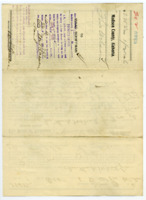
Loan contract between I. Schiffman and Thomas Wilson.
Loan contract for $225.00 for mules, horses, a cow, and equipment, borrowed by Thomas Wilson from Isaac Schiffman. -
Lending Library Page, survey, 1958
Libraries -
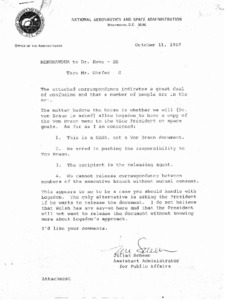
"Memorandum to Dr. Emme - EH through Mr. Shafter - G from Julian Scheer, Assistant Administrator for Public Affairs, National Aeronautics and Space Administration."
This attached correspondence indicates a great deal of confusion and that a number of people are in the act. The matter before the house is whether we will (Dr. von Braun is asked) to allow Logsdon to have a copy of the Von Braun memo to the Vice President on space goals. -
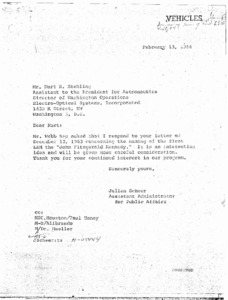
"Letter to Mr. Kurt R. Stehling."
Letter to Kurt R. Stehling from Julian Scheer answering on behalf of "Mr. Webb," stating that Kurt's "idea" was interesting and is to be given careful consideration. -
"Apollo Logistic Support Systems."
According to an abstract found on the page following the title page, this paper includes "one possible conceptual definition of an early Apollo Logistics Support Systems (ALSS) is presented and various payloads for the system are briefly discussed. " It also discusses the Lunar Mobile Laboratory (MOLAB) and other considerations for a lunar scientific mission. -

"Monte Sano State Park."
"A spectacular view from Monte Sano State Park near Huntsville, Alabama. Color by Wayne Floyd." -
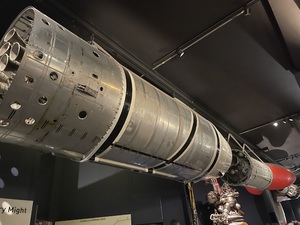
The Black Arrow Rocket dispayed in the Science Museum.
The Black Arrow Rocket is hanging from the ceiling of the space exploration exhibit of the Science Museum. The first stage of the rocket can be seen in the bulk of the image, while the second and third stage of the rocket can be seen further down in the image. -
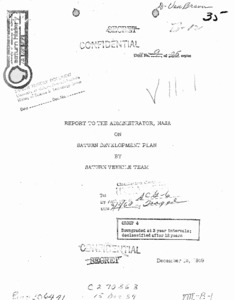
"Report to the administrator, NASA on the Saturn development plan."
In anticipation of this transfer, the NASA and Department of Defense have established, an interim working agreement that provides for immediate assumption by NASA of responsibilities fortechnical management of the Saturn vehicle development. -
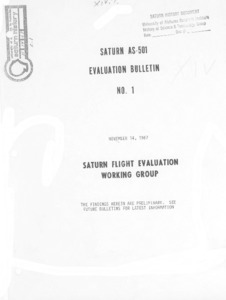
Saturn AS-501 evaluation bulletin No. 1, November 14, 1967.
The findings herein are the results of the combined evaluation efforts of the various Laboratories of Research and Development Operations at MFSC, The Boeing Company, North American Rockwell/Space Division, Douglas Aircraft Company, International Business Machines, and Rocketdyne.