
Browse Items (8242 total)
Sort by:
-

"Management problems faced in making future manned space exploration decisions."
This paper presents in synoptic form, an analysis of the management problems being faced in making fuhlre manned spaceflight decisions. It is an attempt to view the manned space program in total perspective - its relationship to other scientific research, other national programs, the role of Congress, the President's role, industry's role, and then show their relative influence and impact on decisior, making for the Post-Apollo period. -
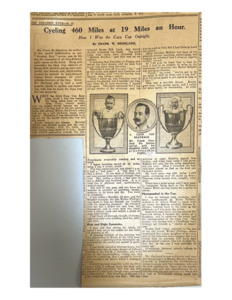
Cycling 460 Miles at 19 Miles an Hour
This is an article from an unknown magazine or newspaper which is authored by Frank Shorland and is about how me won the Cuca Cocoa Challenge Cup. -
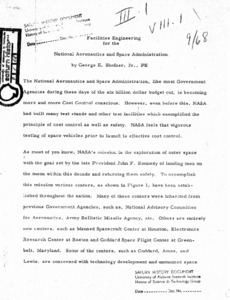
"Facilities Engineering for the National Aeronautics and Space Administration."
Article makes references to a film. Centers around the idea that testing space vehicles extensively before launch is cost control. -

Memorandum to update the "Apollo/Saturn Logistics Support Requirements Plan."
This memorandum contains the pages to be changed in the logistics program for the Apollo/Saturn Project. The logistics plan includes the design, procuring, manufacturing, and production processes. This plan formalizes the program, improves logistic support, and implements management and action plans. -
Stuhlinger, Ernst, 1992
Families -

Percy Bysshe Shelley and Mary Shelley - Joint journal entry (Audio)
"Shelley and Mary eloped at 4.15 am on 28 July 1814, accompanied by Mary's step-sister Jane Clairmont. They were pursued by Mrs Godwin (Claire's mother), who caught up with them the following day at Calais, but failed to persuade them to return. On 2 August Shelley, Mary and Claire reached Paris, where they purchased this notebook. Shelley wrote up their dramatic flight from England, the stormy crossing (during which he began 'to reason upon death') and their arrival in France. Mary makes her first contribution to the journal by lightly completing a sentence: 'Mary was there. Shelley was also with me.'" -
Percy Bysshe Shelley - Letter to Mary Shelley (Audio)
"'Everybody is in despair and every thing in confusion' writes Shelley in his last letter to Mary. He was in Pisa to discuss a new journal, The Liberal, with Leigh Hunt and Lord Byron.
Shelley had been delayed there by Hunt's personal situation (his wife Marianne had been told she did not have long to live) and by Byron's complicated affairs. He hints that Edward Williams might sail back to the Villa Magni ahead of him. Hurriedly concluding the letter, Shelley hopes that Mary was reconciled to staying at the Villa Magni, where he had never been happier, but where she had been ill and wretchedly depressed. In a PS he tells her that he has found the manuscript of his translation." -
Mary Shelley - Journal of Sorrow (Audio)
"In the months immediately following Shelley's death Mary lived at Albaro on the outskirts of Genoa. Her only regular companions were her young son, Percy Florence, and the journal she began on 2 October 1822.
To this 'Journal of Sorrow' she confided her innermost thoughts: 'White paper - wilt thou be my confident? I will trust thee fully, for none shall see what I write.' To be sure, Mary would not have shared the entries she wrote immediately after Shelley's death, in which her remorse and despair sometimes approached hysteria. But she left no instructions for the 'Journal of Sorrow' to be destroyed after her death, and was perhaps reconciled to the idea that this, and her other journals, would eventually be seen by other eyes." -
Mary Shelley - Letter to Percy Bysshe Shelley (Audio)
"Shelley was now financially responsible for Mary and Claire as well as Harriet, who was heavily pregnant with their second child. Godwin refused to see him, but drew on his resources. Mary wrote this impassioned letter to Shelley when he was in hiding from his numerous creditors. They could meet only on Sundays, when it was illegal to make arrests for debt."
-
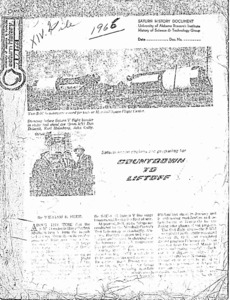
"Countdown to Liftoff".
This is an article from the Boeing Magazine. The Archive copy is a very poor photocopy and is difficult to read.; About the time the S-IC-1 booster is lifting the first Apollo/Saturn V from the launch pad on its maiden unmanned flight next year, a Boeing systems test crew will begin static testing the S-IC-4 at Devils Swamp, Mississippi (MTF). Starting with S-IC-4, all Saturn V first stage boosters will be captive fired at MTF. At present, S-IC firings are conducted by MSFC's test laboratory at Huntsville. The first flight stage, the S-IC-1, was placed in the static test stand on 24 January 1966 and completed its test program 25 Feb. It was removed from the stand March 14 and is undergoing post-firing checkout. it is due to be shipped this summer to KSC where it will be mated to the two upper stages of Saturn V, the IU and Dummy Apollo payload. The S-IC-2 went into the static stand on March 22 and is being tested during April The S-IC-3 also will be tested at Huntsville in 1966. The job of putting the world's largest and most powerful rocket together will be accomplished in the world's largest building, the 52-story vehicle assembly building. -
"A Bibliography of Wernher von Braun."
The document is designated for internal use only. -
-

YOLOv12 Object Detection Validation Prediction Results
The results from the validation test set for the YOLOv12 object detection model for the automated transcriber pipeline. -
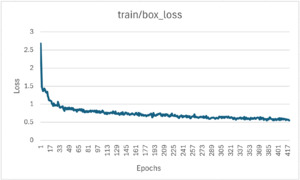
Object Detection Bounding Box Loss Plot
The loss plot for the bounding boxes from a YOLOv12 object detection model. Used to detect letters in a word. -

Layout for Letter Recognition Pipeline
The layout of the pipeline for the automated transcriber. It shows the input from a 1613 Bible, object detected, cropped, then transposed to a letter. -
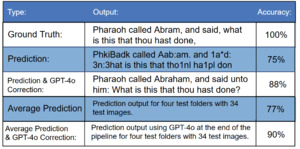
Table of Results from Automated Transcription Pipeline
A table that holds the results from testing for the automated transcription pipeline. -
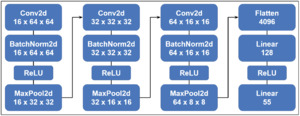
Convolutional Neural Network Architecture
The architecture for the letter recognition convolutional neural network. -
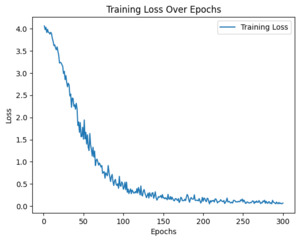
Convolutional Neural Net Loss Plot
A loss plot for the letter convolutional neural net classifier. -
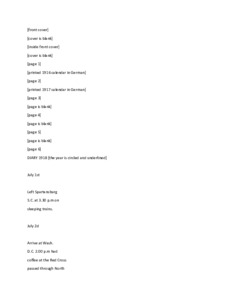
Transcript of the World War I diary of Archie Duncan Shannon.
Archie Shannon was a farmer who served in Company G of the 1st Pioneer Infantry in World War I. Shannon was born in Limestone County, Alabama on November 19, 1891, and at the time of his draft registration on June 5, 1917, he lived in Ardmore, Tennessee. Shannon reported for military duty on September 18, 1917 and entered training at Camp Pike, Arkansas.
This diary covers Shannon's experiences in the U.S. Army from July 1, 1918 to July 7, 1919. He describes his journey to France and details everyday life as a soldier, especially the discomforts of life on the front in both the Marne and Verdun sectors. Shannon discusses bathing and sleeping arrangements, gas masks, air raids, and the terrible sights of war-torn France while repairing roads and burying dead soldiers. Shannon includes descriptions of his involvement in the Meuse-Argonne Offensive, noting the continuous shelling, gas attacks, and miserable weather conditions. He also describes his company's reaction to the Armistice, writing, "Many happy hearts in our company everyone seems to take life anew."
Shannon spent the rest of his World War I service in Belgium, Luxembourg, and Germany, and he returned to the United States on July 7, 1919. A list of soldier names and hometowns is recorded in the back of the diary. Shannon died on May 20, 1969 and is buried in Gatlin Cemetery in Ardmore, Alabama. -
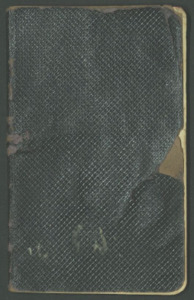
World War I diary of Archie Duncan Shannon.
Archie Shannon was a farmer who served in Company G of the 1st Pioneer Infantry in World War I. Shannon was born in Limestone County, Alabama on November 19, 1891, and at the time of his draft registration on June 5, 1917, he lived in Ardmore, Tennessee. Shannon reported for military duty on September 18, 1917 and entered training at Camp Pike, Arkansas.
This diary covers Shannon's experiences in the U.S. Army from July 1, 1918 to July 7, 1919. He describes his journey to France and details everyday life as a soldier, especially the discomforts of life on the front in both the Marne and Verdun sectors. Shannon discusses bathing and sleeping arrangements, gas masks, air raids, and the terrible sights of war-torn France while repairing roads and burying dead soldiers. Shannon includes descriptions of his involvement in the Meuse-Argonne Offensive, noting the continuous shelling, gas attacks, and miserable weather conditions. He also describes his company's reaction to the Armistice, writing, "Many happy hearts in our company everyone seems to take life anew."
Shannon spent the rest of his World War I service in Belgium, Luxembourg, and Germany, and he returned to the United States on July 7, 1919. A list of soldier names and hometowns is recorded in the back of the diary. Shannon died on May 20, 1969 and is buried in Gatlin Cemetery in Ardmore, Alabama.