
Browse Items (8242 total)
Sort by:
-
"Automated PCM Data Processor Theory of Operation."
Includes a blueprint of DDAS System Block Diagram. -
"Noise reduction study in a scaled model acoustic test facility."
The acoustic properties of five insulation materials were investigated in a 1/10- scale model acoustic facility. The materials were designed for applications in space vehicles. The model facility, consisting of a reverberation chamber coupled to an anechoic chamber, was evaluated for its use in noise reduction testing. It was found that a reasonably diffuse sound field existed above 900 Hertz. Modal density graphs of the reverberation chamber and spatial acoustic gradients measured within the chamber and across the test panel opening are compared to an idealized facility.; Prepared for the 75th Meeting of the Acoustical Society of America,Ottawa, Ontario, Canada. May 21 - 24, 1968. -
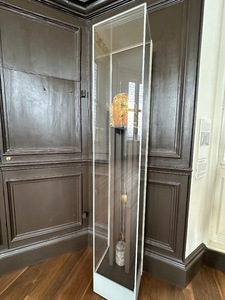
Year-going clock movement, by Thomas Tompion, 1675
This clock was designed for the observation room at the Flamsteed house, and was gifted to John Flamsteed by his patron, Sir Jonas Moore. After Flamsteed's death, his wife, Margaret Flamsteed, massed produced and sold the clocks for domestic use to pay off Flamsteed's debts. -
-
"The history of Army missile development."
Published as "Army Missile Development," Army Information Digest, XI. Establishes the development and history of weaponized rocket ordenance. -
"Toftoy statement to Senate Investigation Committee": Development of the Nike system.
Narrative report of general H.N. Toftoy - Informal interview with Mr. Robert E. Dunne, Assistant Counsel of the Senate Permanent Investigating Subcommittee, in the presence of Mr. P. K. Schaeppi. -
"The Saturn V mission and Alabama."
Speech that covers the topics of the Saturn V lunar mission and the basics of a lunar mission in general. -
Letter to Lt. Col. Charles R. Zimmer from J. R. Thompson.
Thompson answers Zimmer's request for information about two colonels and Major General Powell. While Thompson states he is not acquainted with the two colonels, he does provide a personal evaluation of the character of Major General Powell. -
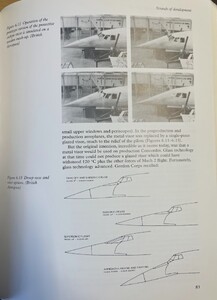
Concorde droop nose drawings and prototypes
Due to the nature of aerodynamic changes at supersonic speeds, Concorde's nose had to have a needle-like design to be aerodynamic enough to break the sound barrier. However, this design presented problems in visibility. This led to the iconic adjustable "droop nose" design, where the high-nose configuration was used when cruising for better aerodynamics, and the low-nose configuration was used during landing for better visibility. This source shows prototypes of the nose design and drawings of multiple nose configurations. -
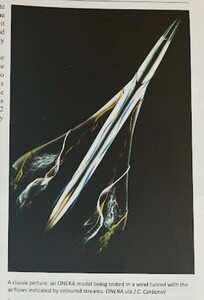
A classic picture: an ONERA model being tested in a wind tunnel with the airflows indicated by colored streams. (Concorde)
ONERA is a French aerospace research center, and this is a demonstration of the aerodynamics of Concorde via an ONERA model. In order to break the sound barrier, the fuselage was created to be needle-like, and the long wings were incredibly thin, making Concorde exceptionally aerodynamic. -
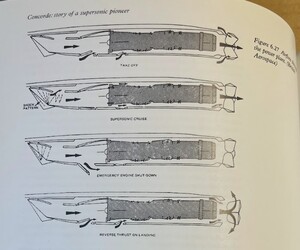
Airflow through the (Concorde) power plant
Demonstration of airflow throughout Concorde power plant in different stages of flight. As the Concorde's engine could only use air flowing at about 300 miles per hour at the fastest, the power plant includes adjustable ramps to slow down airflow from Concorde's top speed of ~1300 mph to a usable range. Also include reverse thrust demonstrations. -
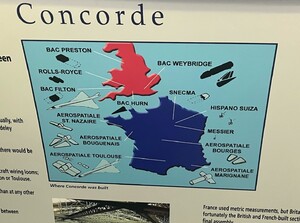
Graphic of Concorde construction locations
As a collaboration between Aérospatiale and the British Aircraft Corporation (BAC), parts of Concorde were constructed in various locations in Britain and France, as shown in this graphic. This graphic originates from Brooklands Museum, a major factory for Concorde. -
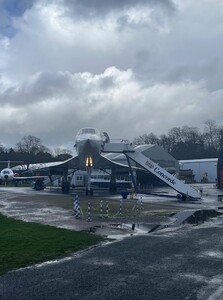
Concorde in Brooklands Museum from front
As the factory where 30% of each Concorde was made, Brooklands Museum now holds G-BBDG, one of the 18 remaining Concordes, for display. -
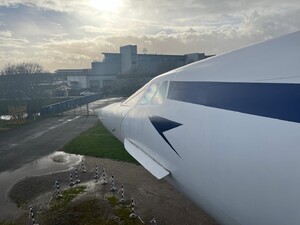
British Airways Concorde nose from front exit stairs
The Concorde is the world's first supersonic commercial aircraft. Due to maintenance costs and noise issues, the plane was retired in 2003. Since then, Concorde has become a British icon. Exhibits such as this one at Brooklands Museum share a goal of presenting the innovation and passenger experience of Concorde. -
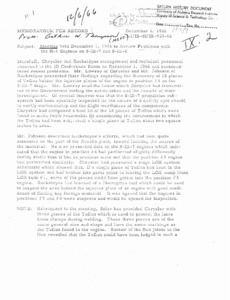
"Memorandum for record : meeting to review problems with H-1 engines on S-IB-7 and S-IB-8."
Memorandum to go over problems with the H-1 engine. -
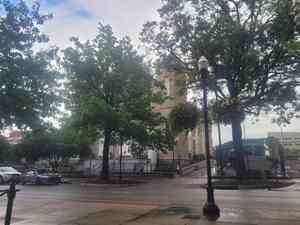
St. Mary of the Visitation Catholic Church in downtown Huntsville.
St. Mary of the Visitation Catholic Church was built in 1877 and has gradually expanded over the years. The church still stands today and has an associated school. The surrounding area has gone from a relatively empty small town to the bustling downtown Huntsville it is today.
-
-
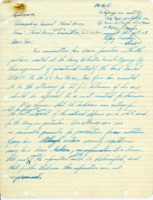
Drafts of letter to the Commanding General, Third Army from the Third Army Advisory Committee.
In response to the "problem created at the Army Ballistic Missile Agency" that would eventually lead to Colonel Nickerson's referral to a court-martial, the Third Army Advisory Committee writes this letter to inform the Commanding General that one of them, Robert K. Bell, had consented to being Nickerson's attorney as they see Nickerson's actions as being in the best interest of the national defense and Army. -
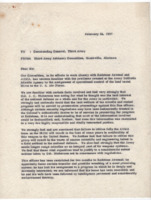
Letter to the Commanding General, Third Army, from the Third Army Advisory Committee.
This letter details the committee's agreement with Nickerson's actions, believing he was acting "for what he thought was the best interest of the national defense." They advocate for the inclusion of the Army Ballistic Missile Agency team on the intermediate-range ballistic missile program. The committee states that trial by court-martial would not reflect the many accomplishments Nickerson has made for the Army weapon program and feel it unnecessary. -
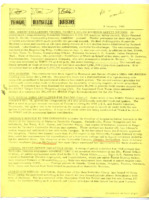
"Thiokol Huntsville Division Employee News Bulletin."
The bulletin mentions the company's "donation of surplus technical journals to the library at the University of Alabama Huntsville Campus." It notes that Thiokol has donated over 15,000 copies of unneeded journals, assisting the university in meeting accreditation requirements.