
Browse Items (8242 total)
Sort by:
-
Letter to Dr. A. V. Grosse from Colonel John C. Nickerson, Jr.
In response to Grosse's letter to Dr. Wernher von Braun that had been sent to him, Nickerson thanks him for his offer of assistance in the case and asks if he would consent to appearing as a witness. -
Letter to Douglas H. McDonald from Robert K. Bell.
Bell responds to McDonald's letter from April 30, 1957. He discusses the Nickerson case and the recent call for witnesses by the trial counsel. He also discusses old aquaintances on a personal level and mentions his upcoming trip to Indianapolis, hoping to have lunch with McDonald while there. -
Letter to Donald A. Quarles from Alexander.
Alexander writes to thank Quarles for making the arrangements that allowed him and his party to "see so many things of interest in the guided missile field." He adds that Lieutenant Colonel Nickerson was very "helpful and informative". -
Letter to Colonel Nickerson and his wife, Carol, from Robert K. Bell.
Bell writes to the Nickersons who now live in Panama on a two-year assignment. Bell updates Nickerson on events that happened since the last time he wrote. He details the outrage directed towards Charles Wilson, the Secretary of Defense. He states that he is saving "pertinent clippings from several newspapers" to send to Nickerson to help provide background to the latest events. Bell writes of many people who are advocating for Nickerson's return and vindication. -
Letter to Colonel John C. Nickerson, Jr. from William F. Nichols.
Nichols writes to Nickerson, reminiscing of their time in active duty together in various places and how he held Nickerson in "highest esteem." He expresses concern over charges that indicate espionage, stating that they are "without foundation." He offers to appear in Nickerson's behalf and recommends reaching out to Brigadier General Pickering as well. -
Letter to Colonel John C. Nickerson, Jr. from Mayor Ralph M. Wiltsie.
Mayor Wiltsie writes to Nickerson in his defense, asking if he can be of any help in the trial such as testifying or giving a character witness. -
Letter to Colonel John C. Nickerson, Jr. from Kenneth A. Roberts.
Roberts writes to Nickerson about his case, expressing interest and stating that by knowing Nickerson's relatives, he is sure Nickerson is anything but disloyal. Roberts also writes that he will be in Huntsville sometime and hopes to arrange to talk with Nickerson. -
Letter to Colonel John C. Nickerson, Jr. from John J. Sparkman.
Sparkman thanks Nickerson for sending a booklet he had requested. He also requests Nickerson to send information on a long range flight conducted by ABMA directly to Erik Bergaust for an interview Bergaust did on Sparkman. -
Letter to Colonel John C. Nickerson, Jr. from Harry M. Moriarty.
Moriarty offers his services as a witness during Nickerson's trial and why what he has to offer would be to their "mutual benefit." He encloses with the letter an outline of a complaint that may be beneficial to Nickerson's case as well as his own. -
Letter to Colonel John C. Nickerson, Jr. from Harold Sedrel.
Sedrel writes on behalf of Nickerson's character, though "unacquainted with the details of this particular case." -
Letter to Colonel John C. Nickerson, Jr. from Colonel Robert C. Works.
Works expresses sympathy toward Nickerson and the situation he is in asking, "�what's happening to the Army?" Works offers a character witness or any deposition or testimony that would help his case. -
Letter to Colonel John C. Nickerson, Jr. from "Curly".
"Curly" writes in support of Nickerson and states that while someone else will have to decide if what he did was right or wrong, he "might be one of the best qualified people alive to testify in your behalf." The second half of the letter is handwritten and discusses personal events in "Curly's" life such as a new grandson and a family member in the Navy. -
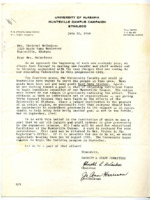
Letter to Christel L. McCanless requesting she "give generously to the expansion program" fundraiser for the University of Alabama Huntsville campus.
Christel L. McCanless is both the recipient and one of the senders of this letter. -
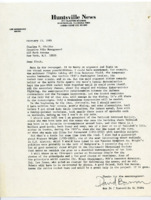
Letter to Charles F. Pfeifer from David Bowman.
Bowman writes to Pfeifer about a "two-pager" that he wrote, detailing its contents. He also includes several other of his resume highlights including four novels, playscripts, and other things he has written. Bowman also includes that he is the president of the Tallulah Bankhead Society, a society that honors and celebrates a 1930s actress from Alabama. Bowman is appealing to Pfeifer, a creative film manager, about his recent work on the Nickerson case. -
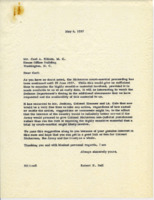
Letter to Carl A. Elliott from Robert K. Bell with a reply from secretary Cora B. Marlowe.
Bell writes to Elliott in Washington D.C. on behalf of the defense counsel in an attempt to change Nickerson's case from trial by court-martial to a non-judicial punishment. Marlowe writes to Bell on behalf of Congressman Elliott who is out of town and will respond to Bell's May 8 letter upon his return. -
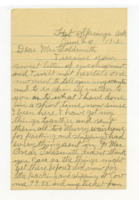
Letter to Betty Goldsmith from Ella Davis.
Ella Davis writes to Betty Goldsmith, Oscar's wife, regarding her move to Hot Springs, Arkansas. She details the cost to move her things and asked Betty to have Mr. Goldsmith send her a check as she is now broke after paying the moving costs. She also writes about declining an offer on the property she is selling because the potential buyer refused to pay interest. -
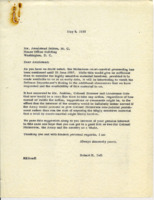
Letter to Armistead Selden from Robert K. Bell.
Bell writes to Selden in Washington D.C. on behalf of the defense counsel in an attempt to change Nickerson's case from trial by court-martial to a non-judicial punishment. Selden replies stating he will pass the information "if the opportunity present[s] itself." -
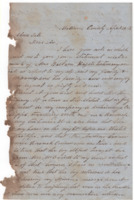
Letter to Abner Tate.
The letter to Abner Tate addresses the testimony of Barbara Hazel, confirming some parts but refuting more of it. It is clear that pages of the letter are missing as it ends in the middle of a sentence and has no author's signature on any page. Note: This could be Moore's statement which would match with the Note to Moore's Statement. -
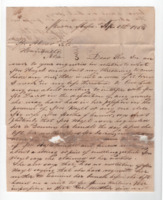
Letter to Abner Tate from William Conner.
This letter is William M. Conner's statement as written to Abner Tate. In this statement, Conner refutes Mrs. Hazel's testimony stating that he has never threatened to "cow hide" anyone. Furthermore, Conner writes that his wife "says most positively" that Mrs. Hazel never requested her to "examine her bundle the day before she left her mother's." -
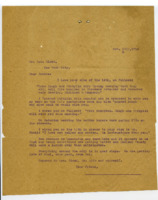
Letter to A. L. Rison.
This letter includes responses to Rison's wire and the return wire. It also includes information on cotton buyers and local weather conditions. The sender did not sign the letter, but it is most likely Oscar Goldsmith.