
Browse Items (8242 total)
Sort by:
-

Oral History Interview With Bran Griffin
Bran Griffin was born in Medford, Oregon. His father was in the military, so they moved around a lot. Bran went to the University of Texas his first year of college, and he studied Architecture. Then, he graduated college with a degree in Architecture from Washington State University. He then went to graduate scholl in Southern California, and he received a fine arts degree. After this, Bran wanted to get a degree in something a little more stable, so he went back to school to get his master's degree in Architecture. After this, Bran was on a shuttleship for a couple of years in Rome, and then he came back to start his career in teaching Architecture. Even though he was teaching Architecture, he had an intense passion for space. Because of this passion, he started to become involved with the Johnson Space Center with a faculty fellowship. Bran was in their Spacecraft Design Division. Since he wanted to be closer to be a part of the Space Industry, he decided to move to Washington State. After a while of working in Washington State, he received a job offer from Boeing in Hunstville, AL and began his career there being involved with the space station.Tags Oral History -
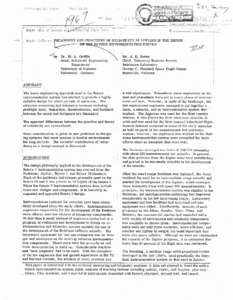
"Philosophy and practices of reliability as applied in the design of the Saturn Instrumentation System."
The basic engineering approach used in the Saturn instrumentation system has evolved to provide a highly reliable design for short periods of operation. The airborne measuring and telemetry systems including preflight tests, inspection, documentation, and feedback between the users and designers are discussed. The apparent differences between the practice and theory of reliability are rationalized. Some consideration is given to new problems in designing systems that must operate in hostile environments for long periods. The potential contribution of redundancy as a design concept is discussed.; This paper is concerned with the airborne measuring and telemetry systems; it does not attempt to treat the entire Saturn instrumentation system which consists of tracking devices including optical, radar, and Doppler, plus television, film cameras, and a myriad of instruments connected with factory checkout, ground test, and launch. -
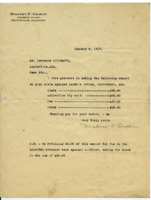
Fee report for a claim suit filed by Lawrence Goldsmith against H. Oliver with Parks & Cotton.
This document contains a detailed breakdown of the fees associated with the "unlawful detainer suit" filed by Lawrence Goldsmith against H. Oliver. -
-
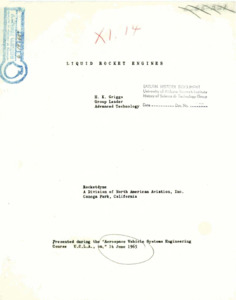
"Liquid Rocket Engines."
This paper presents a discussion on liquid propellant rocket engines. The first part contains a discussion on liquid propellants, including a description of various propellant types such as cryogenic, storable,bipropellant, and monopropellant. This part also points out desirable physical properties and includes a section on performance outlining the methods by which performance is calculated and shows performance for various liquid rocket propellant combinations. -
-
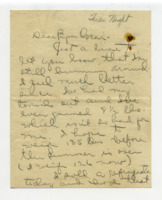
Personal letter to "Papa Oscar" from grandson Oscar.
This personal letter to Oscar Goldsmith from his grandson, also named Oscar, details the removal of young Oscar's tonsils and his gaining eight and a half pounds. He also writes of his first refrigerator sale and his hopes to sell more, though he is "no salesman". He conveys some information from his mom and thanks him for making her trip to New York possible. Finally, young Oscar thanks Papa Oscar for paying his tonsil removal bill, and promises that he can take care of his dentist bill. -
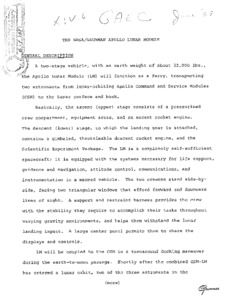
"The NASA/Grumman Apollo lunar module"
Handwritten in pencil on the document. Describes the layout and function of various sections of the Apollo lunar module. -
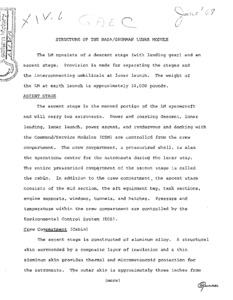
"Structure of the NASA/Grumman lunar module."
Describes the structure and function of each part of the NASA Lunar Module -
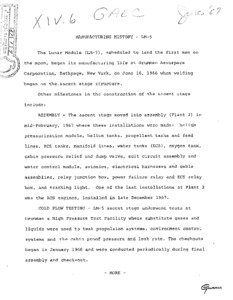
"Manufacturing history - LM-5."
Essay that focuses on the achievements of the Grumman Aerospace Corporation. -
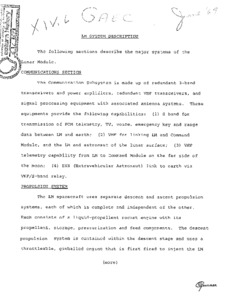
"LM System Description."
Report that describes the major systems of the Lunar Module. -
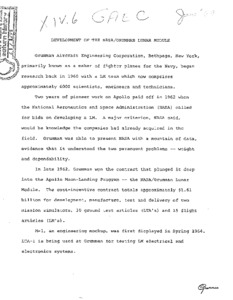
"Development of the NASA/Grumman Lunar Module."
Paper regarding the actions and achievement of the Grumman Aerospace Corporation. -
-
"Nuclear engine design considerations."
The intent of this paper is to examine the static test countdown organization and discuss the need for a systematic method to organize a countdown. -
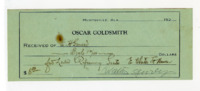
Receipt of payment from E. H. S.
Receipt of payment of $8.50 from E. H. S. signed by Walter Gurley. -
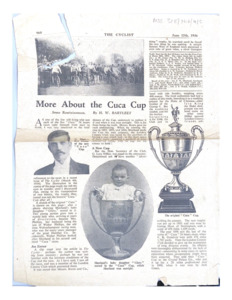
More About the Cuca Cup
This is an article about the Cuca Cocoa Challenge Cup over 40 years after the event took place and specifically discusses the second cup and the challenges that led the demise of the Cuca Cocoa Challenge series. -
"Guidance and Control of Saturn Launch Vehicles."
The navigation, guidance, and control modes and problems of the Saturn launch vehicles are given as the requirements for the guidance and control methods. Two path adaptive guidance modes, featuring flight path optimization, in the form of a polynomial mode and an iterative mode are given in their computation form and compared with respect to mission flexibility, implementation requirements, and performance. Attitude control during the propelled flight phases requires consideration of various bending and sloshing modes; stability of the control system is obtained by phase stabilization of the low frequencies and by attenuation of the higher frequencies. Typical shaping networks and their transfer functions are given. The attitude control system during coasting periods is briefly described. The functional behavior and characteristic data of the main guidance and control hardware such as the inertial sensors, stabilized platform, digital computer, data adapter, control computer, and actuation system are described. Reliability requirements are emphasized. The principle of redundancy is extensively used to obtain highest reliability for long operating times. Data and results from recent Saturn I flights summarize the performance of the guidance schemes. -
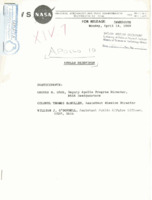
Briefing for Apollo 10.
This document contains a transcript of the briefing meeting for the launch of Apollo 10. Participants include George H. Hage, Colonel Thomas McMullen, and William J. O'Donnell. -
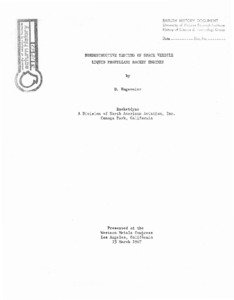
"Nondestructive testing of space vehicle liquid propellant rocket engines."
Presented at the Western Metals Congress, Los Angeles, California, 15 March 1967.; Archive copy is a photocopy.; ABSTRACT: This report describes the various nondestructive test methods employed to evaluate materials and processes used in the manufacture of large liquid propellant rocket engines at the Rocketdyne Division of North American Aviation, Inc. The contents of the paper were purposely oriented for an audience of aerospace, design and materials engineers. A brief description of liquid propellant rocket engine reliability is presented. The relationship of standards and specifications to nondestructive testing is discussed and various test methods are described along with a discussion of their applications and limitations. The sequence of events leading up to the use of nondestructive testing in production inspection is presented. Finally, the organization of labor directly related to nondestructive testing is given.