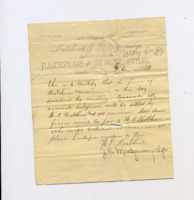
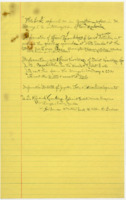
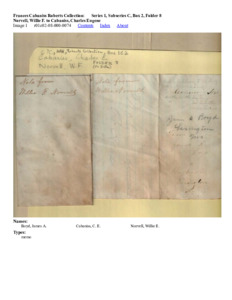
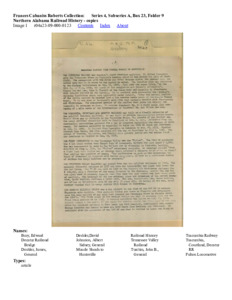
This brief notice states that the firm of Hutchens and Montgomery is dissoved by "mutual consent." It is signed by William Thomas Hutchens and J. E. Montgomery.
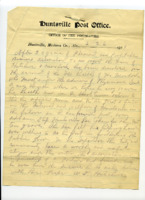
This notice by William Thomas Hutchens written on stationary from the office of the Postmaster describes the dissolving of Hutchens & Murdock due to the "ill health" of Andrew J. Murdock and the recommendation of his physician to "seek a new climate."
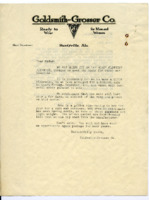
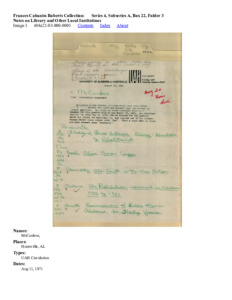
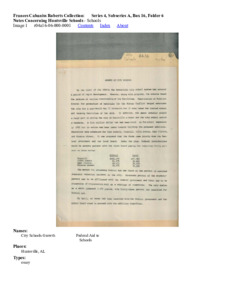
Addressed to "Madam", this letter details a clearance sale on all boys' clothing as it is needing to be cleared out to make room for other merchandise.
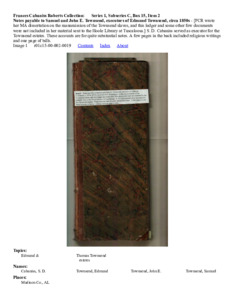
[FCR wrote her MA dissertation on the manumission of the Townsend slaves, and this ledger and some other few documents were not included in her material sent to the Hoole Library at Tuscaloosa.] S. D. Cabaniss served as executor for the Townsend estates. These accounts are for quite substantial notes. A few pages in the back included religious writings and one page of bills.
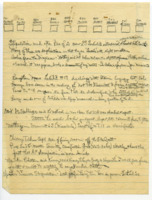
These notes contain detailed information about Dr. Ernest Stuhlinger including his background, experience, training, knowledge of John C. Nickerson, Jr., his thoughts on the Wilson Memo, and the Jupiter missile program.
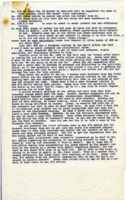
Detailed notes that provide information on Colonel John C. Nickerson's career in the military and involvement with the missile program. The information on Nickerson follows his career up until the disclosure of classified materials that led to his court-martial and trial.
These notes include a summary of the court proceedings, the order in which testimonies were heard or stipulations were read, and a seating chart at the top.
These notes related to Dr. Wernher von Braun's testimony and knowledge of the situation surrounding Colonel Nickerson. It also includes factual information on the missile program and its switch from Army control to Air Force control.
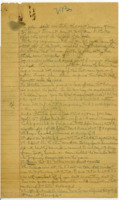
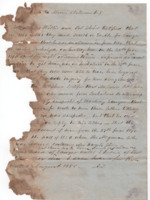
The Note to Moore's Statement was signed A.T., alluding to the possibility that Abner Tate wrote this. The note discusses the testimony of Mrs. Willis and Colonal Sheid regarding a search for Sawyer, one of the murdered men. It traces Sawyer's known whereabouts prior to him going missing. The note claims that A.T. had never heard of Sawyer or Rein, the second victim, until August 1855.
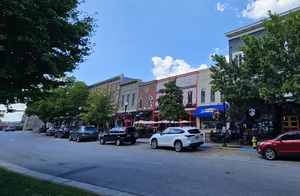
North Side Square, located across from the Huntsville courthouse. This square holds many restaurants and other businesses, acting as a hub for trade in the city.