Presented by Olen P. Ely, National Aeronautics and Space Administration, Marshall Space Flight Center, Huntsville, Alabama and R. W. Hockenberger, International Business Machines. Paper that explores the effects of rocket-engine exhaust on radio-signals.
The first test of the command and communications system, a unified frequency S-band system, aboard AS-501 was successful. Compatibility of this system with the MSFN/USB sites was established. The onboard transponder and antenna system including antenna switching performed as predicted. The command performance was excellent with 5747 valid commands received onboard out of 5748 commands transmitted. Data reduction problems prevented a complete analysis of the tracking data. Telemetry system performance was satisfactory with a measured bit-error-rate of 4 x10⁻⁵ while over the Ascension Island station. This flight provided valuable data which can be used to define vehicle to-ground-station interfaces, to establish attitude constraints during translunar injection, and to improve operational procedures. One more test as successful as the AS-501 test would qualify the system as operational.; May 3,1968.
This glossary contains acronyms and abbreviations commonly found in documentation from the Apollo Program. This glossary is meant to be a tool for historians and other researchers.
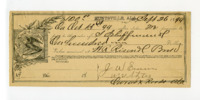
Various documents regarding transactions of different amounts paid by J. W. Erwin and W. V. Styles to S. Schiffman & Co. throughout the year 1899. The final document is a loan form for mules for $409.65.
This paper describes the major highlights or milestones passed in the development of a System Safety Program at MSFC since early 1967. it discusses accomplishments, problems resolved, and decisions made for Apollo Saturn vehicles AS-501 and AS-502, and projects that are to be accomplished on future Saturn vehicles.
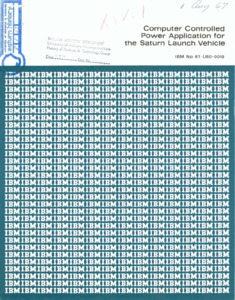
This paper describes a real-time digital computer program that controls the application of electrical power to the S-IVB stage of the Saturn vehicle at Cape Kennedy, Florida. Douglas Aircraft Company, the S-IVB stage manufacturer, provided NASA with the program requirements relative to the energizing sequence, voltage and current measurement tolerances, and vehicle system operational tests. International Business Machines Corporation provided NASA with the computer program to satisfy the task requirements. The program conjoined the components of the Electrical Support Equipment (two RCA 110A computers and control and instrumentation devices) into a closed loop system. The supporting operating system program by IBM is described.