
Browse Items (8242 total)
Sort by:
-
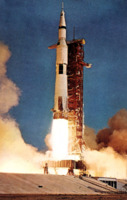
Saturn V Launch
Back: This Is the National Aeronautics and Space Administration's Apollo/Saturn V vehicle, used to place man on the moon. The Saturn V vehicle, developing 7.6 million pounds thrust, was developed under the direction of the NASA-Marshall Space Flight Center, Huntsville, Ala. -
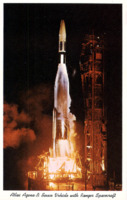
Atlas Agena-B Space Vehicle with Range Spacecraft
Front: Atlas Agena-B Space Vehicle with Ranger Spacecraft
Back: ATLAS AGENA-B SPACE VEHICLE WITH RANGER SPACECRAFT
The Atlas Agena-B space vehicle it shown here with its Ranger spacecraft payload on the pad at Cape Canaveral. Fla. The Atlas Agena-B is being used by NASA to launch the 750-pound Ranger lunar impact missions. The Atlas Agena-B program is managed by the NASA Marshall Space Flight Center, Huntsville, Alabama. -
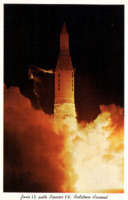
Juno II with Pioneer IV
Front: Juno II, with Pioneer IV, Redstone Arsenal
Back: JUNO II. WITH PIONEER IV, REDSTONE ARSENAL, HUNTSVILLE. ALABAMA
This space-probing vehicle became the first made-in-the-U.S.A. satellite of the sun. Just 40 hours after launching, Pioneer IV sped past the moon and continued on its journey to the sun. Signals were received until it reached a distance of 416,000 miles - farther than any other man-made object had been tracked. -
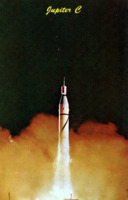
Jupiter C
Front: Jupiter C
Back: JUPITER-C. Huntsville, Ala. This missile was developed in Huntsville, Ala. at the Redstone Arsenal, home of the Army Ballistic Missile Agency. -
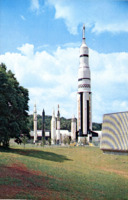
Alabama Space and Rocket Center
Back: ALABAMA SPACE AND ROCKET CENTER
America's Largest Missile and Space Exhibit, Tranquility Base Huntsville, Alabama 35807.
The Alabama Space and Rocket Center is the largest missile and space exhibit in the world. It was dedicated by the citizens of Alabama to those Americans who made it possible for man to walk on the moon and to explore the universe; and to the youth of America who will utilize space technology for the benefit of mankind. -
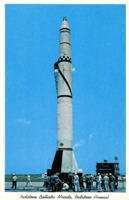
Redstone Ballistic Missile
Front: Redstone Ballistic Missile, Redstone Arsenal
Back: REDSTONE BALLISTIC MISSILE REDSTONE ARSENAL, HUNTSVILLE. ALABAMA
The Army's "Sunday Punch", the Redstone, is a liquid-propelled, surface-to-surface ballistic missile, which can place a nuclear or conventional warhead, with extreme accuracy, on targets up to 200 miles away. The missile is 69 feet long and 70 inches in diameter. -
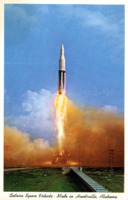
Space Vehicle - Made in Huntsville
Front: Saturn Space Vehicle - Made in Huntsville, Alabama.
Back: NATIONAL AERONAUTICS AND SPACE ADMINISTRATION'S "SATURN" - WORLD'S LARGEST KNOWN ROCKET LAUNCHED FROM CAPE CANAVERAL, FLORIDA ON OCTOBER 27, 1961. -
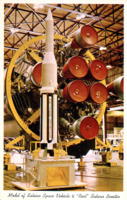
Model of Saturn Space Vehicle & "Real" Saturn Booster
Front: Model of Saturn Space Vehicle & "Real" Saturn Booster.
Back: SCALE MODEL, SATURN SPACE VEHICLE AND "REAL" SATURN BOOSTER
A one-tenth scale model of the Saturn Space vehicle is shown here behind a "real" Saturn booster at the assembly area of the NASA Marshall Space Flight Center, Huntsville, Alabama. The big booster is capable of developing 1.5 million pounds thrust. An assembled vehicle stands 162 feet high. -
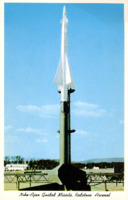
Nike-Ajax Guided Missile
Front: Nike-Ajax Guided Missile, Redstone Arsenal
Back: NIKE-AJAX GUIDED MISSILE, REDSTONE ARSENAL, HUNTSVILLE, ALABAMA
The Army's first supersonic anti-aircraft guided missile designed to follow and destroy the enemy target, regardless of evasive action. The Nike-Ajax system consists essentially of two parts First, an expendable missile; second, an elaborate and highly complex control system requiring approximately 1,400,000 individual parts. It is the first guided missile system to defend American cities against attack. -
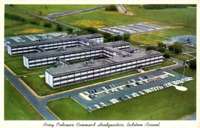
Army Ordnance Command Headquarters, Redstone Arsenal
Front: Army Ordnance Command Headquarters, Redstone Arsenal
Back: THE U. S. ARMY MISSILE COMMAND HEADQUARTERS, REDSTONE ARSENAL, ALABAMA
The Missle Command is responsible for research, design, development, production, maintenance and supply of all Army missiles and rockets. It is a military-civilian team that has pushed the art of missilery rapidly forward. People are the Command's primary resource and their brains and ability are its most precious asset. -
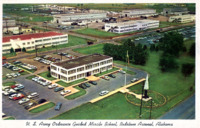
U.S. Army Ordnance Guided Missile School
Front: U. S. Army Ordnance Guided Missile School, Redstone Arsenal, Alabama.
Back: U. S. ARMY ORDNANCE GUIDED MISSILE SCHOOL, REDSTONE ARSENAL, ALABAMA
One of the free world's leading Technical Training Centers valued at $73,000,000. It has trained men from the U. S. Army, Navy, Air Force and Marine Corps and 15 Allied nations to man and maintain a powerful array of new weapons at bases throughout the free world. -
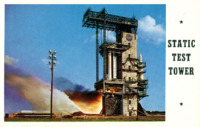
Static Firing Test Tower
Front: Static Test Tower.
Back: STATIC FIRING TEST TOWER, MARSHALL SPACE FLIGHT CENTER
The Saturn booster undergoes static firing at the NASA George C. Marshall Space Flight Center, Huntsville, Alabama. The booster has been successfully static fired many times prior to the launching of the first Saturn from Cape Canaveral, Florida on October 27, 1961. The same tower has been used for Redstone and Jupiter programs. Static testing of a missile consists of locking the missile into place on the stand and firing it. The missile does not "take off", but as it strains against the mighty grip of the great tower its roaring engine can be studied for performance characteristics as if it were actually in flight. -
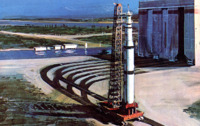
Artist's Conception of Saturn V/Apollo Being Transported on Crawler
Back: Artist's conception of Saturn V/Apollo being transported on crawler the size of a baseball infield, to the launch area at Mila, John F. Kennedy Space Center. The NASA Marshall Space Flight Center at Huntsville, Alabama, has been developing and providing rockets for our space achievements since the very beginning of our entry into this field. -
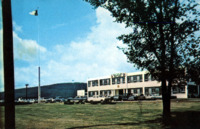
Missile and Maintenance Center and School at Redstone Arsenal
Back: Headquarters and school of the Missile and Maintenance Center and School at Redstone Arsenal near Huntsville, Alabama. -
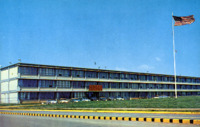
U.S. Army Ordnance Missile Command Headquarters
Back: HEADQUARTERS BUILDING, U.S. ARMY ORDNANCE MISSILE COMMAND
Here all of the U.S. Army's rocket and guided missile and space programs are controlled, under the direction of Maj. Gen. J. B. Medaris. -
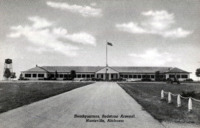
Headquarters, Redstone Arsenal
Front: Headquarters, Redstone Arsenal, Huntsville, Alabama. -
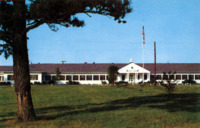
Redstone Aresenal
Back: REDSTONE ARSENAL southwest of Huntsville, Alabama.
Site of the nation's largest ordnance, rocket, and guided missile research. -
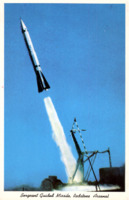
Sergeant Guided Missile
Front: Sergeant Guided Missile, Redstone Arsenal.
Back: SERGEANT GUIDED MISSILE, REDSTONE ARSENAL, HUNTSVILLE, ALABAMA.
Measuring about 30 feet in length, the Army's Sergeant is a surface-to-surface, solid propellant, ballistic guided missile possessing a very high degree of reliability and accuracy. Also highly mobile, it can be quickly emplaced and fired by a very small crew, under all conditions of weather and terrain, delivering a nuclear blow far behind enemy lines. Its highly accurate guidance system is invulnerable to ony known means of enemy counter-measures. -
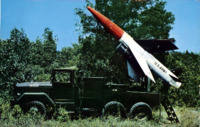
Lacrosse Guided Missile
Back: LACROSSE GUIDED MISSILE, REDSTONE ARSENAL, HUNTSVILLE, ALABAMA.
An Army surface-to-surface artillery guided missile. The Lacrosse system consists of three basic units the missile, which is a solid fuel rocket, a launcher mounted on a standard Army truck, and a guidance station. The Lacrosse is capable of delivering a variety of warheads, at the direction of the combat commander, with precision accuracy. -
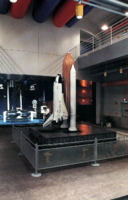
Spacedome Lobby
Back: SPACEDOME LOBBY, Huntsville, Ala. A large Space Shuttle model is dramatically displayed in the lobby of the Spacedome theater which features space and science films. The Spacedome adjoins Earths Largest Space Museum at the Space & Rocket Center.