
Browse Items (56 total)
Sort by:
-
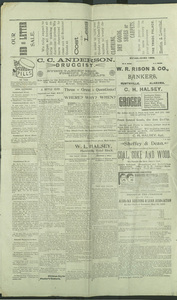
W.L. Halsey and C.H. Halsey grocery store advertisements, 1896.
This is an image of page six of the Weekly Mercury from July 1896. W.L. Halsey and C.H. Halsey advertisements for their grocery stores are featured on this page. Other advertisements on this page include "C.C. Anderson Druggist", "W.R. Rison & Co. Bankers", "Sheffey & Dean", and "Herstein & Lowenthal, Proprietors." -
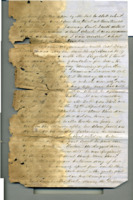
Testimony of a Resident of Elizabeth Routt as Requested by Abner Tate.
The author of this written statement is illegible. It appears that the first name of the author may be Francis but it being so faded, is difficult to discern. The author does state that he was living with Elizabeth Route at the time and managing her plantation, during which he became aquainted with Daniel H. Bingham. The written statement, recorded as the author was "called upon by Mr. Tate to state what my testimony was upon his trial...", details the interaction of the author with Bingham, who wished to marry Mrs. Routt, and Mrs. Routt, beginning in March 1854 through 1855. -
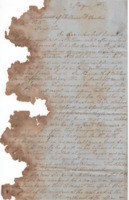
Statement of William W. Sanders addressed to Abner Tate.
In his statement, William W. Sanders details the day Mrs. Hazel claimed to have seen Sawyer's body being burned by Abner Tate's slaves. He tells of how she told the story to him and that he was surprised when she relayed everything to him. Sanders ends by stating he believes Mrs. Hazel charged a "man of excellent character". -
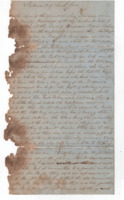
Statement of Sarah Pool.
The statement of Sarah Pool tells of her encounter with Mrs. Hazel in 1845 in Mississippi. She details the "strange stories" told by Mrs. Hazel and how she accused Mrs. McDavid of stealing and had "opened her bundle," a reference made in William Conner's letter to Abner Tate, that supposedly contained some medicines. Mrs. Hazel then asked Sarah to convey the story to Mrs. McDavid to which Sarah said Mrs. McDavid acted surprised at the accusations. Sarah also tells how Mrs. Hazel spoke of Mr. Tate and his right hand man involved in the murder of a man who she could not name. -
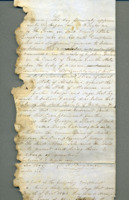
Statement Letter of D. H. Bingham.
This is the statement of Daniel H. Bingham taken in December of 1855 regarding a murder that occurred in Alabama that occured in 1842. In his statement, D. H. Bingham accuses Abner Tate of the murder of one Jonathan K. Rier of Tuscaloosa. He also accuses Tate's slave, George Cabiness, of aiding and abetting in the committing of the crime. Following Bingham's statement, a statement of support is taken from Barbara Hazel placing a "stranger" in the home of Abner Tate the night of the murder. The next page is a second statement given by D. H. Bingham regarding the murder of Charles B. Sawyer of Coffee County, Tennessee and accusing Abner Tate and his slave, George Cabiness of the crime. His statement is followed by the witness, Barbara Hazel's statement that placed the victim in the home of Abner Tate. -
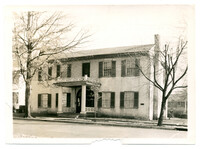
Snapshot of the Weeden House.
The Weeden House is located at 300 Gates Avenue in downtown Huntsville. The house underwent restoration in the 1970s and is now a historic house museum and garden open to the public. -
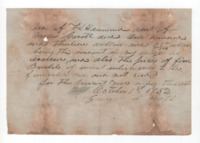
Receipt of George W. Scott.
This receipt is from October 1, 1852 and notes Scott's wages and the price of wheat bushels. -
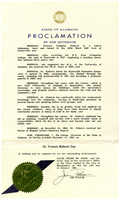
Proclamation from Gov. Jim Folsom announcing December 12, 1993 as Dr. Frances Roberts Day.
Folsom issued the proclamation on the same day that Roberts received an honorary doctorate from the University of Alabama in Huntsville. The text of the proclamation commends Roberts' service to the university and the community, noting that "Dr. Roberts combined her job of teaching, research and service with a much broader sense of responsibility which led her to do above and beyond what she was asked." -
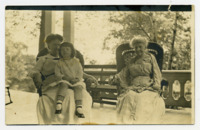
Postcard of a woman, possibly Virginia Clay-Clopton, and companions.
The back of this real photo postcard reads, "Virginia Clay Clopton, age 90." -
-
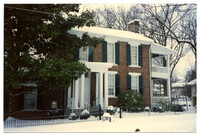
Photograph of the Cabaniss House in the snow.
The house is located at 603 Randolph Avenue in downtown Huntsville. Frances Roberts lived there for much of her adult life. -
-
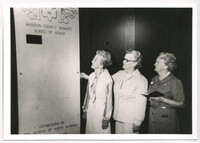
Photograph from the inaugural Madison County Women's Scroll of Honor ceremony.
Frances Roberts, shown at center, was named to the Madison County Women's Scroll of Honor in 1976. According to the Huntsville Times, recipients of the honor "are native to or identified most closely with Huntsville and Madison County and who have made significant contributions within their professional fields of activity or concern." Roberts was honored alongside Huntsville artist and poet Maria Howard Weeden (1847-1905). The award is a project of the Girl Scouts of North-Central Alabama. -
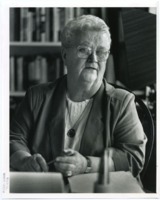
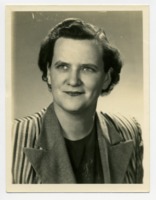
Photo of Frances C. Roberts.
Photo from the Huntsville Times. The photo was taken for an article about the honorary doctor of humane letters that Roberts received from UAH on December 12, 1993. -
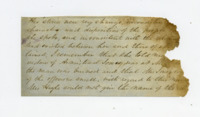
Partial statement of John P. Pool.
In these pieces of John's statement, John corroborates that which his wife Sarah said in her statement. The small pieces of paper detail the strange stories told by Mrs. Hazel that were out of character and not representative of the people she spoke of. He also mentions what she stated of the murder of the man she cannot name and how a Mrs. Jones assisted by covering the "offensive smell." He also writes of Mrs. Hazel's accusations of Mrs. McDavid stealing her money and medicines. In the larger piece, John Pool brings up the porch location that she supposedly witnessed the murdered man from. -
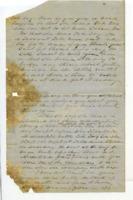
Partial deposition and court questions.
This page is most likely missing a few pages. The front details someone's statement, though the author is unknown. It tells of phrases spoken by Abner Tate that were overheard by Mrs. Hazel. The botton of the page inquires what the author/interviewee would think if they heard such phrases. The last line appears to have the initials S. D. G. that may be the author of the page. The back side includes questions 13 through 18 that were most likely asked in court. -
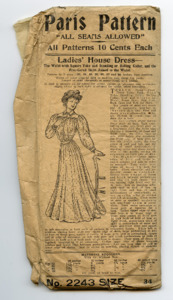
Paris Pattern no. 2243, Ladies' House Dress.
Made for a size 34-inch bust, this house dress pattern includes pieces for "The Waist with Square Yoke and Standing or Rolling Collar, and the Five-Gored Skirt Joined to the Waist." The front of the pattern envelope lists all instructions for the construction of the garment as well as material required. The pattern pieces are unprinted. -
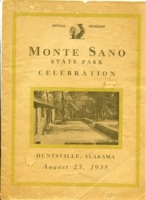
Official program of the Monte Sano State Park Celebration.
This celebration was held on the park's opening day. Events included a parade, an address given by Speaker of the U.S. House of Representatives William B. Bankhead, a history pageant, and a "Queen's Ball" that evening at the Russel Erskine Hotel. The program includes a description of the cabins, the "Legend of Monte Sano," a history of Huntsville, and a program for the history pageant, titled "The Parade of Progress." -
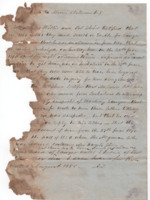
Note to Moore's Statement.
The Note to Moore's Statement was signed A.T., alluding to the possibility that Abner Tate wrote this. The note discusses the testimony of Mrs. Willis and Colonal Sheid regarding a search for Sawyer, one of the murdered men. It traces Sawyer's known whereabouts prior to him going missing. The note claims that A.T. had never heard of Sawyer or Rein, the second victim, until August 1855. -
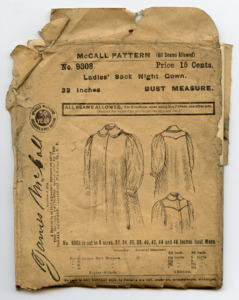
McCall Pattern no. 9308, Ladies' Sack Night Gown.
Made for a size 32-inch bust, this nightgown pattern includes five pieces for the front, back, collar, sleeve, and sleeveband. The pattern does not include pieces for the yoke. The front of the pattern envelope lists the material required for each size, and the back describes garment construction. The pattern pieces are unprinted.