Browse Items (56 total)
Sort by:
-
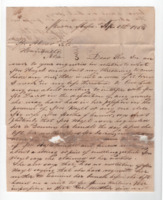
Letter to Abner Tate from William Conner.
This letter is William M. Conner's statement as written to Abner Tate. In this statement, Conner refutes Mrs. Hazel's testimony stating that he has never threatened to "cow hide" anyone. Furthermore, Conner writes that his wife "says most positively" that Mrs. Hazel never requested her to "examine her bundle the day before she left her mother's." -
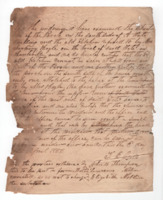
Desposition of T. O. Gill
The deposition of T. O. Gill. In his statement, Gill calls for a retrial at this document certifies that despite Mrs. Hazel's statement, Abner Tate's kitchen could not be seen from any part of the porch. The statement further details other areas of the house pertaining to the witness's statement. -
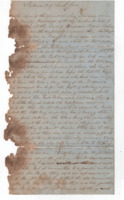
Statement of Sarah Pool.
The statement of Sarah Pool tells of her encounter with Mrs. Hazel in 1845 in Mississippi. She details the "strange stories" told by Mrs. Hazel and how she accused Mrs. McDavid of stealing and had "opened her bundle," a reference made in William Conner's letter to Abner Tate, that supposedly contained some medicines. Mrs. Hazel then asked Sarah to convey the story to Mrs. McDavid to which Sarah said Mrs. McDavid acted surprised at the accusations. Sarah also tells how Mrs. Hazel spoke of Mr. Tate and his right hand man involved in the murder of a man who she could not name. -
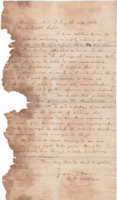
Letter from H. G. Wellborn to her uncle.
Wellborn writes to her uncle requesting information on the case of her "Pa", Abner Tate, who was arrested and tried for murder. She informs her uncle that there was a supposed detailed report in a Huntsville publication but couldn't get her hands on a copy. She concludes by writing of their temporary living arrangements just outside of Memphis, Tennessee. -
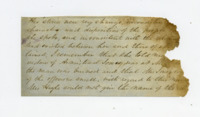
Partial statement of John P. Pool.
In these pieces of John's statement, John corroborates that which his wife Sarah said in her statement. The small pieces of paper detail the strange stories told by Mrs. Hazel that were out of character and not representative of the people she spoke of. He also mentions what she stated of the murder of the man she cannot name and how a Mrs. Jones assisted by covering the "offensive smell." He also writes of Mrs. Hazel's accusations of Mrs. McDavid stealing her money and medicines. In the larger piece, John Pool brings up the porch location that she supposedly witnessed the murdered man from. -
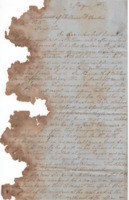
Statement of William W. Sanders addressed to Abner Tate.
In his statement, William W. Sanders details the day Mrs. Hazel claimed to have seen Sawyer's body being burned by Abner Tate's slaves. He tells of how she told the story to him and that he was surprised when she relayed everything to him. Sanders ends by stating he believes Mrs. Hazel charged a "man of excellent character". -
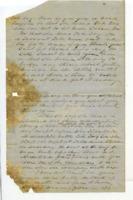
Partial deposition and court questions.
This page is most likely missing a few pages. The front details someone's statement, though the author is unknown. It tells of phrases spoken by Abner Tate that were overheard by Mrs. Hazel. The botton of the page inquires what the author/interviewee would think if they heard such phrases. The last line appears to have the initials S. D. G. that may be the author of the page. The back side includes questions 13 through 18 that were most likely asked in court. -
Depositions of Daniel Curry and Polly Curry.
The depositions include the questions asked and the answer. Daniel Curry's deposition is first. The questions regard Elizabeth Routt and her husbands, particularly her third, Alexander Jeffries, whom Daniel Curry knew well. He details his death, claiming he saw him the day he died and he did not appear sick at that time. Later questions interrogate Curry about Routt's character and ability to murder her husbands. Polly Curry was asked the same questions as her husband. Her responses were similar. She stated that Routt was well thought of prior to the death of her third husband, Jeffries, the lost her good standing after that. Polly adds that she heard Routt say that she was glad her second husband was dead following his death and that she wished her last husband, Mr. Routt, was also dead so she could "live in peace." She also includes the rumors that Mrs. Routt was "too intimate" and charged with sleeping with two of her slaves, and had stolen cotton previously. -
Deposition of Dr. Gabriel S. Davies.
As a witness for the defendant, Abner Tate, Dr. Davies' deposition includes a list of the questions asked and the corresponding answers on the blue document. Davies is asked about Elizabeth Routt and her husbands, particularly Alexander Jeffries. Dr. Davies is asked his professional medical opinion about the cause of death to which he states was believed to be from "inflamation of the stomach and perhaps the bowels." Dr. Davies also states that he believed him to have been sick approximately six to eight weeks. He also compares the symptoms of Jeffries and Brown, Routt's fifth husband. -
Depositions of William Ashworth and Thomas O. Gill.
Ashworth and Gill are witnesses for the defendant, Abner Tate. Ashworth's deposition is first. He answers questions regarding Elizabeth Routt and her husbands, particularly of her character and what others said and thought of her. He includes at the end that he has heard of her destroying the lives of her husbands, stealing cotton by way of her slaves, and was accused of having one of her slaves shoot Abner Tate. Thomas O. Gill's deposition follows. He is asked about Elizabeth Routt and her husbands as well, including her character and what others said and thought of her. Gill also confirms hearing of the "great many charges alleged against her." Gill is then cross examined by the plantiff's, Elizabeth Routt, counsel. He is asked whether the charges against her character are of his knowledge or the publics'. Gill names those whom he heard the information from and admits that the charges were rumors rather than facts. He also details the pamphlet written by Abner Tate that he received from an unknown sender. He was also asked about the sicknesses of Routt's husbands and the attending physicians which he was unable to answer. -
Depositions of Joseph Whitaker and Newton Whitaker.
The Whitakers were witnesses for the defendant, Abner Tate. Joseph Whitaker's deposition is first. He answers questions regarding Elizabeth Routt and her husbands, particularly the death of Alexander Jeffries. Joseph states that it is his opinion that Jeffries was poisoned. He also states that rumors have spread that she had ordered a slave to murder Abner Tate. Newton Whitaker's desposition is second. He also answers questions regarding Elizabeth Routt and her husbands, including the death of Alexander Jeffries. Newton states that he is also of the opinion that Jeffries was poisoned. Like Joseph, he also adds that she is said to have destroyed the lives of her husbands, stole cotton, and sought to harm Abner Tate. -
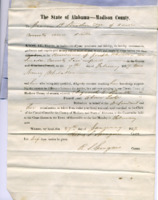
Deposition of Nancy Whitaker.
Nancy Whitaker acted as a witness for the defendant, Abner Tate. Nancy responds to questions about Alexander Jeffries, her father, and Elizabeth Routt. She expresses her belief that her father was poisoned by Routt though she was not present until the morning after he died. Nancy details the dark color of her father's body and how it was swollen and "unnatural" in appearance. She also includes the rumors she has heard regarding several charges brought against Routt. She concludes by stating that it is her opinion that Routt is guilty in the case of her father's death. -
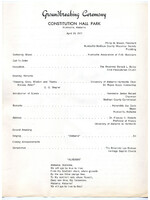
"Groundbreaking Ceremony: Constitution Hall Park."
Speakers included James Record, Frances Roberts, and Huntsville Mayor Joe Davis, with an invocation by Rev. Donald L. Bailey and a benediction by Rev. Lee Hudson. The program includes a map of Constitution Hall Park. -
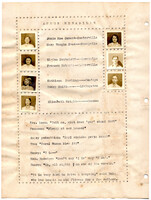
Excerpt from the Livingston High School "Annus Mirabilis" yearbook, 1932.
This page includes the photo of Frances Roberts, who later became a UAH history professor and the namesake of Roberts Hall. Roberts was a Senior II, or a junior, in high school at the time of this yearbook's printing. -
-
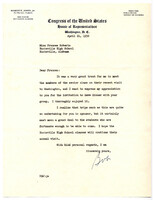
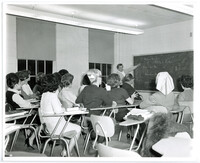
Letter from Rep. Bob Jones in Washington, D.C. to Frances Roberts in Huntsville, Alabama.
In this letter, Jones thanks Roberts, then a history teacher at Huntsville High School, for the opportunity to meet her students on their recent trip to Washington, D.C. -
-
-
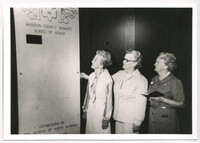
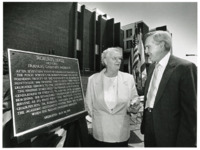
Photograph from the inaugural Madison County Women's Scroll of Honor ceremony.
Frances Roberts, shown at center, was named to the Madison County Women's Scroll of Honor in 1976. According to the Huntsville Times, recipients of the honor "are native to or identified most closely with Huntsville and Madison County and who have made significant contributions within their professional fields of activity or concern." Roberts was honored alongside Huntsville artist and poet Maria Howard Weeden (1847-1905). The award is a project of the Girl Scouts of North-Central Alabama. -