
Browse Items (56 total)
Sort by:
-
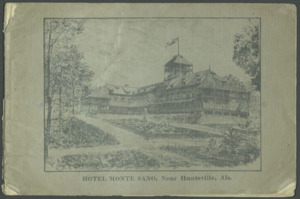
"HOTEL MONTE SANO, Near Huntsville, Ala."
This pamphlet announces the opening of the Hotel Monte Sano on June 1, 1887 and lists the manager as "Mr. S.E. Bates." The first section of the pamphlet includes a brief history of Huntsville and a description of the city's amenities. The author extolls the health advantages of Huntsville as "most healthfully situated at the base of Monte Sano" and describes the city's lack of recent disease outbreaks. The second section of the pamphlet details the Hotel Monte Sano's furnishings and amenities. The author emphasizes the "healthful" environs of the mountain and the hotel and includes letters from Huntsville's "eminent physicians" as testimonials. The pamphlet includes illustrations of scenes from Huntsville and Monte Sano. -
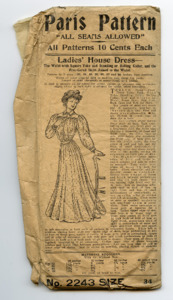
Paris Pattern no. 2243, Ladies' House Dress.
Made for a size 34-inch bust, this house dress pattern includes pieces for "The Waist with Square Yoke and Standing or Rolling Collar, and the Five-Gored Skirt Joined to the Waist." The front of the pattern envelope lists all instructions for the construction of the garment as well as material required. The pattern pieces are unprinted. -
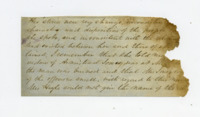
Partial statement of John P. Pool.
In these pieces of John's statement, John corroborates that which his wife Sarah said in her statement. The small pieces of paper detail the strange stories told by Mrs. Hazel that were out of character and not representative of the people she spoke of. He also mentions what she stated of the murder of the man she cannot name and how a Mrs. Jones assisted by covering the "offensive smell." He also writes of Mrs. Hazel's accusations of Mrs. McDavid stealing her money and medicines. In the larger piece, John Pool brings up the porch location that she supposedly witnessed the murdered man from. -
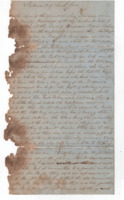
Statement of Sarah Pool.
The statement of Sarah Pool tells of her encounter with Mrs. Hazel in 1845 in Mississippi. She details the "strange stories" told by Mrs. Hazel and how she accused Mrs. McDavid of stealing and had "opened her bundle," a reference made in William Conner's letter to Abner Tate, that supposedly contained some medicines. Mrs. Hazel then asked Sarah to convey the story to Mrs. McDavid to which Sarah said Mrs. McDavid acted surprised at the accusations. Sarah also tells how Mrs. Hazel spoke of Mr. Tate and his right hand man involved in the murder of a man who she could not name. -
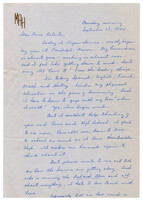
Letter from Martha Holliman in Lynchburg, Virginia, to Frances Roberts in Huntsville, Alabama.
Holliman was one of Roberts' students at Huntsville High School. She describes her first days at Randolph-Macon College and thanks Roberts for her excellent teaching. -
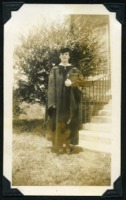
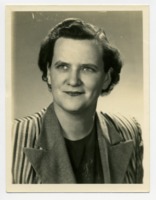
Frances C. Roberts at the time of her graduation from Alabama State Teachers College in Livingston, Alabama.
Roberts received a Bachelor of Science from Alabama State Teachers College in 1937. The college is known today as the University of West Alabama. -

-
-
-
-
-
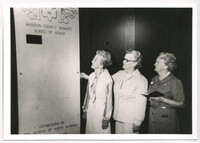
Photograph from the inaugural Madison County Women's Scroll of Honor ceremony.
Frances Roberts, shown at center, was named to the Madison County Women's Scroll of Honor in 1976. According to the Huntsville Times, recipients of the honor "are native to or identified most closely with Huntsville and Madison County and who have made significant contributions within their professional fields of activity or concern." Roberts was honored alongside Huntsville artist and poet Maria Howard Weeden (1847-1905). The award is a project of the Girl Scouts of North-Central Alabama. -
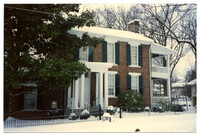
Photograph of the Cabaniss House in the snow.
The house is located at 603 Randolph Avenue in downtown Huntsville. Frances Roberts lived there for much of her adult life. -
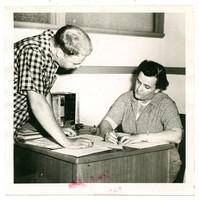
-
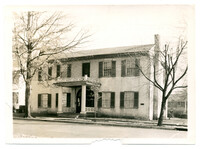
Snapshot of the Weeden House.
The Weeden House is located at 300 Gates Avenue in downtown Huntsville. The house underwent restoration in the 1970s and is now a historic house museum and garden open to the public. -
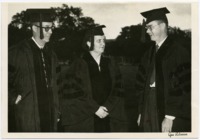
Frances C. Roberts at commencement at the University of Alabama.
This photo was taken at the time of Roberts' doctoral graduation from the University of Alabama in Tuscaloosa, Alabama. She was the first woman to receive a Ph.D. in history from the University of Alabama. On either side of her are Howard C. Elliot, Jr., Ph.D. in biochemistry, and Elmer Dean Calloway, Ph.D. in chemistry. -
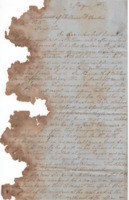
Statement of William W. Sanders addressed to Abner Tate.
In his statement, William W. Sanders details the day Mrs. Hazel claimed to have seen Sawyer's body being burned by Abner Tate's slaves. He tells of how she told the story to him and that he was surprised when she relayed everything to him. Sanders ends by stating he believes Mrs. Hazel charged a "man of excellent character". -
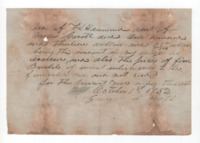
Receipt of George W. Scott.
This receipt is from October 1, 1852 and notes Scott's wages and the price of wheat bushels. -
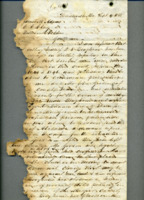
Letter to James M. Adams, C. C. Clay, and William Acklen from Abner Tate.
This letter, written on September 4, 1855, contains information regarding several murders the occurred at the [sic] House between 1841 and 1846, as reported by D. H. Bingham. He further details the arrest and imprisonment of a Mr. John Gordon in relation to the murders, and his appearing in court. Possible information regarding the burial of the murdered men are offered in the letter as well. The letter ends with Abner Tate discussing the validity of certain confessions as many "delight" in "destroying the reputations of others." -
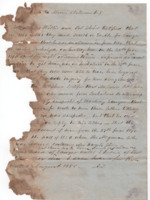
Note to Moore's Statement.
The Note to Moore's Statement was signed A.T., alluding to the possibility that Abner Tate wrote this. The note discusses the testimony of Mrs. Willis and Colonal Sheid regarding a search for Sawyer, one of the murdered men. It traces Sawyer's known whereabouts prior to him going missing. The note claims that A.T. had never heard of Sawyer or Rein, the second victim, until August 1855.