
Browse Items (215 total)
Sort by:
-
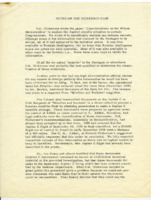
"Notes on the Nickerson Case."
A typed version and the andwritten notes regarding the Nickerson case. The author is unknown. These notes regard Nickerson's "Considerations on the Wilson Memorandum" and more. -
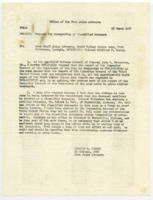
"Request for Downgrading of Classified Document."
On behalf of the defense counsel, Charles R. Zimmer writes to the Army Staff Judge Advocate, Colonel Clifford F. Cordes, to request that the report of the Inspector General of the Department of the Army be downgraded from classified to unclassified. Zimmer states that he feels without this document being accessible to the defense counsel, the "defense in this case is being hampered." -
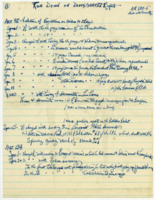
"Run Down on Department of Army IG Report."
Various handwritten notes on the Army missile program and other information pertaining to the case of Colonel John C. Nickerson, Jr. -
"Senior Officers Debriefing Program."
A conversation between Lieutenant General Austin W. Betts, Colonel Henk, and Colonel Wahle, published as a part fo the US Army Military History Research Collection. This conversation details the "Army versus the Air Force difficulties in the late '50's" during the transfer of the missile and space program. This program switch was the basis of the case United States v. Colonel John C. Nickerson, Jr. as Nickerson was in charge of the program. This document contain only the portion relative to Colonel Nickerson. -
"Senior Officers Oral History Program."
A project of the U.S. Army Military History Institute, this contains the interview of Dr. John L. McDaniel by Lieutenant Colonel Joseph W. Camp, Jr. from 1985. The interview is about the US Army's first satellite into space. McDaniel brings up the case of Colonel Nickerson relative to the interview. This document contains only the portion of the interview that mentions Colonel Nickerson. -
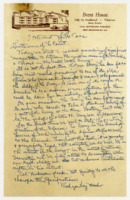
"Statement of the Case."
Addressed to the "Gentlemen of the court", this statement outlines the reason for the trial and ends stating, "Colonel Nickerson pleads not guilty to all the charges and specifications." -
"Summary of Investigation Testimony in Nickerson Case."
This is the summary of the testimony of a witness in the Nickerson case. He is referred to as "B" throughout the document. -
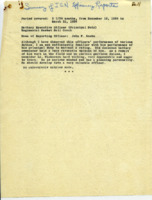
"Summary of JCN Efficiency Reports."
Written by John F. Roehm, this report covers a summary of reports of Colonel John C. Nickerson, Jr.'s efficiency from his former Battery Executive Officer and regimental basketball boach. -
"Summary of Pre-Trial Investigation Testimony in Nickerson Case."
A list of potential witnesses to give testimony as related to certain important aspects of the case including Nickerson's character and Nickerson's testimony as it stands prior to the trial. -
"Trial Panel or Court."
List of names, locations, and credentials of those who are a part of the trial panel in the case of United States vs. John C. Nickerson, Jr. -
Acknowledgment of receipt of documents from John C. Nickerson, Jr. to Charles R. Zimmer.
This letter acknowledges the receipt of a letter, an envelope for delivery, two courtesty copies, and a carbon copy of various letters. -
Argument of Robert K. Bell before the General Court-Martial in the case of United States v. Colonel John C. Nickerson, Jr.
Argument of Robert K. Bell before the General Court-Martial at Redstone Arsenal in defense of Colonel John C. Nickerson, Jr. Nickerson plead guilty and Bell's testimony was present in an effort to "extenuate or mitigate whatever he might have done." Bell calls Nickerson's judgment "bad" and his actions "unfortunate" and "careless" but argues that he is not disloyal, disobedient, or promoting his own welfare above that of the Army or national security. -
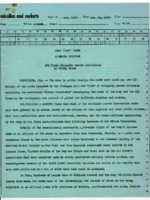
Article from Missiles and Rockets publication.
This article, "Army 'Leak' Probe Agitates Redstone", published in the February 1957 issue, details secret information that went public in 1957 through Drew Pearson. The "leak" concerns the "Wilson Memorandum" that transfers the Army's role to the Air Force in the development and control of guided and ballistic missiles and rockets. The leak is traced back to Colonel John C. Nickerson, Jr. The article states that the "prevailing opinion is that Col. Nickerson is being made a scapegoat by persons very high up in the Army." The article further details the events that led to the court martial of Colonel Nickerson. -
Character testimony of unknown person.
This character testimony has no known author nor is it clear of whom the author is speaking about. -
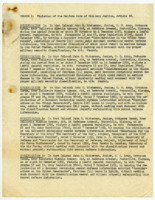
Charge I and Charge II brought against Colonel Nickerson.
Detailed information regarding the two charges brought against Colonel John C. Nickerson, Jr. and the corresponding specifications. -
Colonel John C. Nickerson, Jr. clarification of actions took.
To clarify his intentions of the actions he took that led him to be court-martial, John C. Nickerson, Jr. writes a detailed document outlining three points. This set of documents includes two drafts of his message. -
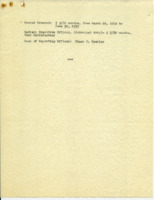
Compilation of reports on Colonel John C. Nickerson, Jr.
This compilation covers periods in Nickerson's career from 1939 to 1953. In includes various reporting officers writing of Nickerson's character, actions, and command. -
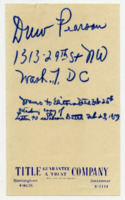
Contact information for Drew Pearson.
Handwritten contact information for Drew Pearson. Pearson was the journalist whom make Nickerson's classified documents public. -
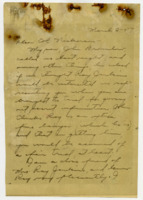
Correspondence between Colonel John C. Nickerson, Jr. and Margaret C. Brownlow.
Brownlow writes to give Nickerson the name of someone that would be interested in his case, Ray Jenkins, who would eventually join Nickerson's defense counsel with Robert K. Bell, along with two others. Nickerson responds, thanking Brownlow for the information. He expresses concern over financially securing Jenkins for his defense but hopes that Brownlow could still arrange a meeting in Knoxville, Tennessee. The third letter is a rough draft of Nickerson's response. Brownlow's second letter responds that she was able to get in touch with Ray Jenkins and left him with materials to read on Nickerson's case. Brownlow states she would get back to Nickerson as soon as he says "yes". -
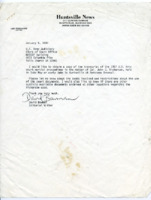
Correspondence between David Bowman and Mary B. Dennis.
Bowman writes to the U.S. Army Judiciary Clerk of Court Office to request a copy of the transcript of the Nickerson court martial proceedings. Mary B. Dennis, Deputy Clerk of Court responds that a large portion is classified and asks if he wants that material reviewed towards declassification though it would be a lengthy process. She also guides him towards other "publicably available documents" regarding the case. The following letters from Dennis regards the review of the classified transcripts of the Nickerson case and more details about the record of the trial. Bowman's second letter includes a check to pay for the transcripts and the review of the classified material. Dennis writes several more letters regarding more classified prosection exhibits and that Bowman's request to review the classified material has been denied. The final letter is the memo that states that the review has been denied from Deputy Director Robert J. Monahan.