
Browse Items (215 total)
Sort by:
-
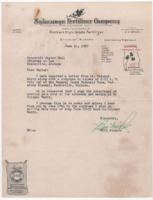
Letter to Robert K. Bell from William Nichols.
Nichols writes to Bell to inform him of the supoena he received to appear in court on July 2nd. He states that he will proceed as requested unless he hears from Bell with other instructions. -
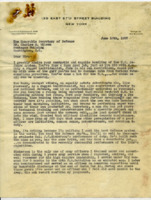
Letter to Secretary of Defense Charles E. Wilson from J. Bancroft Webster.
Webster writes saying he thinks Wilson does a good job running the nation's defense system and because of that, Webster asks Wilson to evaluate Nickerson's performance of duty and would feel "thoroughly disillusioned to see such a 1st class officer sacked." -
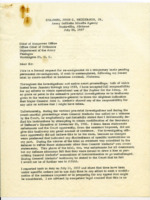
Letter to the Chief of Manpower Office from Colonel John C. Nickerson, Jr.
Nickerson writes to the Chief of Manpower requesting a re-assignment on a temporary basis following his recent trial by court-martial at Redstone Arsenal in Huntsville, Alabama. Nickerson reported back to duty on July 11, 1957 and writes that his newly assigned duties are "of relatively no importance to the Army of to ABMA." Nickerson requests a new assignment that allows him back at Redstone Arsenal. -
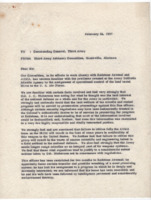
Letter to the Commanding General, Third Army, from the Third Army Advisory Committee.
This letter details the committee's agreement with Nickerson's actions, believing he was acting "for what he thought was the best interest of the national defense." They advocate for the inclusion of the Army Ballistic Missile Agency team on the intermediate-range ballistic missile program. The committee states that trial by court-martial would not reflect the many accomplishments Nickerson has made for the Army weapon program and feel it unnecessary. -
Letter to the Commanding General, Third Army.
In this letter, it is requested that May 13-17, 1957 be set as the dates of the Nickerson trial. It then details the reasons for these specific dates. -
Letter to the Commanding General, Third United States Army from the Defense Counsel.
The Defense Counsel writes to the Commanding General, Third United States Army requesting "top secret clearance for all members of the General Court Martial, the Court Reporter, and the Civilian Counsel n the case of Colonel John C. Nickerson, Jr." -
Letter to the Commanding General, Third United States Army from the Defense Counsel.
This letter from the Defense Counsel requests a continuance of the trial of Colonel John C. Nickerson due to the counsel still waiting on a response to their request for top secret clearance for access to pertinent information for the trial and the delay of the release of the pre-trial investigation to the civilian defense counsel. A letter from John Nickerson follows, detailing how without top secret clearance, he is unable to provide his civilian counsel with "essential components of the real issues in my defense without divulging information that is now classified." Multiple copies are included. -
Letter to the Commanding General, Third United States Army, from Ray H. Jenkins.
Jenkins writes to Major General Crump Gavin citing his personal reasons why the Commanding General should approve the defense counsel's request for a continuance. -
Letter to the Commanding General, Third United States Army, from the defense counsel.
The Defense Counsel writes to the Commanding General, Third United States Army, requesting a continuance of trial of Colonel John C. Nickerson, Jr., citing the failure of the government to approve their request for top secret clearance as the reason. The defense counsel details how the clearance is vital to Nickerson's defense. -
Letter to the Commanding General, Third United States Army, from the Defense Counsel.
This letter is the first request of a continuance of the trial of Colonel John C. Nickerson, Jr. by the defense counsel due to waiting on top secret clearance for information pertinent to the case and other various reasons. -
Letter to the defense counsel from John E. Moss.
Moss writes in response to the defense counsel's request of March 25, 1957 for information from the House Government Information Subcommittee. Moss states that all published hearings and reports on the subject are being mailed separately. -
Letter to Walter Emmett Perry from Robert K. Bell.
The defense counsel believes that the Commanding General or Convening Authority is both the accuser and the reviewer in the proceeding. Bell asks Perry in this letter for any "citations" on that particular point. -
Letter to William G. Barry from Charles R. Zimmer.
Zimmer writes to Lt. Colonel Willaim G. Barry with the stipulations that will not be accepted in the case of Colonel John C. Nickerson. -
Letter to William G. Barry from the Defense Counsel.
This letter requests a pre-trial conference be held on the 26th or 27th of April, 1957. -
Letter to William Nichols from William G. Barry.
This letter requests William Nichols to be present at the trial as a defense witness and a written statement from Nichols to detail what his testimony would be. The letter includes questions for Nichols to answer in the written statement. -
Letter to William Nichols from William G. Barry.
Letter requests William Nichols' presence at the trial of Colonel John C. Nickerson, Jr. It also includes questions Nichols is to answer in a written statement and an anticipated range of dates he will be expected to give his testimony in court. -
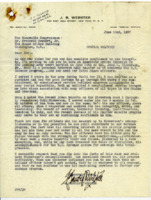
Letters from J. Bancroft Webster.
Webster sends three copies of the same letter to Congressman Frederic Coudert, Jr., Senator Irving M. Ives, and Secretary of the Army Wilber M. Brucker, asking them to take "an immediate active interest in the pending army court martial" of Colonel John C. Nickerson. He testifies to Nickerson's character and his value to the national defense system. -
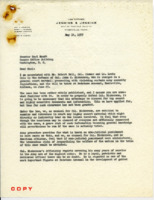
Letters to senators in Washington D.C. from Ray Jenkins.
Ray Jenkins sends the same letter to various senators in Washington D.C. in an effort to speed up the approval of top secret clearance for the defense counsel and advocate for non-judicial punishment for Colonel Nickerson rather than court-martial. He summarizes Nickerson's efficiency reports as well. Jenkins concludes by asking if the senator would convey the message and thinking of the defense counsel to the Secretary of Defense, Mr. Wilson. -
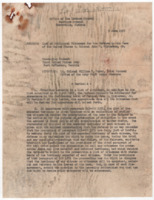
List of additional witnesses for the defense of Colonel John C. Nickerson, Jr.
This submitted list of additional witness was in addition to the list submitted on April 25, 1957. -
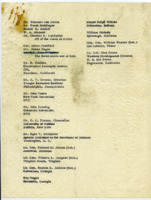
List of names pertaining to the Nickerson case.
List of names include Dr. Wernher von Braun, Dr. Ernest Stuhlinger, Lt. Gen. Edward M. Almond, Mayor Ralph Wiltsie, and more.