
Browse Items (215 total)
Sort by:
-
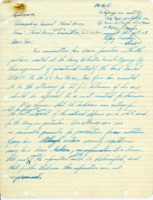
Drafts of letter to the Commanding General, Third Army from the Third Army Advisory Committee.
In response to the "problem created at the Army Ballistic Missile Agency" that would eventually lead to Colonel Nickerson's referral to a court-martial, the Third Army Advisory Committee writes this letter to inform the Commanding General that one of them, Robert K. Bell, had consented to being Nickerson's attorney as they see Nickerson's actions as being in the best interest of the national defense and Army. -
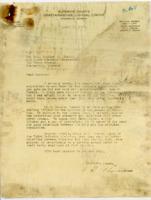
Letter to Lt. Col. Charles R. Zimmer from J. R. Thompson.
Thompson answers Zimmer's request for information about two colonels and Major General Powell. While Thompson states he is not acquainted with the two colonels, he does provide a personal evaluation of the character of Major General Powell. -
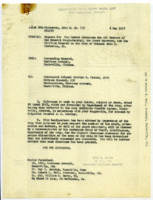
Response to the request for top secret clearance in the case of Colonel John C. Nickerson, Jr.
The request of March 28, 1957 asks for top secret clearance for the members of the General Court-Martial, the Court Reporter, and the Civil Counsel as classified information is vital to the defense of Colonel Nickerson. This letter from Lt. Col. John S. Tyler states that the request was forwarded to the Army Ballistic Missile Agency and that the request would be cleared for the "highest clearance necessary for the proper disposition of the case". -
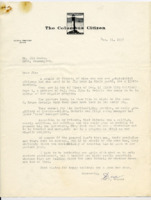
Letter to Jim Lucas from Don E. Weaver.
In this letter, Weaver writes to Lucas about concerns regarding Major Jeneral John B. Medaris. Weaver states that "according to my friends�Medaris was a selfish, overly ambitious and ruthless man who would stop at nothing to promote his own interests." -
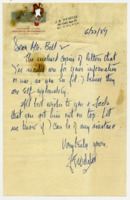
Handwritten letter to Robert K. Bell from J. B. Webster.
Webster writes to wish Bell and Nickerson good luck in the case and send copies of letters that may have information useful to the defense of Nickerson. -
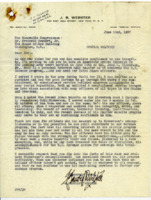
Letters from J. Bancroft Webster.
Webster sends three copies of the same letter to Congressman Frederic Coudert, Jr., Senator Irving M. Ives, and Secretary of the Army Wilber M. Brucker, asking them to take "an immediate active interest in the pending army court martial" of Colonel John C. Nickerson. He testifies to Nickerson's character and his value to the national defense system. -
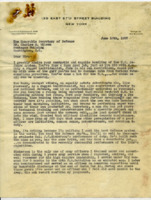
Letter to Secretary of Defense Charles E. Wilson from J. Bancroft Webster.
Webster writes saying he thinks Wilson does a good job running the nation's defense system and because of that, Webster asks Wilson to evaluate Nickerson's performance of duty and would feel "thoroughly disillusioned to see such a 1st class officer sacked." -
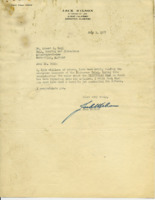
Letter to Robert K. Bell from attorney Jack Wilson.
Wilson writes to Bell to congratulate him on the Nickerson case and states that he has been "avidly reading the newspaper accounts of the Nickerson trial" but still believes that Bell did a "terrific" job defending Colonel Nickerson. -
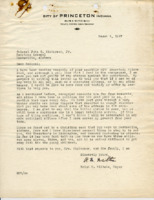
Letter to Colonel John C. Nickerson, Jr. from Mayor Ralph M. Wiltsie.
Mayor Wiltsie writes to Nickerson in his defense, asking if he can be of any help in the trial such as testifying or giving a character witness. -
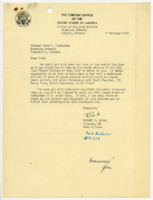
Letter to Colonel John C. Nickerson, Jr. from Colonel Robert C. Works.
Works expresses sympathy toward Nickerson and the situation he is in asking, "�what's happening to the Army?" Works offers a character witness or any deposition or testimony that would help his case. -
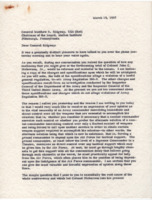
Letter to General Matthew B. Ridgway from Lt. Colonel Charles R. Zimmer.
These documents include the draft of the letter and the final letter. Zimmer writes to Ridgway regarding his testimony and its importance in the Nickerson trial. Zimmer also asks for Ridgway's opinion on the "necessity of an Army commander exercising immediate and direct control" over defense weapons. -
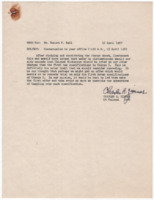
Memorandum for Robert K. Bell from Charles R. Zimmer.
This memo was written about a conversation earlier that day. Zimmer tells Bell that after discussing with Lieutenant Cole, they agree that Colonel Nickerson should not be tried on any other charges than the first ten specification to Charge I. -
Letter to William G. Barry from Charles R. Zimmer.
Zimmer writes to Lt. Colonel Willaim G. Barry with the stipulations that will not be accepted in the case of Colonel John C. Nickerson. -
Acknowledgment of receipt of documents from John C. Nickerson, Jr. to Charles R. Zimmer.
This letter acknowledges the receipt of a letter, an envelope for delivery, two courtesty copies, and a carbon copy of various letters. -
Defense counsel's request for access to classified information.
This letter outlines the defense counsel's request for access to flassified information in reference to a previous letter received from the Office of the Commanding General, Third United States Army. -
List of additional witnesses for the defense of Colonel John C. Nickerson, Jr.
This submitted list of additional witness was in addition to the list submitted on April 25, 1957. -
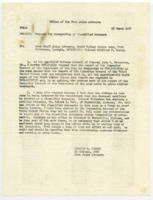
"Request for Downgrading of Classified Document."
On behalf of the defense counsel, Charles R. Zimmer writes to the Army Staff Judge Advocate, Colonel Clifford F. Cordes, to request that the report of the Inspector General of the Department of the Army be downgraded from classified to unclassified. Zimmer states that he feels without this document being accessible to the defense counsel, the "defense in this case is being hampered." -
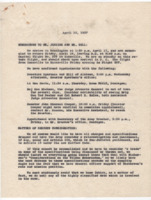
Memorandum for Ray H. Jenkins and Robert K. Bell
This memo details an upcoming trip to Washington and the scheduled appointments with various senators and military officials in regard to the Nickerson case. The memo states that it would be preferred is all charges and specifications dropped and consider a reinvestigation and punishment. It includes other information regarding the case. -
Defense Notes on Nickerson Case.
Defense notes outline the charges against Colonel John C. Nickerson, Jr. and the accompanying specifications of each charge. It also outlines how Nickerson went about publishing the classified information through the newspaper journalist Drew Pearson. It includes an affidavit of John A. Baumann, the expected testimonies of Dr. Wernher von Braun, Dr. Charles Lundquist, Mr. Rudolph Schlidt, and Dr. Ernst Stuhlinger, correspondence related to the case, written statements, handwritten notes, and character letters. -
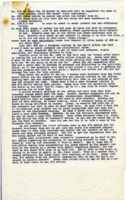
Notes in regards to the Nickerson case.
Notes detail James, who suggested the name of Drew Pearson to Colonel Nickerson, and his actions as pertaining to the case.