
Browse Items (215 total)
Sort by:
-
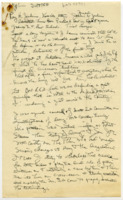
Handwritten letter to Ray H. Jenkins from Jim G. Lucas.
Lucas writes that after spending a day with the trial lawyer, he has become convinced that Colonel Nickerson is a valuable asset to the nation's defense and to the Army. Lucas continues to provide information he knows relevant to the case. -
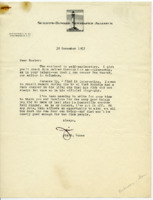
Letter to Robert K. Bell from Jim G. Lucas.
Lucas writes concerning an enclosed document and thoughts regarding Colonel Medaris and the Nickerson case that had closed earlier that year. He closes by thanking Bell and his wife for their hospitality during his last stay in Huntsville. -
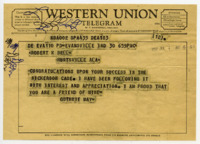
Telegram to Robert K. Bell from Guthrie May.
May wires Bell to congratulate him on the success of the Nickerson case and states that he is proud to be Bell's friend. -
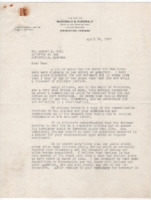
Letter to Robert K. Bell from Douglas H. McDonald.
McDonald expresses interest in John C. Nickerson's case to Bell in this letter. He explains that he heard about the case from a friend, Ralph Wiltsie, who served under Colonel Nickerson during World War II. McDonald writes that Wiltsie is under the impression that the counsel will want to call him as a trial witness. -
Letter from Douglas H. McDonald to Robert K. Bell.
In response to Bell's May 8th letter, McDonald informs Bell that Mr. Wiltsie will proceed as instructed regarding the reponse to the inquiry. He also expresses that he and his wife are excited to have Bell and his wife visit them. -
Reports on Colonel John C. Nickerson, Jr.
These three reports on Nickerson by various military officers testify to his character and military service. -
Handwritten letter to Colonel John C. Nickerson, Jr. from Ben Messick.
Messick writes to encourage Nickerson in his case, stating that he is confident Nickerson did what he believed to be in the best interest of the Army. -
Letter to Robert K. Bell from Person Moore.
Moore sends another case to Bell hoping it will be of interest to him in the Nickerson case. -
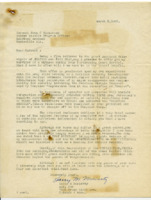
Letter to Colonel John C. Nickerson, Jr. from Harry M. Moriarty.
Moriarty offers his services as a witness during Nickerson's trial and why what he has to offer would be to their "mutual benefit." He encloses with the letter an outline of a complaint that may be beneficial to Nickerson's case as well as his own. -
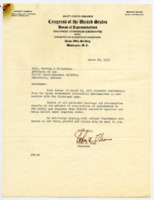
Letter to the defense counsel from John E. Moss.
Moss writes in response to the defense counsel's request of March 25, 1957 for information from the House Government Information Subcommittee. Moss states that all published hearings and reports on the subject are being mailed separately. -
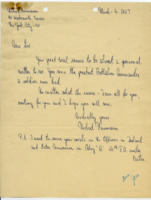
Handwritten letter to Colonel John C. Nickerson, Jr. from Norbert Neumann.
Neumann calls Nickerson case a "personal matter" and writes that he is rooting for him and that he was the greatest Battalion Commander he had ever had. -
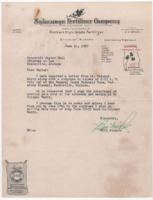
Letter to Robert K. Bell from William Nichols.
Nichols writes to Bell to inform him of the supoena he received to appear in court on July 2nd. He states that he will proceed as requested unless he hears from Bell with other instructions. -
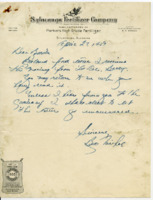
Handwritten letter to Robert K. Bell.
Nichols writes regarding a letter he received from Lt. Col. Barry that may be of some interest to Bell and the Nickerson case. -
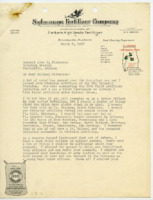
Letter to Colonel John C. Nickerson, Jr. from William F. Nichols.
Nichols writes to Nickerson, reminiscing of their time in active duty together in various places and how he held Nickerson in "highest esteem." He expresses concern over charges that indicate espionage, stating that they are "without foundation." He offers to appear in Nickerson's behalf and recommends reaching out to Brigadier General Pickering as well. -
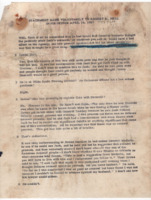
Statements of Mrs. Nickerson and Dr. Wernher von Braun.
These voluntary statements were made in the office of Robert K. Bell. The first by Mrs. John C. Nickerson and the second by Dr. Wernher von Braun. -
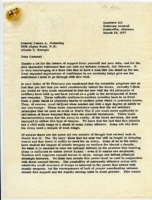
Letter from Col. John C. Nickerson at Redstone Arsenal in Huntsville, Alabama, to Gen. James A. Pickering in Atlanta, Georgia.
In this letter, Nickerson thanks Gen. Pickering for his support and explains why he believes the Army is the best service branch to develop ballistic missiles. He also discusses the need for missiles in case of war with the Soviet Union. Nickerson was a staff officer at the Army Ballistic Missile Agency at Redstone Arsenal assigned to work on the Jupiter, the United States' first mid-range ballistic missile. He was arrested and court martialed for espionage in 1957 after releasing sensitive documents about the United States missile program to the press. At the time, Secretary of Defense Charles E. Wilson granted the Air Force sole authority to develop intermediate range ballistic missile systems. Nickerson disagreed with this policy, and in response, leaked documents that demonstrated the superiority of Army missiles compared to those developed by the Air Force. He eventually pled guilty to lesser charges and was suspended from the Army for one year and was fined $1,500. Dr. Wernher von Braun was among those who testified on Nickerson's behalf. -
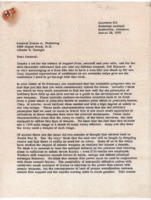
Letter to James A. Pickering from John "Jack" Nickerson.
Nickerson thanks Pickering for the letters of support sent to his defense counsel. He also discusses ballistic surface-to-surface missiles and "scientific progress". He ends by requesting a deposition as Pickering will be in Europe in May, when the trial is scheduled to happen. -
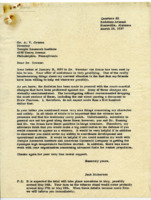
Letter to Dr. A. V. Grosse from Colonel John C. Nickerson, Jr.
In response to Grosse's letter to Dr. Wernher von Braun that had been sent to him, Nickerson thanks him for his offer of assistance in the case and asks if he would consent to appearing as a witness. -
Letter to Ray H. Jenkins from Colonel John C. Nickerson, Jr.
This letter states that Nickerson sent two letters and a statement concerning member of the Court. However, this is the only letter in the collection. -
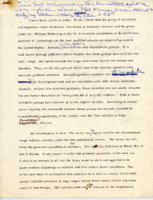
Colonel John C. Nickerson, Jr. clarification of actions took.
To clarify his intentions of the actions he took that led him to be court-martial, John C. Nickerson, Jr. writes a detailed document outlining three points. This set of documents includes two drafts of his message.