
Browse Items (215 total)
Sort by:
-
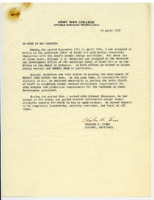
Letter from Col. Charles B. Hines.
This letter is written to testify of Colonel John C. Nickerson, Jr.'s character. Hines writes that Nickerson showed himself to be "completely trustworth, security conscious, and loyal at all times." -
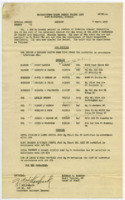
Special Orders Number 43.
The order calls to convene a General Court-Martial at Redstone Arsenal in Huntsville, Alabama for the trial of Colonel John C. Nickerson, Jr. of the Army Ballistic Missle Agency. The document lists the names of the members of the members and counsel. -
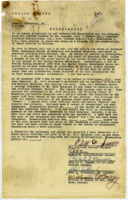
Stipulation of the testimony of Edward Hull.
Written testimony of Edward Hull, assistant editor of Missiles and Rockets Magazine, as presented if he were "present in court". Signed by the defense counsel, the accused, and the trial counsel. -
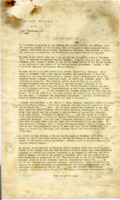
Stipulation of the testimony of William F. Hunt.
Written testimony of William F. Hunt, employee of Reynolds Metals Company, as presented if he were "present in court". No signatures of the defense counsel, accused, or trial counsel are on the document. -
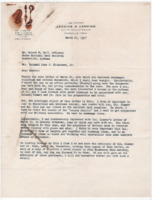
Letter to Robert K. Bell from Ray H. Jenkins.
Jenkins writes in response to Bell's March 22 letter, addressing the various information that was included in Bell's letter and his ability to visit Huntsville for nine days to help prepare for the trial. -
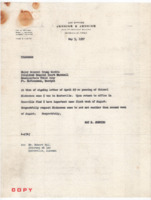
Telegram to Major General Crump Garrin from Ray H. Jenkins.
Jenkins requests the trial of Colonel Nickerson to be scheduled no earlier than the second week of August due to an important case he has the first week of August. -
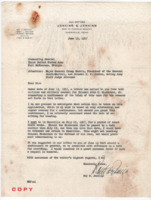
Letter to the Commanding General, Third United States Army, from Ray H. Jenkins.
Jenkins writes to Major General Crump Gavin citing his personal reasons why the Commanding General should approve the defense counsel's request for a continuance. -
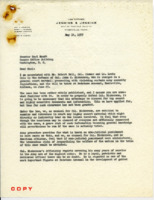
Letters to senators in Washington D.C. from Ray Jenkins.
Ray Jenkins sends the same letter to various senators in Washington D.C. in an effort to speed up the approval of top secret clearance for the defense counsel and advocate for non-judicial punishment for Colonel Nickerson rather than court-martial. He summarizes Nickerson's efficiency reports as well. Jenkins concludes by asking if the senator would convey the message and thinking of the defense counsel to the Secretary of Defense, Mr. Wilson. -
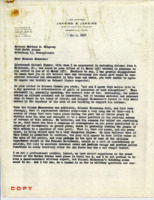
Letter to General Matthew B. Ridgeway from Ray H. Jenkins.
Jenkins writes to Ridgeway in response to his letter to Charles Zimmer that his testimony would not be relevant and admissible in the case of Colonel Nickerson. Jenkins details in his letter why Ridgeway should reconsider and awaits his reply with interest. -
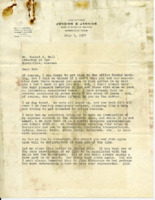
Letter to Robert K. Bell from Ray H. Jenkins.
Jenkins writes after the trial of Colonel Nickerson, stating that he is completely relaxed and trying to get back into office routine. He approximates the expenses in the Nickerson case and says that his fee would be satisfactory as the amount agreed upon by Nickerson and Bell. He concludes by stating that Nickerson came out of the trial "unscathed and unscarred" and sends his best to Bell and his wife. The Nickerson trial ended with the dropping of the Espionage Act and perjury charges in exchange for 15 minor counts of mishandling defense information. Nickerson was fined $1,500, reprimanded, and forbidden to exercise his command for a year. He was later sent to a military base in Panama and died in a car crash a few years later. -
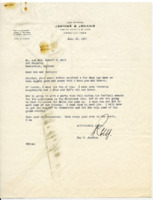
Letter to Robert K. Bell and his wife, Carolyn, from Ray H. Jenkins.
This letter addressed to both Robert and his wife details personal correspondence about various daily activities of Jenkins' life. -
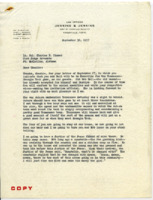
Letter to Lt. Col. Charles R. Zimmer from Ray H. Jenkins.
Jenkins writes in reponse to Zimmer's letter of September 27, 1957 about Zimmer's upcoming visit to Knoxville for the Georgia Tech game. Jenkins writes that Bell has also accepted the invitation and will be there as well. This copy of the letter includes a message for Robert K. Bell as it was forwarded to him as well. Jenkins writes about a mutual friend, Kenneth Nugent, who called after the game. Jenkins tells Bell to thank Kenneth for the call and that he is sorry to have missed him. -
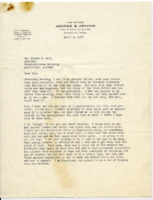
Letter to Robert K. Bell from Ray H. Jenkins.
Jenkins writes to Bell in response to a previous letter. They frequently exchange humorous stories through correspondence and Jenkins states that he will tell another when they meet in person again. Jenkins also expresses longing to get together with the entire defense counsel and their families and looks forward to doing so. -
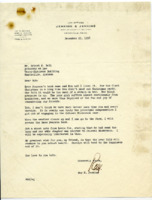
Letter to Robert K. Bell from Ray H. Jenkins.
Jenkins writes to Bell about Drew Pearson's book, U.S.A.--Second-Class Power?, of which, he mentions, has an entire chapter on Colonel Nickerson. -
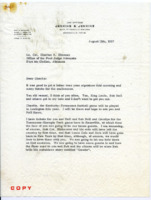
Letter to Lt. Col. Charles R. Zimmer from Ray H. Jenkins.
Jenkins writes to invite Zimmer to the Tennessee-Georgia Tech game in Knoxville along with Robert K. Bell and his wife. -
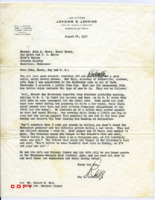
Letter to John L. Greer, Harry Brown, Roy Brown, and T. G. Brown.
Jenkins writes to the Browns to inform them that Robert K. Bell and his wife will be in Knoxville for the Tennessee-Georgia Tech football game and states that they must come meet the Bells. Jenkins includes two paragraphs from a previous letter from Bell to demonstrate his personality. -
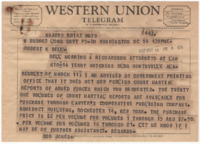
Telegram to Robert K. Bell from Bob Jones.
Jones sent this telegram in reponse to Bell's March 11th letter requesting information for the Nickerson case. He informs Bell that the information cannot be sent to him but may be purchased in a 15 volume book set. -
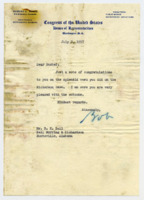
Letter to Robert K. Bell from Robert E. Jones.
Bob Jones writes to Bell to congratulate him on the "splendid work" he did on the Nickerson case. -
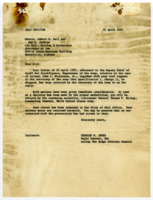
Letter and draft of letter to Robert K. Bell and Ray H. Jenkins from Stanely W. Jones.
Jones writes to Bell and Jenkins in response to their letter of April 13, 1957 to the Deputy Chief of Staff for Intelligence, Department of the Army. With an oral request, the defense counsel had requested for the drop of Specification 1, Charge II. Jones states that as soon as a decision is made the convening authority will advise them of it. -
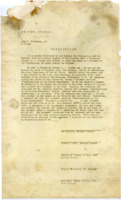
Stipulation of the testimony of Brigadier General A. J. Kinney.
Written testimony of Brigadier General A. J. Kinney, Director of the Office of information Services, Department of the Air Force, as presented if he were "present in court". No signatures of the defense counsel, accused, or trial counsel are on the document.