
Browse Items (215 total)
Sort by:
-
Index entries under "Nickerson, John Charles, Jr."
This is a copy of an index that contains entries related to Colonel John C. Nickerson, Jr. and his court martial. The index contains entries that are found in the Army Navy Register and the Army Navy Journal. -
Letter and draft of letter to Crump Garvin and C. F. Cordes from Robert K. Bell.
In this letter, Bell explains that the defense counsel still has not received approval for top secret security clearance, necessary to "properly defend the accused." Bell states that while the defense counsel would prefer not to request a delay of the proceedings, if the clearance is not granted, they may have no choice but to do so. The documents also include the original draft of the letter. -
Letter and draft of letter to Robert K. Bell and Ray H. Jenkins from Stanely W. Jones.
Jones writes to Bell and Jenkins in response to their letter of April 13, 1957 to the Deputy Chief of Staff for Intelligence, Department of the Army. With an oral request, the defense counsel had requested for the drop of Specification 1, Charge II. Jones states that as soon as a decision is made the convening authority will advise them of it. -
Letter and draft of letter to the Chief of Manpower Office from Patrick W. Richardson.
Richardson writes to the Chief of Manpower prior to Nickerson's letter to the Chief of Manpower of July 25. Richardson states that the orders that Nickerson is not to use duty time to modify the sentence imposed upon him or for appeal is inappropriate and "perhaps illegal". He also states that Nickerson's assignment to the ABMA is unfair and, like Nickerson, requests that he be re-assigned to Redstone Arsenal "until all legal proceedings in this case are complete." -
Letter and drafts of letter to Robert K. Bell from Colonel C. F. Cordes.
This letter is in response to Bell's letter of March 22, 1957 to the Commanding General, Third United States Army. Cordes confirms the reception of Bell's request for the setting of the trial during the week of May 13-17, 1957 and states that Major General Crump Garvin has postponed it to May 15, 1957. -
Letter and drafts of letter to the Deputy Chief of Staff for Intelligence from Robert K. Bell.
These drafts of the letter and final letter to the Deputy Chief of Staff for Intelligence requesting highly classified information to be made available to the Court in order to "insure a proper defense" in the Nickerson case. These documents also include a letter from Bell to Ray H. Jenkins asking him to read the draft of the letter before Bell sends it and also asks about traveling to Washington the following week. -
Letter from Col. Charles B. Hines.
This letter is written to testify of Colonel John C. Nickerson, Jr.'s character. Hines writes that Nickerson showed himself to be "completely trustworth, security conscious, and loyal at all times." -
Letter from Col. John C. Nickerson at Redstone Arsenal in Huntsville, Alabama, to Gen. James A. Pickering in Atlanta, Georgia.
In this letter, Nickerson thanks Gen. Pickering for his support and explains why he believes the Army is the best service branch to develop ballistic missiles. He also discusses the need for missiles in case of war with the Soviet Union. Nickerson was a staff officer at the Army Ballistic Missile Agency at Redstone Arsenal assigned to work on the Jupiter, the United States' first mid-range ballistic missile. He was arrested and court martialed for espionage in 1957 after releasing sensitive documents about the United States missile program to the press. At the time, Secretary of Defense Charles E. Wilson granted the Air Force sole authority to develop intermediate range ballistic missile systems. Nickerson disagreed with this policy, and in response, leaked documents that demonstrated the superiority of Army missiles compared to those developed by the Air Force. He eventually pled guilty to lesser charges and was suspended from the Army for one year and was fined $1,500. Dr. Wernher von Braun was among those who testified on Nickerson's behalf. -
Letter from Douglas H. McDonald to Robert K. Bell.
In response to Bell's May 8th letter, McDonald informs Bell that Mr. Wiltsie will proceed as instructed regarding the reponse to the inquiry. He also expresses that he and his wife are excited to have Bell and his wife visit them. -
Letter from James A. Pickering.
Pickering writes a general letter about Colonel John c. Nickerson, Jr.'s character, stating that Nickerson was a man of "sterling character" and an "intelligent and highly valuable officer." -
Letter from Michael G. Smith.
Smith writes to "Pat" with information as the former president of the court-martial, that would be beneficial to the defense counsel. "Pat" most likely is one of the members of the defense counsel as Smith refers to "you and Buster" several times throughout his letter, "Buster" being the nickname for Robert K. Bell, defense attorney. -
Letter to Armistead Selden from Robert K. Bell.
Bell writes to Selden in Washington D.C. on behalf of the defense counsel in an attempt to change Nickerson's case from trial by court-martial to a non-judicial punishment. Selden replies stating he will pass the information "if the opportunity present[s] itself." -
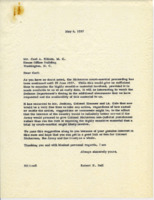
Letter to Carl A. Elliott from Robert K. Bell with a reply from secretary Cora B. Marlowe.
Bell writes to Elliott in Washington D.C. on behalf of the defense counsel in an attempt to change Nickerson's case from trial by court-martial to a non-judicial punishment. Marlowe writes to Bell on behalf of Congressman Elliott who is out of town and will respond to Bell's May 8 letter upon his return. -
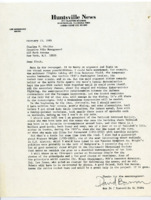
Letter to Charles F. Pfeifer from David Bowman.
Bowman writes to Pfeifer about a "two-pager" that he wrote, detailing its contents. He also includes several other of his resume highlights including four novels, playscripts, and other things he has written. Bowman also includes that he is the president of the Tallulah Bankhead Society, a society that honors and celebrates a 1930s actress from Alabama. Bowman is appealing to Pfeifer, a creative film manager, about his recent work on the Nickerson case. -
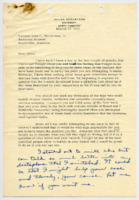
Letter to Colonel John C. Nickerson, Jr. from "Curly".
"Curly" writes in support of Nickerson and states that while someone else will have to decide if what he did was right or wrong, he "might be one of the best qualified people alive to testify in your behalf." The second half of the letter is handwritten and discusses personal events in "Curly's" life such as a new grandson and a family member in the Navy. -
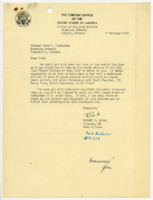
Letter to Colonel John C. Nickerson, Jr. from Colonel Robert C. Works.
Works expresses sympathy toward Nickerson and the situation he is in asking, "�what's happening to the Army?" Works offers a character witness or any deposition or testimony that would help his case. -
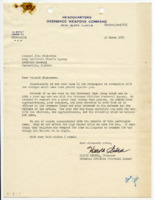
Letter to Colonel John C. Nickerson, Jr. from Harold Sedrel.
Sedrel writes on behalf of Nickerson's character, though "unacquainted with the details of this particular case." -
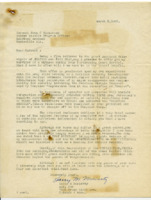
Letter to Colonel John C. Nickerson, Jr. from Harry M. Moriarty.
Moriarty offers his services as a witness during Nickerson's trial and why what he has to offer would be to their "mutual benefit." He encloses with the letter an outline of a complaint that may be beneficial to Nickerson's case as well as his own. -
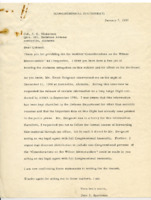
Letter to Colonel John C. Nickerson, Jr. from John J. Sparkman.
Sparkman thanks Nickerson for sending a booklet he had requested. He also requests Nickerson to send information on a long range flight conducted by ABMA directly to Erik Bergaust for an interview Bergaust did on Sparkman. -
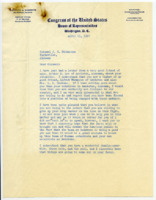
Letter to Colonel John C. Nickerson, Jr. from Kenneth A. Roberts.
Roberts writes to Nickerson about his case, expressing interest and stating that by knowing Nickerson's relatives, he is sure Nickerson is anything but disloyal. Roberts also writes that he will be in Huntsville sometime and hopes to arrange to talk with Nickerson.