
Browse Items (215 total)
Sort by:
-
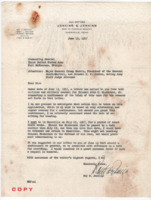
Letter to the Commanding General, Third United States Army, from Ray H. Jenkins.
Jenkins writes to Major General Crump Gavin citing his personal reasons why the Commanding General should approve the defense counsel's request for a continuance. -
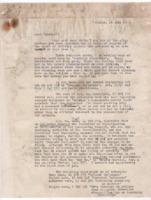
Letter to Robert "Buster" Bell from Walter Emmett Perry.
Perry responds to Bell's letter of June 10th regarding the possible accuser also being the reviewer in the Nickerson trial proceedings. -
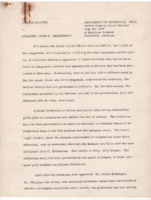
Argument of Robert K. Bell before the General Court-Martial in the case of United States v. Colonel John C. Nickerson, Jr.
Argument of Robert K. Bell before the General Court-Martial at Redstone Arsenal in defense of Colonel John C. Nickerson, Jr. Nickerson plead guilty and Bell's testimony was present in an effort to "extenuate or mitigate whatever he might have done." Bell calls Nickerson's judgment "bad" and his actions "unfortunate" and "careless" but argues that he is not disloyal, disobedient, or promoting his own welfare above that of the Army or national security. -
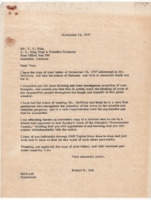
Correspondence between T. C. King and Robert K. Bell and various attached letters.
T. C. King writes to the Secretary of Defense, Neil H. McElroy, regarding the Nickerson case, calling it the "second Billy Mitchell case". He encourages McElroy to restore Nickerson to active duty, return to Redstone Arsenal, promote Nickerson and remove Medaris. The Adjutant General , Herbert Jones, replies that promotions are based on the officers' entire records and Nickerson plead guilty. King's reponse is included. This exchange of letters was forwarded to Robert K. Bell in the interest of the case. -
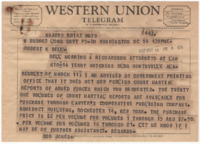
Telegram to Robert K. Bell from Bob Jones.
Jones sent this telegram in reponse to Bell's March 11th letter requesting information for the Nickerson case. He informs Bell that the information cannot be sent to him but may be purchased in a 15 volume book set. -
Defense Notes on Nickerson Case.
Defense notes outline the charges against Colonel John C. Nickerson, Jr. and the accompanying specifications of each charge. It also outlines how Nickerson went about publishing the classified information through the newspaper journalist Drew Pearson. It includes an affidavit of John A. Baumann, the expected testimonies of Dr. Wernher von Braun, Dr. Charles Lundquist, Mr. Rudolph Schlidt, and Dr. Ernst Stuhlinger, correspondence related to the case, written statements, handwritten notes, and character letters. -
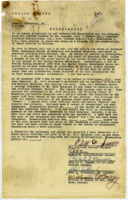
Stipulation of the testimony of Edward Hull.
Written testimony of Edward Hull, assistant editor of Missiles and Rockets Magazine, as presented if he were "present in court". Signed by the defense counsel, the accused, and the trial counsel. -
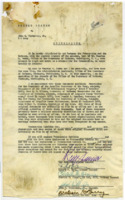
Stipulation of the testimony of Maurice W. Roche.
Written testimony of Maurice W. Roche, administrative assistant for the Office of the Secretary of Defense, as presented if he were "present in court". Signed by the defense counsel, the accused, and the trial counsel. -
Stipulation of the testimony of Erik Bergaust.
Written testimony of Erik Bergaust, managing editor of Missiles and Rockets Magazine, as presented if he were "present in court". Signed by the defense counsel, the accused, and the trial counsel. -
Stipulation of the testimony of Brigadier General A. J. Kinney.
Written testimony of Brigadier General A. J. Kinney, Director of the Office of information Services, Department of the Air Force, as presented if he were "present in court". No signatures of the defense counsel, accused, or trial counsel are on the document. -
Stipulation of the testimony of William F. Hunt.
Written testimony of William F. Hunt, employee of Reynolds Metals Company, as presented if he were "present in court". No signatures of the defense counsel, accused, or trial counsel are on the document. -
Stipulation of the testimony of Colonel William C. Pritchard
Written testimony of William C. Pritchard, Colonel with the Army Physical Evaluation Board at Walter Reed Hospital, as presented if he were "present in court". Page two missing. Handwritten note at the bottom says, "2d page only had signatures." -
Stipulation of the testimony of John A. Baumann.
Written testimony of John A. Baumann, employee of the Radio Corporation of America, presented if he were "present in court". No signatures of the defense counsel, accused, or trial counsel are on the document. -
Notes in regards to the Nickerson case.
Notes detail James, who suggested the name of Drew Pearson to Colonel Nickerson, and his actions as pertaining to the case. -
List of names pertaining to the Nickerson case.
List of names include Dr. Wernher von Braun, Dr. Ernest Stuhlinger, Lt. Gen. Edward M. Almond, Mayor Ralph Wiltsie, and more. -
Letter to the Commanding General, Third United States Army, from the Defense Counsel.
This letter is the first request of a continuance of the trial of Colonel John C. Nickerson, Jr. by the defense counsel due to waiting on top secret clearance for information pertinent to the case and other various reasons. -
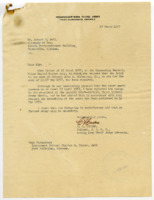
Letter and drafts of letter to Robert K. Bell from Colonel C. F. Cordes.
This letter is in response to Bell's letter of March 22, 1957 to the Commanding General, Third United States Army. Cordes confirms the reception of Bell's request for the setting of the trial during the week of May 13-17, 1957 and states that Major General Crump Garvin has postponed it to May 15, 1957. -
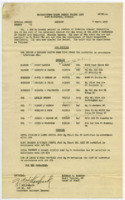
Special Orders Number 43.
The order calls to convene a General Court-Martial at Redstone Arsenal in Huntsville, Alabama for the trial of Colonel John C. Nickerson, Jr. of the Army Ballistic Missle Agency. The document lists the names of the members of the members and counsel. -
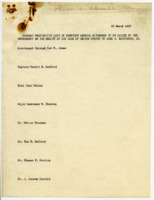
Prospective list of witnesses in the case of United States vs. John C. Nickerson. Jr.
A list of potential witnesses to be called in the case of United States vs. Colonel John C. Nickerson, Jr. -
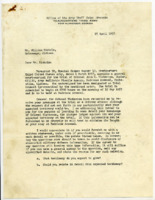
Letter to William Nichols from William G. Barry.
Letter requests William Nichols' presence at the trial of Colonel John C. Nickerson, Jr. It also includes questions Nichols is to answer in a written statement and an anticipated range of dates he will be expected to give his testimony in court.