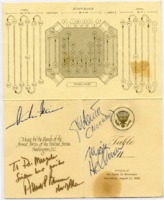
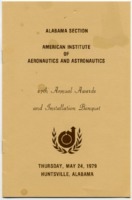
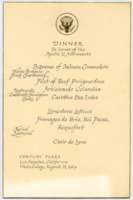
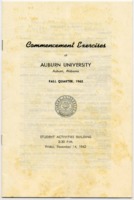
The item shows the table arrangement for the dinner and is signed by Alabama governor Albert Brewer. William and Berta Mrazek were assigned to table 11.
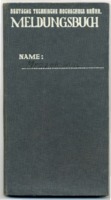
This booklet, a Meldungsbuch, is a record of Mrazek's enrollment at Deutsche Technische Hochschule Brünn (German Technical University in Brünn, Czechoslovakia, now Brno, Czech Republic), where he received an MS in Engineering in 1934. The booklet identifies his courses and professors and includes a photograph of Mrazek.
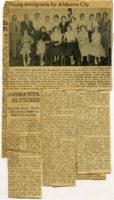
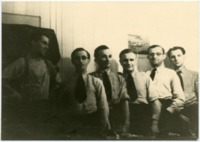
The members of the group were all children of German engineers who were brought to the United States under Operation Paperclip. The clippings include photos of the group with their new immigration registration cards.
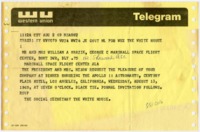
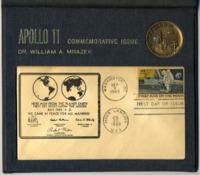
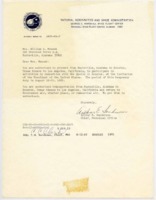
In the letter, Sanderson authorizes Mrazek to travel to Houston, Texas and Los Angeles, California "to participate in activities in connection with the Apollo 11 mission, at the invitation of the President of the United States."
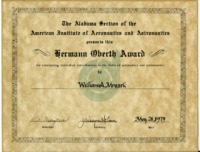
Mrazek was the 1978 recipient of the Oberth Award. During his career, Mrazek worked on the design and development of the Jupiter ICBM, Jupiter-C, and Saturn launch vehicles. He retired from Marshall Space Flight Center as the Associate Director for Engineering in Project Development in 1973.
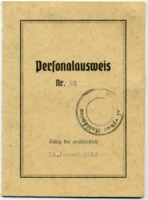
This German identity card, or Personalausweis, was issued to Berta Mrazek at Nestomitz, Germany (now Neštěmice, Czech Republic) in 1941. The card includes a photograph of Mrazek and her daughter Ursula.
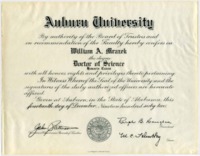
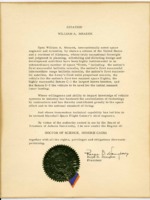
Given by Auburn University president Ralph Brown Draughon, the citation notes Mrazek's accomplishments as "Marshall Space Flight Center's chief engineer."
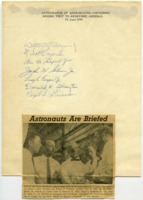
The group gave out autographs during their visit to Redstone Arsenal in 1959. A news clipping with a photograph of five of the seven astronauts in Huntsville is attached.
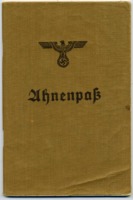
The document identifies Berta Mrazek's family lineage, including parents, grandparents, great grandparents, and 2nd-great grandparents. The Ahnenpass was a standard booklet issued to German citizens in order to prove their ancestry in the Third Reich.