
Browse Items (94 total)
Sort by:
-
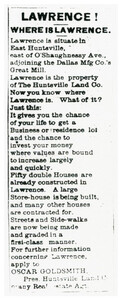
Advertisement for Lawrence Village.
This is a copy of a Huntsville newspaper advertisement for Lawrence Village. This advertisement detailed where Lawrence Village was and promoted the rapidly expanding community built by Huntsville Land Co. The text at the end of the advertisement states "For further information concerning Lawrence, apply to Oscar Goldsmith, Pres. Huntsville Land Co." Lawrence was the name of Oscar Goldsmith's son. -
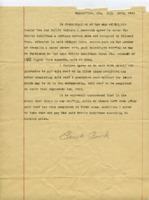
Agreement for the installation of galvanized roofing.
Agreement for the installation of galvanized roofing on a cotton shed occupied and rented by Gilbert Bros. from I. Schiffman and Co. at the request of Bettie Schiffman. Bettie's name appears on documents after July 1910 due to the death of her husband, Isaac. -
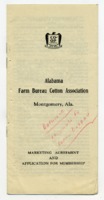
Alabama Farm Bureau Cotton Association Marketing Agreement and Application for Membership.
From the business records of I. Schiffman and Company. The application for membership was completed by Lawrence B. Goldsmith, a member of the I. Schiffman & Co. firm. The front of the pamphlet notes that this copy is a duplicate. -
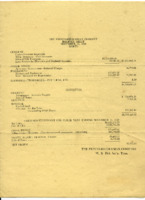
Balance sheets for the Printz-Biederman Company and letters to the stockholders.
Documents include three years of balance sheets for the Printz-Biederman Company and the accompanying letters with further information. -
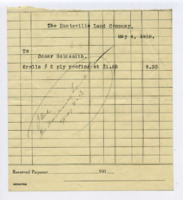
Bill for Oscar Goldsmith and the Huntsville Land Company.
A bill for six rolls of roofing for $9.30 to Oscar Goldsmith with the Huntville Land Co. -
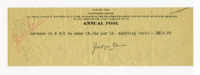
Cash advance and receipt for cotton.
Receipt of check tendered as a cash advance from Judge Cain for six bales of cotton at 15.64 cents per pound, signed by Judge Cain, and the dray receipt from Planters Warehouse & Storage Co. from Judge Cain for the six bales of cotton. The final document is a draft receipt showing the 6 bales of cotton from the annual pool for Judge Cain. -
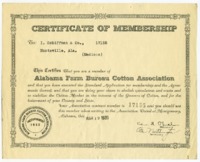
Certificate of membership in the Alabama Farm Bureau Cotton Association.
From the business records of I. Schiffman and Company. The certificate was issued to I. Schiffman & Co. on March 19, 1930. -
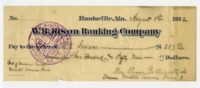
Check from Oscar Goldsmith to W. R. Rison Banking Company.
A check from Oscar Goldsmith for $259.51 to W. R. Rison Banking Company, signed on the back by R. E. Sessions. The second check is blank on the front with a handwritten note on the back for the following day. The writing is difficult to read but notes something about one dollar for or from Oscar Goldsmith, also signed by R. E. Sessions. -
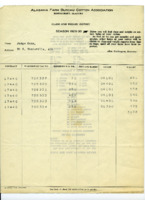
Class and Weight Report.
This is the class and weight report for the Alabama Farm Bureau Cotton Association based on the 1929-1930 cotton season. -
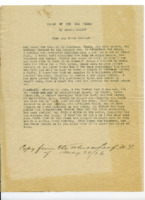
Copy of "Tale of the Old Times: When the Train Stalled" by Arnold Pollak.
A copy of a story written by Arnold Pollak titled "Tales of the Old Times: When the Train Stalled." This article recounts a time when Pollak's train was stalled in Texas and, being told it would be two more more hours before it started moving again, he engaged in trading fish and wanted to trade the samples for a new cigar jobber. When the train started moving before he was done, Pollak started running but unable to catch the train, Pollak's friend Oscar Goldsmith pulled the rope to stop the train. Handwritten note reads: "Copy from the Tobacco Leaf N. Y. of May 29/26". -
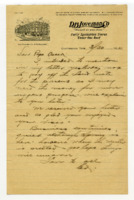
Correspondence between Ed and "Papa Oscar".
These first two letters, written by Ed to "Papa" Oscar Goldsmith detail paying off land notes to get money for possible "urgent purpose[s]". The second letter discusses a charge Ed put in the ledger and the hope to "improve things" with his business. The next letter is also from Ed. In this letter, Ed discloses information regarding his lack of a permanent place and inquires if he should sell the property on Clinton Street and his car. The final two letters are written by an unknown author, but contain information from Oscar to Ed in reponse to Ed's letters. The letters advise Ed not to sell the house on Clinton Street as it would sell for less than he owes on it at the time, but does advise to sell his car. It also tells of payments made by Oscar at the request of Ed. It discloses details about Ed's financial situation. The second letter regards a dividend Ed received from the Wonderfield Oil Co. along with a note that "Papa" is feeling better. -
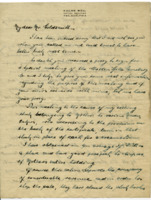
Correspondence between Edgar Weil and Oscar Goldsmith, and Oscar Goldsmith and Harry.
In this letter, Edgar Weil gives Goldsmith information regarding the sale of his mother's stocks in the Chelten Hills Cemetery Company, as Goldsmith is unable to attend and will need a proxy, and the reasoning behind the call to change the per value of the stock. Weil states that the Company does not earn any return for their stocks and so he is selling the stocks for a low price per share due to the fact that "nobody will ever get a cent for these holdings." The second document is a letter from Oscar requesting a proxy for the meeting, and Harry's response to be Oscar's proxy. The final documents are signed and blank contracts appointing attorneys to vote for the decrease in per value of the capital stocks at the stockholders meeter. -
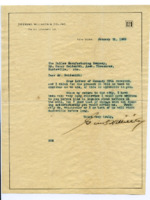
Correspondence between G. H. Milliken and Oscar Goldsmith about a visit to the mill in Huntsville from Milliken and Mr. Winchester.
Milliken writes to Oscar Goldsmith in the first letter stating that he hopes to visit the Huntsville mill with Mr. Winchester soon. Goldsmith responds that he would be glad to have them visit. -
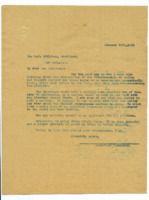
Correspondence between G. H. Milliken and Oscar Goldsmith about the Treasurership of Dallas Mnfg. Co.
These letters discuss the appointment of a new treasurer of Dallas Mnfg. Co. to succeed Mr. Rison. Oscar Goldsmith offers himself as an applicant for the position in the first letter. The second letter is Milliken's response to the topic. He states that Mr. Rhett has been selected for some time now while Mr. Rison was still there. Milliken thanks Goldsmith for his willingness to take on more work and hopes he will continue as Assistant Treasurer as he deems it "unwise for a man of your age" to take on additional responsibilities. Goldsmith replies in the final letter expressing happiness at Mr. Rhett's appointment and mentions the already-scheduled Director's Meeting. -
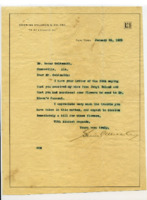
Correspondence between G. H. Milliken, W. E. Winchester, and Oscar Goldsmith.
Correspondence between G. H. Milliken, W. E. Winchester, and Oscar Goldsmith regarding flowers bought for the funeral of Mr. Rison. -
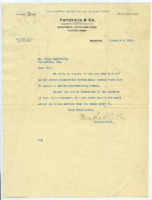
Correspondence between Hotchkin and Co. and Oscar Goldsmith.
The letters detail information about Dallas Manufacturing Co. stocks being sold. This set of documents also includes a check for the forty shares. -
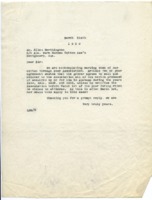
Correspondence between I. Schiffman and Co. in Huntsville, Alabama, and Allen Northington of the Alabama Farm Bureau Cotton Association in Montgomery, Alabama.
From the business records of I. Schiffman and Company. In the first letter, Lawrence B. Goldsmith of I. Schiffman and Co. inquires about selling cotton through the Alabama Farm Bureau Cotton Association. In his reply, Northington asserts that "we will be glad to handle any cotton for you that was grown on your farm and make the government advance up to 15.64� Middling basis." -
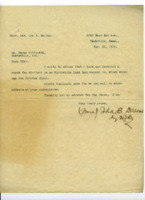
Correspondence between Ida B. Dallas and Oscar Goldsmith.
Correspondence regarding Ida B. Dallas's missing dividend check on her stocks for Huntsville Land Improvement Co. Goldsmith responds, informing her that no dividends were paid October 1, 1912 due to repairs and painting of the property of the Company, therefore the expenses do not allow for a surplus for dividends. -
Correspondence between Mrs. Ella Davis and Mrs. Owens.
Mrs. Owens writes to Ella Davis regarding a lost tax receipt for 1920, requesting that she send the receipt again as the books do not show payment of taxes for the year. Ella Davis replies with the receipt, asking that they take care not to lose it and return it to her promptly. -
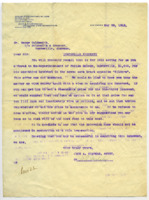
Correspondence between Oscar Goldsmith, John A. Chapman, and W. H. Halsey regarding property price negotiations.
These letters detail a chronological correspondence between Oscar Goldsmith and John A. Chapman, his agent, regarding negotiations to purchase property on Meridianville Pike from W. H. Halsey. The letters between Chapman and Goldsmith discuss reasonable price offers and "fancy" price Halsey wants for the property. In the end, Halsey writes a letter detailing the final transaction and cost.