
Browse Items (94 total)
Sort by:
-
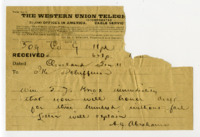
Telegram and a handwritten letter from A. J. Abrahams to S. Schiffman.
In the telegram A. J. Abrahams acknowledges that S. Schiffman will cover a $300 bill. It ends with a promise to explain the circumstances in a letter that will follow. In the handwritten letter to S. Schiffman, A. J. Abrahams details the circumstances surrounding the need for S. Schiffman to cover the bill and thanks him for his kindness. -
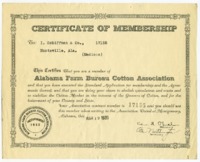
Certificate of membership in the Alabama Farm Bureau Cotton Association.
From the business records of I. Schiffman and Company. The certificate was issued to I. Schiffman & Co. on March 19, 1930. -
Alabama Farm Bureau Cotton Association Marketing Agreement and Application for Membership.
From the business records of I. Schiffman and Company. The application for membership was completed by Lawrence B. Goldsmith, a member of the I. Schiffman & Co. firm. The front of the pamphlet notes that this copy is a duplicate. -
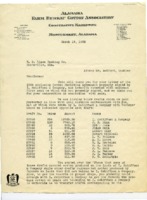
Correspondence concerning cooperative marketing of Huntsville-area farmers' cotton.
From the business records of I. Schiffman and Company. The letters contain lists of farmers whose cotton I. Schiffman & Co. is marketing through the Alabama Farm Bureau Cotton Association. The materials include notes from each farmer instructing the Association to hold their cotton in the "regular annual pool [...] subject to lien on same held by I. Schiffman & Company." Each letter indicates the value of the cotton. -
Materials regarding prices and cooperative marketing of the 1930 cotton crop.
From the business records of I. Schiffman and Company. The materials include letters and instructions for handling and delivering the 1930-31 cotton crop to the Alabama Farm Bureau Cotton Association. The instructions describe the different pools available for marketing cotton and lists warehouses throughout Alabama to be used for storing cotton. The last item, a letter from N. S. Stewart, discusses low cotton prices since 1926 and lists advantages of marketing cotton through the Association. -
Class and Weight Report.
This is the class and weight report for the Alabama Farm Bureau Cotton Association based on the 1929-1930 cotton season. -
Receipts for the sale of property.
Two receipts detailing the sale of horses, wagons, and harnesses to I. Schiffman & Co. for $80.00 and $85.00. -
I. Schiffman & Co. claim from Tom Toney's lawsuit.
These three letters detail I. Schiffman & Co.'s claim to $500 from the mortgage of Tom Toney on the automobile that was originally sold to him but later seized in 1919 for transporting untaxpaid liquor (see "Lawsuit against Tom Toney"). However, while the claim was approved by a Mr. McNeel, the refund was refused by the commissioner at Washington. R.E. Smith, representing I. Schiffman & Co., writes to McNeel, Danforth, and O'Rear Advisors and Consultants in hopes of reopening the claim again. McNeel, Danforth, and O'Rear advise Smith that reopening the claim would do no good. In the end, the prohibition commissioner, R. A. Haynes permanently closes the claim and I. Schiffman & Co. does not receive the $500 claim. -
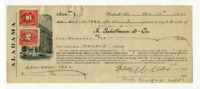
Frank Williams rent and work.
Various documents detailing land rented by Frank Williams, payments owed, and rental information including the promissory note promises the payment of $600 to Nelson Acklin for land rented by Frank Williams with signatures of Nelson Acklin and [sic] Schiffman on the back, an inquiry from Laurence Goldsmith regarding the character of Frank Williams as a renter and the bank's business intentions with him, a handwritten note detailing the amounts owed by Frank Williams that were mentioned in the letter from Goldsmith, a response to Goldsmith's inquiry from J. G. Bennett, a note stating the transfer of the rent note to the landlord, I. Schiffman & Co., and the release of Albert Clay's crop, a letter from Frank Williams to Laurence Goldsmith requesting help as he cannot work the land himself due to his wife's illness, and a letter from I. Schiffman & Co. after the transfer of the rented land to the company. -
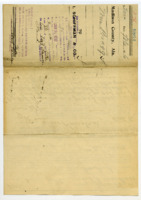
Loan contracts, bills, and receipts for business between I. Schiffman & Co. and Bill Bragg and Percy Bragg.
Various loan contracts, bills, and receipts for purchases made by Bill Bragg and Percy Bragg from I. Schiffman and Co. in 1906. The final document is a receipt for livestock and equipment in 1907. -
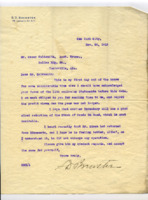
Letter to Oscar Goldsmith from S. D. Brewsters about yearly sales and inventory.
S. D. Brewster writes to Oscar Goldsmith in response to a previous letter in which Goldsmith sent earning statements for the Dallas Mnfg. Co. He details how the profit was lower than he had hoped and wish the treasurer, Mr. Rison, who had been sick and just returned from Minnesota, well. -
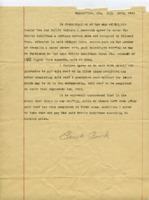
Agreement for the installation of galvanized roofing.
Agreement for the installation of galvanized roofing on a cotton shed occupied and rented by Gilbert Bros. from I. Schiffman and Co. at the request of Bettie Schiffman. Bettie's name appears on documents after July 1910 due to the death of her husband, Isaac. -
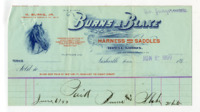
Transaction for horses purchased by I. Schiffman.
These documents contain reciepts, correspondence, and payment of the purchase of horse equipment and "1 pair horses" by I. Schiffman. -
Lawsuit against Tom Toney.
These documents detail a lawsuit brought against Tom Toney by Mitchell & Mitchell Automobile Repairing. The first IOU details Tom Toney's debt to I. Schiffman & Co. for a Dodge car for $60. Following the check is a bill for repairs on the Dodge totalling $28.25. Tom Toney's car was seized upon discovery it was being used to "convey spiritous or vinous liquor contrary to law", resulting in a lawsuit brought by the State of Alabama. The statement is Mitchell & Mitchell claiming that Toney never paid his auto repair bill for the lawsuit. The back of the final letter has a handwritten note that reads: "No. 683 State vs. Toney. Claim of Mitchell & Mitchell. Filed June 11/19 F. S. Cabaniss Reg." -
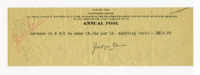
Cash advance and receipt for cotton.
Receipt of check tendered as a cash advance from Judge Cain for six bales of cotton at 15.64 cents per pound, signed by Judge Cain, and the dray receipt from Planters Warehouse & Storage Co. from Judge Cain for the six bales of cotton. The final document is a draft receipt showing the 6 bales of cotton from the annual pool for Judge Cain. -
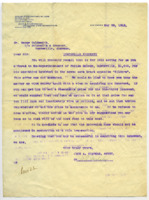
Correspondence between Oscar Goldsmith, John A. Chapman, and W. H. Halsey regarding property price negotiations.
These letters detail a chronological correspondence between Oscar Goldsmith and John A. Chapman, his agent, regarding negotiations to purchase property on Meridianville Pike from W. H. Halsey. The letters between Chapman and Goldsmith discuss reasonable price offers and "fancy" price Halsey wants for the property. In the end, Halsey writes a letter detailing the final transaction and cost. -
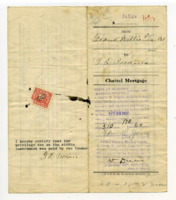
Frank Williams' chattel mortgage paperwork, seed receipts, checks, payments, and debts.
Various chattel mortgage contracts and paperwork, seed receipts, checks, payments, and debts pertaining to Frank Williams and the rented land he worked. These documents include multiple handwritten notes. -
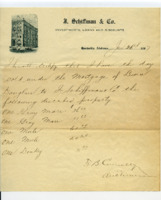
Document certifying the sale of property from Lewis Douglass to I. Schiffman and Co.
This documents details the sale of property of Lewis Douglass to I. Schiffman and Co. and the accompaning prices. The sold property includes horses, mules, and donkeys. -
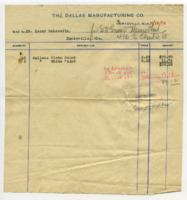
Receipts for the Dallas Manufacturing Company.
Receipts detailing the purchase of paint by Oscar Goldsmith and and itemized receipt and list. -
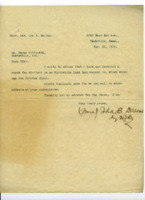
Correspondence between Ida B. Dallas and Oscar Goldsmith.
Correspondence regarding Ida B. Dallas's missing dividend check on her stocks for Huntsville Land Improvement Co. Goldsmith responds, informing her that no dividends were paid October 1, 1912 due to repairs and painting of the property of the Company, therefore the expenses do not allow for a surplus for dividends.