
Browse Items (27 total)
Sort by:
-
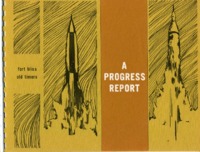
"Fort Bliss Old Timers: A Progress Report."
Subtitled "Some of the Old Timers' Contributions to the Science of Space," this booklet commemorates the accomplishments of the group of engineers posted at Fort Bliss, Texas, beginning in 1945. It includes a brief history of rocket development in Germany from 1929 through 1944, photographs of the 1965 Old Timers Reunion, and a directory of the oldtimers. It also includes a transcript of a speech given by Wernher von Braun in honor of Walter Dornberger's retirement. -
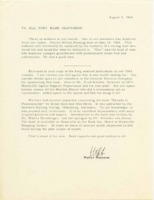
1963 Fort Bliss Old Timers Reunion booklet and letter.
The materials include a letter from Walter Wiesman and an Old Timers Reunion booklet. The booklet includes reproduced news clippings, the reunion program, and photographs from Fort Bliss, as well as photographs of reunion attendees and activities with subjects identified. The reunion booklet also includes photographs from a meeting of the Alabama Section of the American Institute of Aeronautics and Astronautics. -
-
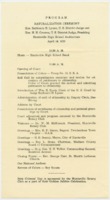
Naturalization ceremony program.
Held at the Huntsville High School auditorium, the ceremony naturalized many of the German engineers who were transferred to Huntsville in 1950. -
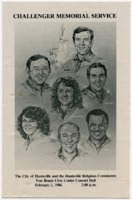
Program from the Challenger disaster memorial service held in Huntsville, Alabama.
The service was held in downtown Huntsville at the Von Braun Civic Center Concert Hall. The program includes remarks from Edward O. Buckbee, Mayor Joe Davis, and Alabama's Teacher in Space finalist Robert Kirchner. -
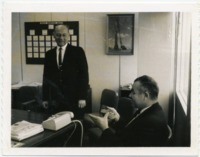
William A. Schulze and Hans Palaoro at Marshall Space Flight Center.
The bulletin board behind Schulze reads "Vehicle Engineering Branch." Palaoro was the head of the Vehicle Systems Engineering Branch of the Structures and Mechanics Division at Marshall Space Flight Center. -
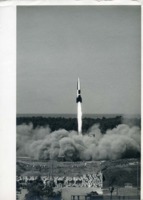
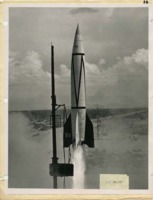
V-2 rocket launch at Peenemünde, Germany.
The back of the photograph is stamped "Geheime Kommandosache" ("Secret Military Document"). -
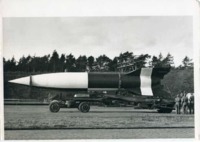
V-2 rocket in transport.
The back of the photograph is stamped "Geheime Kommandosache" ("Secret Military Document"). -
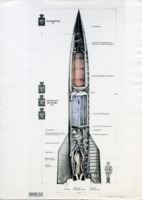
Diagram of an A-4 rocket.
The V-2 rocket was also called the A-4, or Aggregat 4, its technical name. The back of the diagram is stamped "Geheime Kommandosache" ("Secret Military Document"). -
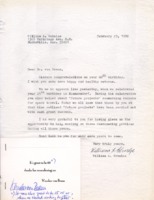
Correspondence related to Wernher von Braun's sixtieth birthday.
The materials include a congratulatory note from William A. Schulze to von Braun, in which he notes, "To me it appears like yesterday, when we celebrated your 25th birthday in Kummersdorf." Von Braun's response, handwritten on a card, reads: "It was also great to be 25 or so, when we started working together!" Enclosed are instructions from Eberhard Rees encouraging Marshall retirees to send von Braun personalized birthday wishes for inclusion in a bound volume later. -
-
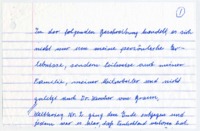
Autobiography and résumé of William August Schulze.
In this partial autobiography, Schulze describes his experiences growing up in Neulaubusch, Germany and training and working as an engineer. He notes that he began working for Wernher von Braun at Kummersdorf in 1936 and then moved to Peenemünde, where he worked on the A-3, A-5, A-7, and V-3 rockets. The documents also include a lengthy handwritten excerpt from Schulze's 1945 day book and a résumé. Includes a transcription and a partial English translation. -
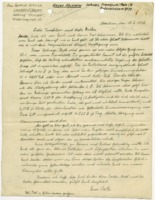
Letter from August Schulze in Aberdeen, Maryland to Trude and Erika Schulze in Landshut, Bavaria, Germany.
Schulze wrote this letter to his wife, Trude, and daughter, Erika, on the back of a photostat copy of his War Department Notification of Personnel Action. In the letter, he discusses his pay and accommodations with the U. S. Army. -
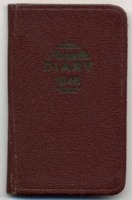
1946 day book.
Written by William A. Schulze, this day book includes notes from his activities at Army Proving Ground at Aberdeen, Maryland in early 1946. Schulze was transported from Germany to Aberdeen in late 1945 as part of the first group of German engineers sent to the United States. During the week of March 17-23, Schulze records his travel from Aberdeen to El Paso, Texas, leaving on Monday, March 18, and arriving in Texas on Thursday, March 21. The day book includes entries on shopping, leisure activities, birthdays, and mail. Schulze's notes reference H. N. Toftoy, Konrad Dannenberg, Wilhelm Jungert, Hannes Luehrsen, Theo Poppel, Erich Neubert, Walter Schwidetski, and others. -
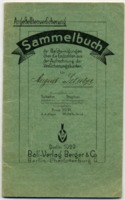
German state health insurance book and cards belonging to William August Schulze.
This booklet, "Sammelbuch der Bescheinigung über die Endzahlen aus der Aufrechnung der Versicherungskarten für August Schulze," documents Schulze's government health insurance while he was employed in Germany from 1930 through 1944. Each page serves as an insurance card for each year of employment. Page seven marks Schulze's first insurance record as an employee at Peenemünde. -
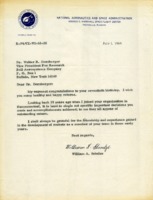
Correspondence between William A. Schulze in Huntsville, Alabama, and Walter Dornberger in Buffalo, New York.
In his letter to Dornberger, Schulze congratulates him on his seventieth birthday and notes, "Looking back 29 years ago when I joined your organization in Kummersdorf, it is hard to single out specific important decisions you made and accomplishments achieved; to me they all appear of outstanding nature. I shall always be grateful for the friendship and experience gained in the development of rockets as a member of your team in those early years." Dornberger's reply is enclosed. -
-
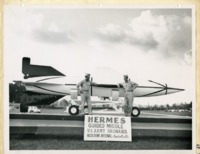
Hermes guided missile on display.
The sign in front of the missile reads, "Hermes Guided Missile, U.S. Army Ordnance, Redstone Arsenal, Huntsville, Ala." -
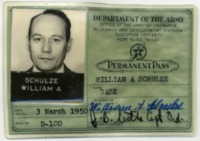
Department of the Army Permanent Pass.
This pass was issued by the Office of the Chief of Ordnance, Research and Development Division Suboffice (Rocket), at Fort Bliss, Texas. -
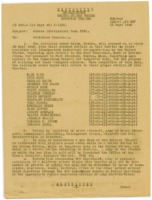
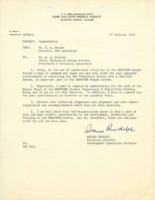
Orders for the transportation of seventeen German civilians to the United States.
This document identifies the first group of German engineers to be brought to the United States as part of Operation Paperclip. Seven of the men listed were eventually transported to the U. S. Army post at Fort Bliss, Texas: Wernher von Braun, Wilhelm Jungert, Erich Neubert, Theo Poppel, Eberhard Rees, August Schulze, and Walter Schwidetski. The men were transported from Germany by air and then by train once in the United States.