Browse Items (49 total)
Sort by:
-
-
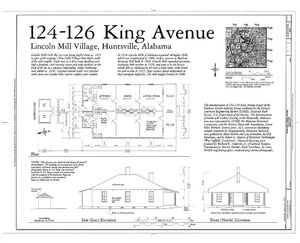
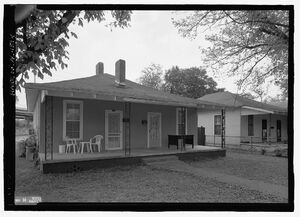
124-126 King Avenue, Lincoln Mill Village, Huntsville, Alabama
Field note:
Significance: Lincoln Mills built this six-room frame duplex home ca. 1925 as part of the company's New South Village three blocks south of the mill complex. Each room in a three-room dwelling unit had a fireplace, with running water and toilet facilities at the back of the lot in a separate outbuilding. Indoor bathrooms were added ca. 1950. Original exterior walls were finished with stucco over wooden lath; interior surfaces were wooden. In 1918 Lincoln Mills of Alabama succeeded Abingdon Mills, which was incorporated in 1906, itself a successor to Madison Spinning Mill built in 1900. Lincoln Mill expanded operations, employing 600 workers in 1920, and grew to be the largest textile mill in Alabama by the time a bitter labor strike forced the mill to close in 1955. Most workers found employment in local aerospace industries. The mill complex burned in 1980. -
-
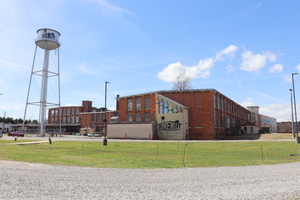
Lowe Mill with Water Tower
A view of Lowe Mill from the back parking lot. This photo features both the water tower and the loading dock. -
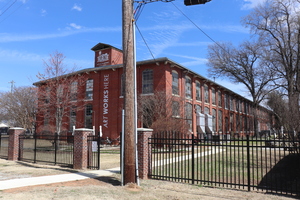
Entrance to Lowe Mill
A street view of Lowe Mill from the corner of Seminole and 9th Avenue. This is one of the many entrances to the modern Lowe Mill Arts and Entertainment Center. -
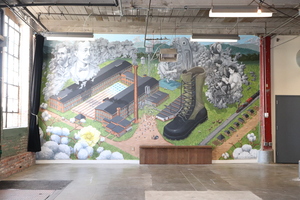
Lowe Mill History Mural Inside
A mural inside of Lowe Mill depicting Lowe Mill's history as a textile mill and shoe factory. This mural was created by Logan Tanner. -
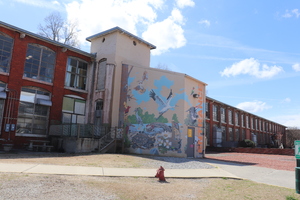
Lowe Mill Side
A side view of Lowe Mill from the parking lot. This shows the historic windows as well as the incorporation of modern art. -
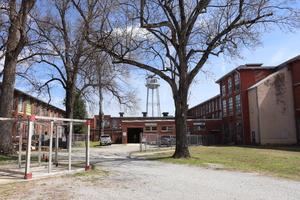
Current View Behind Paymaster's Office Toward Lowe Mill
A view of Lowe Mill behind the old paymaster's office and current studio, bike store. It features the water tower in the background. -
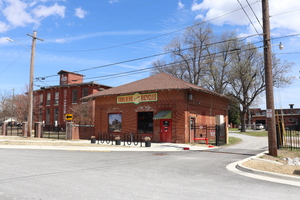
Paymaster's Office With Lowe Mill in the Background
This is the current view of the historic Paymaster's Office, featuring Lowe Mill Arts and Entertainment in the background. The office has currently been repurposed as a studio for the arts center and is functioning as a bike store. -
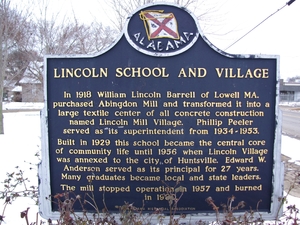
Lincoln School and Village historical marker.
The inscription of the Lincoln School and Village marker reads:
In 1918 William Lincoln Barrell of Lowell MA. purchased Abingdon Mill and transformed it into a large textile center of all concrete construction named Lincoln Mill Village. Phillip Peeler served as its superintendent from 1934-1953.
Built in 1929 this school became the central core of community life until 1956 when Lincoln Village was annexed into the city of Huntsville. Edward W. Anderson served as its principal for 27 years. Many graduates became local and state leaders.
The mill stopped operation in 1957 and burned in 1980.
The historical marker was erected by the Alabama Historical Association in 1985. -
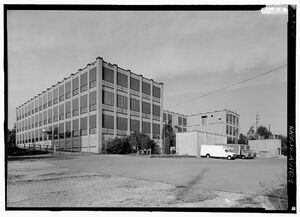
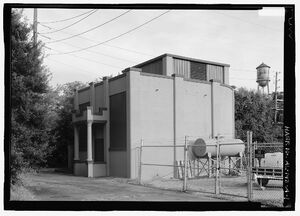
Lincoln Mill, Abington Avenue, Huntsville, Madison County, AL
View looking east of Lincoln Mill (originally Mill No. 3 of a larger complex that no longer stands). Built 1927 - Lincoln Mill, Abington Avenue, Huntsville, Madison County, AL -
-
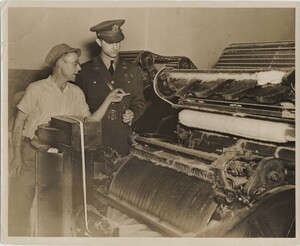
Military Tours Lincoln Mill, circa 1940s
A US Army officer receives a tour of the Lincoln Mill, c. 1940s. A mill worker demonstrates how the equipment is used during his visit. -
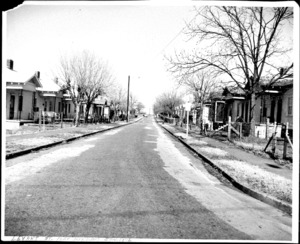
A view of Levert St, circa 1972.
Levert St is situated in Lincoln Mill village, which accommodated a substantial number of mill workers. The photograph is incorrectly labeled as Levent St. This photograph is dated 1972. -
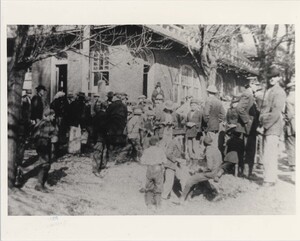
Lewis Hine Dallas Mill Workers Outside the Mill.
A photo by Lewis Hine, Progressive Era social advocacy photographer, of mill workers and child laborers outside of Dallas Mill in November of 1910. -
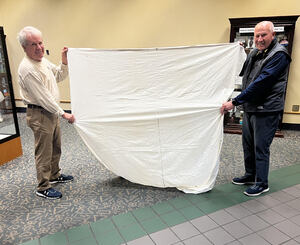
Larry Layne and Lawrence Hillis with Dallas Mills Sheet
Larry Layne and Lawrence Hillis holding up a sheet made by Hillis’ grandmother, Hattie Dunham Warren. Warren accumulated approximately 20 sheets from 1918 to 1924 while she worked at the mill.
-
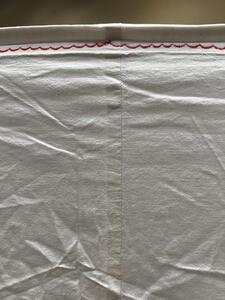
Dallas Mills Sheet
a sheet made by Lawrence Hillis’ grandmother, Hattie Dunham Warren. Warren accumulated approximately 20 sheets from 1918 to 1924 while she worked at the mill. The sheets would be sewn together to fit a bed, and after work Warren added red scalloped stitching for a personal touch. -
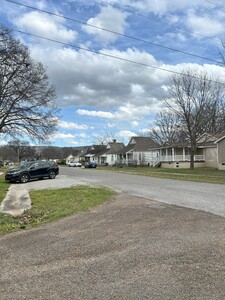
Dallas Mill Village today, taken 19 March 2025
This is a photo of Stevens Avenue in Dallas Mill Village Historic District. -
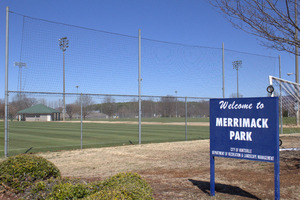
Merrimack Soccer Park, Formerly Merrimack Mill
A modern-day photo of the Merrimack Park Complex -