
Browse Items (456 total)
Sort by:
-
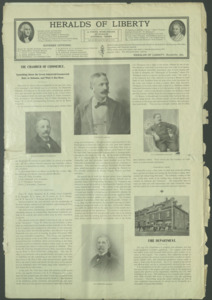
Huntsville Chamber of Commerce Page in the Huntsville Post, 1900
This is a page from the December 27, 1900, Art Industrial Edition of the Huntsville Post. This newspaper was used as a promotional material for the City of Huntsville. On this page, is an advertisement for the Heralds of Liberty, a progressive organization in Huntsville, and an article about the work of the Huntsville Chamber of Commerce. The men photographed on the page are Oscar Goldsmith, Vice-President; T.W. Pratt, President; H.J. Lowenthal, Treasurer; and N.F. Thompson, Secretary. -
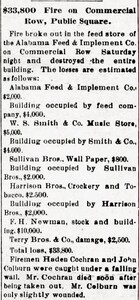
$33, 800 Fire on Commercial Row, 1901
This news article from The Journal, Huntsville, Alabama's Black-owned newspaper, lists the cost of a fire on Commercial Row in December 1901. The article was published on December 26, 1901. The total cost of the fire was $33, 800. -
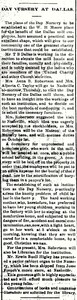
United Charities and the Dallas Day Nursery, 1900
This is an article featured in a Dallas News section of the Huntsville Weekly Democrat on September 19, 1900. According to the article, Dallas Mill had plans to establish a day nursery on the W.H. Moore property with the help of United Charity. United Charities was a group of women who lobbied the Huntsville city council to better the conditions in Huntsville's cotton mill villages. The day nursery was expected to solve the problem of child labor in the mill. Mrs. Anna B. Robertson and Mrs. Alberta C. Taylor visited the Dallas Mill in Nashville to research the day nursery there. Mrs. Robertson was to be the matron of the nursery. The article also announces a dormitory for homeless girls and a school to be built on the same W.H. Moore property. -
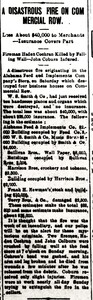
A Disastrous Fire on Commercial Row, Weekly Democrat, 1901
This article from the Huntsville Weekly Democrat reports the cause and the estimated losses of the Commercial Row Fire on December 21, 1900. According to the article, the fire originated in the Alabama Feed and Implements Company store. One man died due to injuries from the fire and another man was injured. Estimated losses for each of the businesses on the street are listed in the article. The estimated loss for Harrison Brothers two buildings was $4,500. -
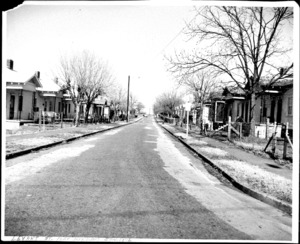
A view of Levert St, circa 1972.
Levert St is situated in Lincoln Mill village, which accommodated a substantial number of mill workers. The photograph is incorrectly labeled as Levent St. This photograph is dated 1972. -
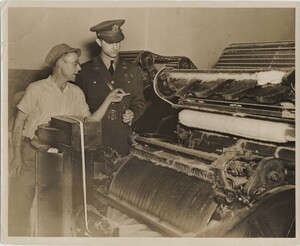
Military Tours Lincoln Mill, circa 1940s
A US Army officer receives a tour of the Lincoln Mill, c. 1940s. A mill worker demonstrates how the equipment is used during his visit. -
-
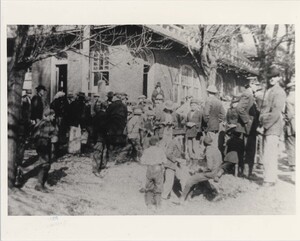
Lewis Hine Dallas Mill Workers Outside the Mill.
A photo by Lewis Hine, Progressive Era social advocacy photographer, of mill workers and child laborers outside of Dallas Mill in November of 1910. -
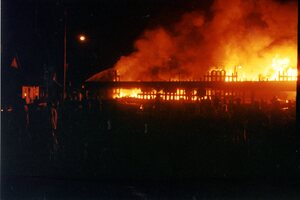
Dallas Mill Burning
Dallas Mill was set on fire on July 24, 1991 by a serial arsonist. This is an image of the burning, with people in Huntsville watching in the middle of the night. -
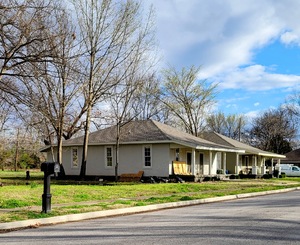
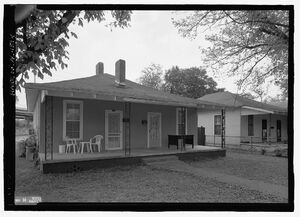
Lincoln Mill village housing, March 2025.
These homes in Lincoln Mill Village are located behind Lincoln School. The houses were built to provide accommodation for mill workers. The photograph was taken in March 2025. -
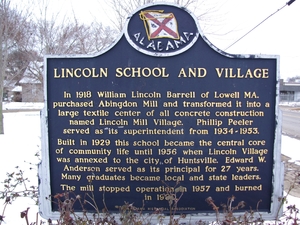
Lincoln School and Village historical marker.
The inscription of the Lincoln School and Village marker reads:
In 1918 William Lincoln Barrell of Lowell MA. purchased Abingdon Mill and transformed it into a large textile center of all concrete construction named Lincoln Mill Village. Phillip Peeler served as its superintendent from 1934-1953.
Built in 1929 this school became the central core of community life until 1956 when Lincoln Village was annexed into the city of Huntsville. Edward W. Anderson served as its principal for 27 years. Many graduates became local and state leaders.
The mill stopped operation in 1957 and burned in 1980.
The historical marker was erected by the Alabama Historical Association in 1985. -
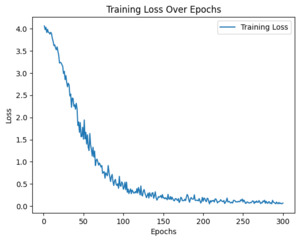
Convolutional Neural Net Loss Plot
A loss plot for the letter convolutional neural net classifier. -
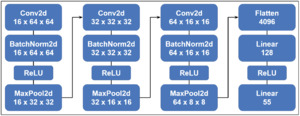
Convolutional Neural Network Architecture
The architecture for the letter recognition convolutional neural network. -
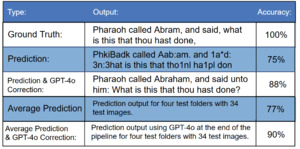
Table of Results from Automated Transcription Pipeline
A table that holds the results from testing for the automated transcription pipeline. -
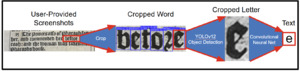
Layout for Letter Recognition Pipeline
The layout of the pipeline for the automated transcriber. It shows the input from a 1613 Bible, object detected, cropped, then transposed to a letter. -
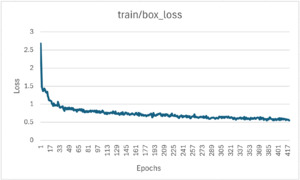
Object Detection Bounding Box Loss Plot
The loss plot for the bounding boxes from a YOLOv12 object detection model. Used to detect letters in a word. -
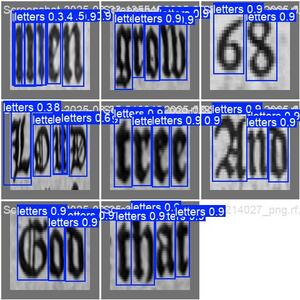
YOLOv12 Object Detection Validation Prediction Results
The results from the validation test set for the YOLOv12 object detection model for the automated transcriber pipeline. -
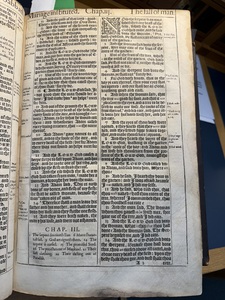
1613 Bible Open Image
A page from a 1613 Bible taken from the British Library. -
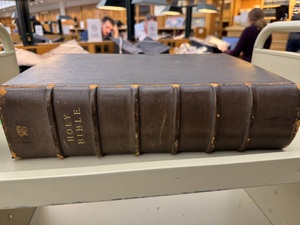
Spine of 1613 Bible
The spine for the 1613 Bible taken at the British Library. -
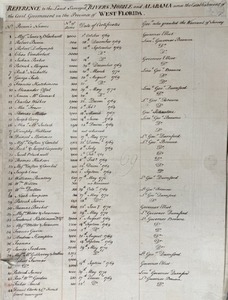
A Photo of Reference to the Land Surveyed on the Rivers Mobile and Alabama since the Establishment of the Civil Government in the Province of West Florida
A Photo of Reference to the Land Surveyed on the Rivers Mobile and Alabama since the Establishment of the Civil Government in the Province of West Florida.