
Browse Items (456 total)
Sort by:
-
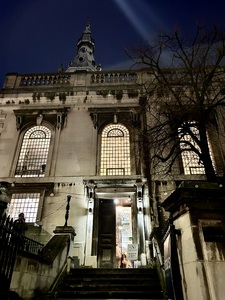
St. Nicholas Cole Abbey.
St. Nicholas Cole Abby Centre for Workplace Ministry was one of the churches that was destroyed in the London Fire in 1666. It was the first church rebuilt by Sir Christopher Wren. It has gone through many changes in the last hundred years, but today it is home to The Wren, a coffee shop, and a workplace ministry. -
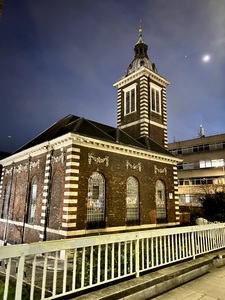
St. Benet Paul's Wharf.
St. Benet Paul's Wharf dates back to the 12th century in London. It was rebuilt by Sir Christopher Wren after it was destroyed in 1666 due to the London Fire. It is one of the few churches that was sparred during the Blitz in World War II. Today, it is a Welsh Anglican Church. -
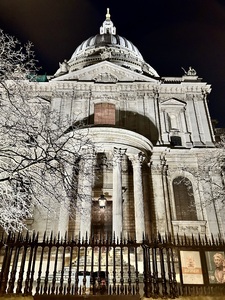
St. Paul's Cathedral.
St. Paul's Cathedral dates back to 604. It was destroyed in 1666 due to the London Fire. Sir Christopher was contracted to rebuild the Cathedral as part of the Commission to rebuild London's churches. It was completed in 1711. -
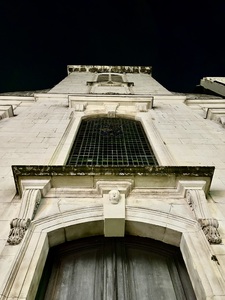
St. Martin-within-Ludgate.
St. Martin-within-Ludgate is a medieval church that dates back to 1437. It was destroyed in 1666 due to the London Fire. Sir Christopher Wren rebuilt it in 1684 and it remains largely unchanged. -
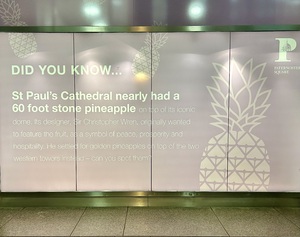
Information Board in London.
This information board exists around St. Paul's Cathedral. It discusses how Sir Christopher Wren, the architect of St. Paul's, wanted to feature a pineapple in the Cathedral because it is a symbol of peace, prosperity, and hospitality. It states that there are two golden pineapples on top of two of the western towers. -
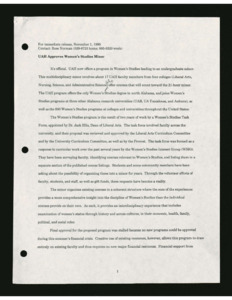
"UAH Approves Women's Studies Minor"
A press release from Rose Norman that details the creation of the Women's Studies Minor, notifying the public that the program will be offered. -
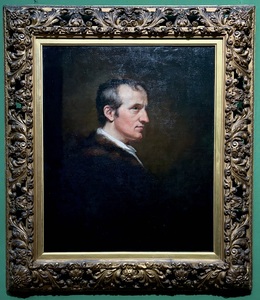
Portrait of William Godwin
Portrait of William Godwin, philosopher and novelist, by James Northcote, oil on Canvas. On display in the National Portrait Gallery. -
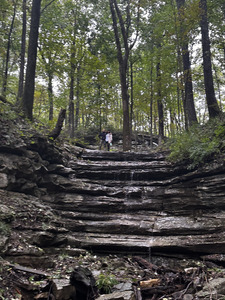
View of Wisdom Falls in Monte Sano State Park. The photo was taken near the base of the waterfall.
Wisdom Falls is located near what used to be the Monte Sano Hotel but is now in Monte Sano State Park. The Hotel opened in 1887, closed in 1900, and 1944 the Hotel was torn down. The falls can be found along the South Plateau loop, near SE Nolen Avenue. -
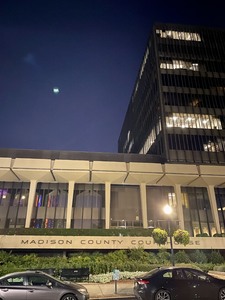
View of the fourth courthouse in Madison Alabama
This is a photograph of the fourth courthouse. The photograph is taken right in front of the courthouse on October 8, 2024. This courthouse was built in 1967 and is still up today. -
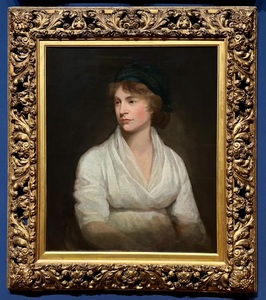
Mary Wollstonecraft
Portrait of Mary Wollstonecraft by John Opie, oil on canvas, c. 1797. -
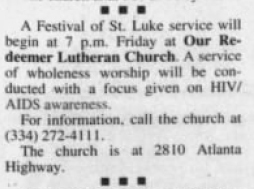
A Festival of St. Luke Service - Montgomery Advertiser
A clipping of the Montgomery Advertiser announcing a Festival of Saint Luke church service at Our Redeemer Lutheran Church that was going to focus on HIV/AIDS prayers. -
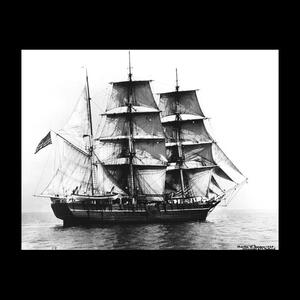
Bark Charles W. Morgan under sail
A photograph taken in 1920 of the Charles W. Morgan under sail -
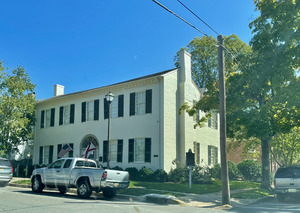
Photo taken of the Weeden House Museum in the present day at 300 Gates Avenue SE
This is a front three quarters view photograph of the Weeden House Museum and Garden located in Huntsville, Alabama. It was the house of Maria Howard Weeden, a famous artist and poet from the late 1800s. -
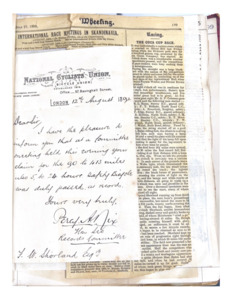
Letter from National Cyclists' Union with Shoreland's Record
One of the sources on this document is a letter from the National Cyclists' Union addressed to Frank Shorland to recognize him for his 24 hour safety bicycle record. -
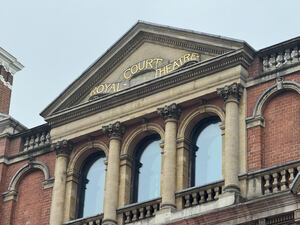
Picture of The Royal Court Theatre
Picture taken outside The Royal Court Theatre -
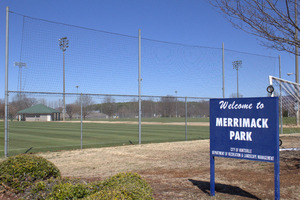
Merrimack Soccer Park, Formerly Merrimack Mill
A modern-day photo of the Merrimack Park Complex -
-
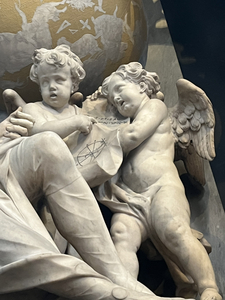
Section of Isaac Newton's memorial at Westminster Abbey.
Two stone cherubs hold a scroll inscribed with one of Isaac Newton's mathematical proofs. -
-
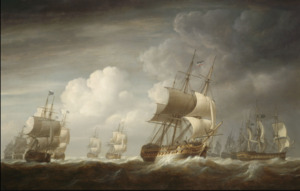
Ships of the East India Company at Sea
Nicholas Pocock’s 1803 painting Ships of the East India Company at Sea captures a dramatic maritime scene, showcasing the grandeur and might of British merchant vessels during the height of imperial trade. Housed at the National Maritime Museum in Greenwich, the artwork reflects the strategic and economic significance of the East India Company’s naval presence.