
Browse Items (456 total)
Sort by:
-
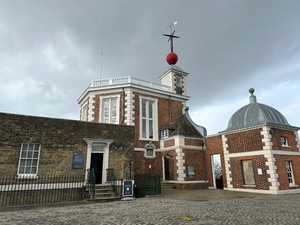
Flamsteed House, London 2024
The Flamsteed House, where the Royal Astronomers stayed with their families. The first astronomer and family to live there was the John Flamsteed with his family. This house was built in 1676, however the picture was taken March 15th, 2024. -
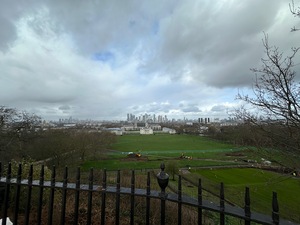
View of Queen's House and River Thames, March 2024
This is the physical imagery captured by the Camera Obscura at the Flamsteed House in March 2024 -
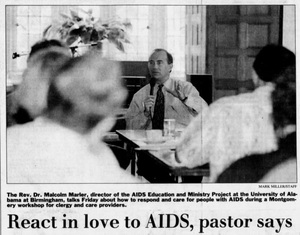
Picture of Malcolm Marler teaching an AIDS seminar in the Montgomery Advertiser
A picture from a digitization of the Montgomery Advertiser of Malcolm Marler teaching an AIDS seminar for clergy in 1995. -
-
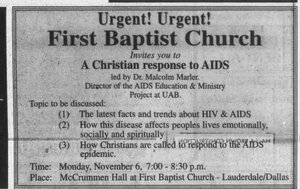
"Urgent! Urgent! A Christian Response to AIDS."
A clipping of a scan of the November 3, 1995 Selma Times newspaper with an advertisement for a class to teach interested parties how to deal with AIDS in a Christian manner. U -
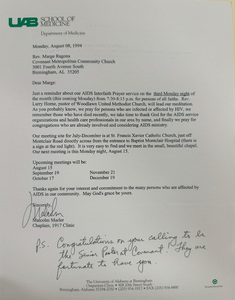
A Letter from The AIDS Education & Ministry Project at UAB
A letter from the Rev. Malcolm Marler at the 1917 AIDS Clinic to the Rev. Marge Ragona at the Covenant Metropolitan Community Church telling her about an Interfaith AIDS church service at Woodlawn United Methodist Church. -
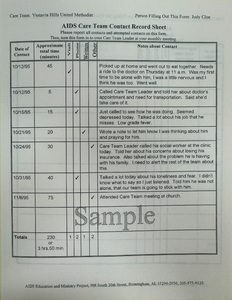
-
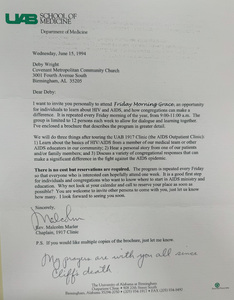
A Letter to Deby Wright from AIDS Chaplain Malcolm Marler about Friday Morning Grace
A letter from the Rev. Malcolm Marler at the 1917 AIDS Clinic to Deby Wright, paster at the Covenant Metropolitan Community Church in Birmingham, Alabama. He is inviting her to the Friday Morning Grace program at the clinic and detailing out the planned schedule for the class. He also explains how she can make reservations to attend. There is a personal note at the bottom from Malcolm offering prayers for the death of a man named Cliff. -
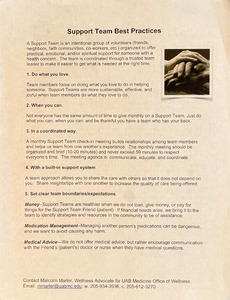
Support Teams Best Practices
A document used by the 1917 AIDS Clinic in Birmingham, Alabama to detail out the best practices for the AIDS Care/AIDS Support teams. These concepts were taught in training sessions, and give practices to help volunteers provide the best care possible to patients they are working with. These best practices are also currently used for support teams for other illness than HIV. -
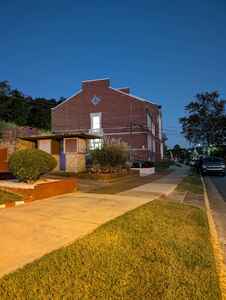
View of Bibb Graves left side
Bibb Graves Hall, located along Buchanan way at A&M University, where the Green Bottom Inn once was. -
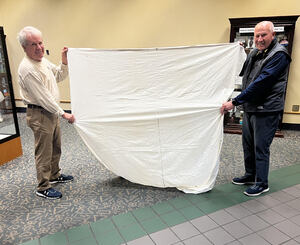
Larry Layne and Lawrence Hillis with Dallas Mills Sheet
Larry Layne and Lawrence Hillis holding up a sheet made by Hillis’ grandmother, Hattie Dunham Warren. Warren accumulated approximately 20 sheets from 1918 to 1924 while she worked at the mill.
-
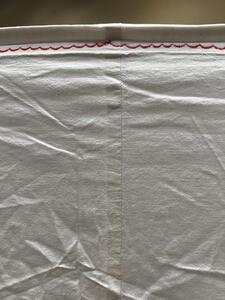
Dallas Mills Sheet
a sheet made by Lawrence Hillis’ grandmother, Hattie Dunham Warren. Warren accumulated approximately 20 sheets from 1918 to 1924 while she worked at the mill. The sheets would be sewn together to fit a bed, and after work Warren added red scalloped stitching for a personal touch. -
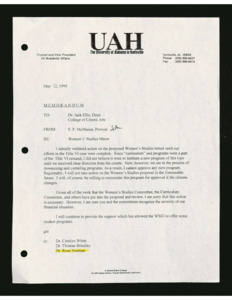
Denial of Women's Studies Minor
Provost Samuel McManus notifies Jack Ellis and CAHSS that the minor has been denied due to concerns related to the outstanding Title VI case. -
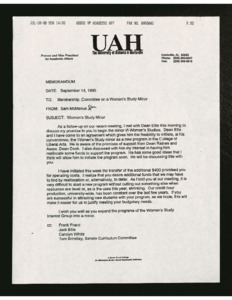
"Women's Studies Minor"
Provost Sam McManus approves the creation of the Women's Studies minor. -
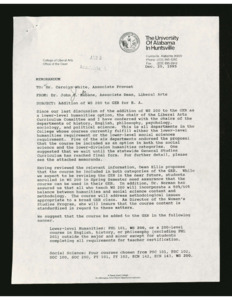
"Addition of WS 200 to GER for B. A."
The associate dean of CAHSS notifies the associate Provost that all departments have supported the new WS class to be added to general education requirements for CAHSS students. -
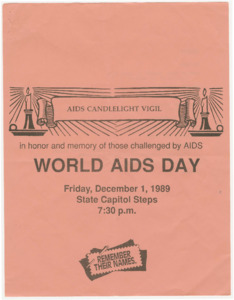
Program for a World AIDS Day candlelight vigil at the Capitol in Montgomery, Alabama.
A digitization of a program for World AIDS Day on December 1, 1989 at the Capitol in Montgomery, Alabama. Includes Program order, as well as prayers, hymns, and information about AIDS and World AIDs Day. -
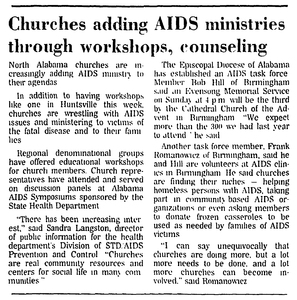
Churches Adding AIDS Ministries - The Decatur Daily
A clipping of a newspaper scan of the October 12, 1991 Decatur Daily Religion section front page. It is a smaller part of a larger article that talks about ministers learning about how to deal with AIDS. -
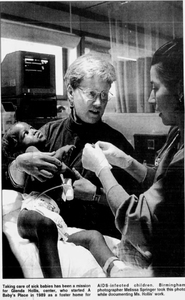
Glenda Hollis Taking Care of a Sick Baby
A scan of a newspaper clipping with a photograph from Birmingham photographer Melissa Springer of Glenda Hollis, founder of A Baby's Place, taking care of a sick child, that appeared in a 1996 edition of the Birmingham Post-Herald. -
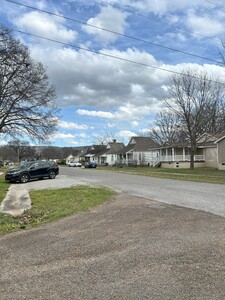
Dallas Mill Village today, taken 19 March 2025
This is a photo of Stevens Avenue in Dallas Mill Village Historic District. -
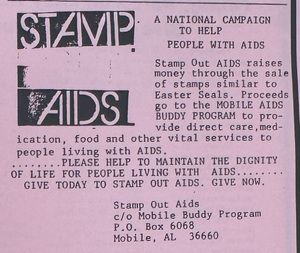
Stamp Out AIDS Clipping From MCC Newsletter
A fundraising advertisement in a summer 1988 edition of the Metropolitan Community Church newsletter. It was soliciting funds to help the AIDS Buddy Program.