
Browse Items (226 total)
Sort by:
-
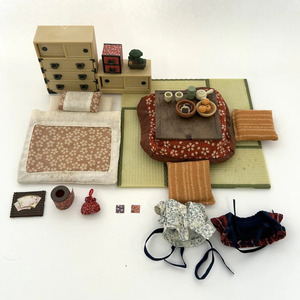
Sylvanian Families Japanese Room
The Sylvanian Families 20th Anniversary Japanese Room Set offers a charming miniature glimpse into traditional Japanese living. It features a low kotatsu table with futon coverings, perfect for gathering and staying warm, along with zabuton cushions for comfortable seating on the tatami mat flooring. The set also includes a tansu chest for storage and a decorative bonsai tree, all evoking a sense of Japanese home decor. This set beautifully represents the importance of communal spaces, floor-level living, and appreciation for natural elements within Japanese culture. -
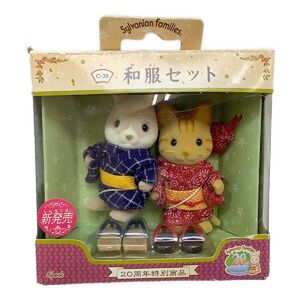
20th Anniversary Kimono Set Sylvanian Families
This enchanting Sylvanian Families 20th Anniversary Kimono Set features two adorable figures dressed in traditional Japanese attire. The figure on the left sports a dark blue kimono with a white diamond pattern and a vibrant yellow obi belt, while the figure on the right wears a striking red kimono adorned with delicate white and red floral designs, complemented by a gold obi. Complete with traditional zori sandals, this set beautifully captures the essence of Japanese cultural clothing. It serves as a charming representation of Japan's rich heritage and aesthetic. -
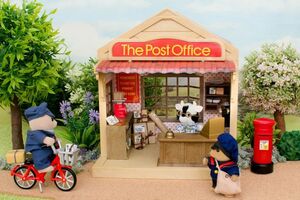
Post Office playset for Sylvanian Families Figurines
The Sylvanian Families Post Office playset beautifully captures elements of British culture. The set includes a charming post office building, complete with a classic red post box, an iconic symbol of British postal services. The postman figure, dressed in a traditional uniform, signifies the importance of mail and newspaper delivery in British society. This playset offers a delightful glimpse into a familiar aspect of British life. -
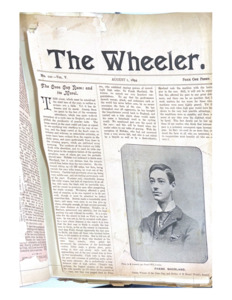
The Cuca Cup Race: and its Moral
This is an article about the Cuca Cocoa Challenge Cup and goes into the race, eventually describing how Shorland's bicycle made a difference to the end result of the race. -
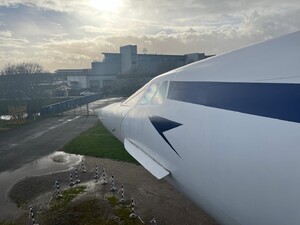
British Airways Concorde nose from front exit stairs
The Concorde is the world's first supersonic commercial aircraft. Due to maintenance costs and noise issues, the plane was retired in 2003. Since then, Concorde has become a British icon. Exhibits such as this one at Brooklands Museum share a goal of presenting the innovation and passenger experience of Concorde. -
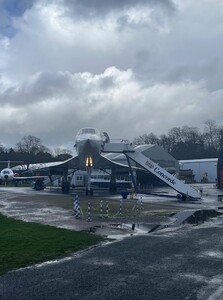
Concorde in Brooklands Museum from front
As the factory where 30% of each Concorde was made, Brooklands Museum now holds G-BBDG, one of the 18 remaining Concordes, for display. -
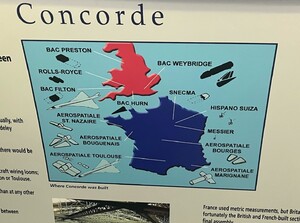
Graphic of Concorde construction locations
As a collaboration between Aérospatiale and the British Aircraft Corporation (BAC), parts of Concorde were constructed in various locations in Britain and France, as shown in this graphic. This graphic originates from Brooklands Museum, a major factory for Concorde. -
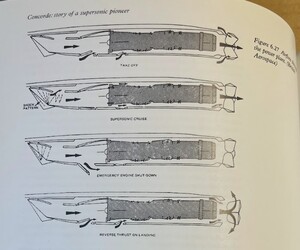
Airflow through the (Concorde) power plant
Demonstration of airflow throughout Concorde power plant in different stages of flight. As the Concorde's engine could only use air flowing at about 300 miles per hour at the fastest, the power plant includes adjustable ramps to slow down airflow from Concorde's top speed of ~1300 mph to a usable range. Also include reverse thrust demonstrations. -
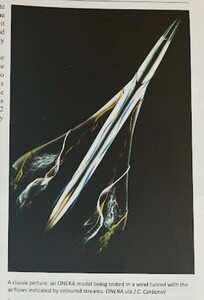
A classic picture: an ONERA model being tested in a wind tunnel with the airflows indicated by colored streams. (Concorde)
ONERA is a French aerospace research center, and this is a demonstration of the aerodynamics of Concorde via an ONERA model. In order to break the sound barrier, the fuselage was created to be needle-like, and the long wings were incredibly thin, making Concorde exceptionally aerodynamic. -
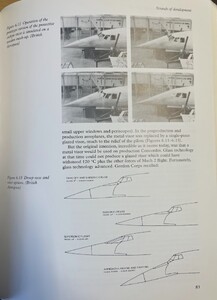
Concorde droop nose drawings and prototypes
Due to the nature of aerodynamic changes at supersonic speeds, Concorde's nose had to have a needle-like design to be aerodynamic enough to break the sound barrier. However, this design presented problems in visibility. This led to the iconic adjustable "droop nose" design, where the high-nose configuration was used when cruising for better aerodynamics, and the low-nose configuration was used during landing for better visibility. This source shows prototypes of the nose design and drawings of multiple nose configurations. -
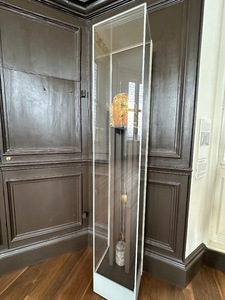
Year-going clock movement, by Thomas Tompion, 1675
This clock was designed for the observation room at the Flamsteed house, and was gifted to John Flamsteed by his patron, Sir Jonas Moore. After Flamsteed's death, his wife, Margaret Flamsteed, massed produced and sold the clocks for domestic use to pay off Flamsteed's debts. -
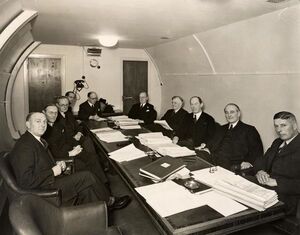
Railway Executive Committee meeting in Down Street Underground station
The Railway Executive Committee meets in an underground room in the disused Down Street Underground station during the Second World War. Frank Pick, vice chairman of the London Transport Passenger Board Executive, is fourth from right. Down Street Underground station, off Piccadilly, provided the perfect central and safe location for the committee headquarters. Accommodation included a telephone exchange and eating and sleeping facilities. The station was also used by the Cabinet before the Cabinet War Rooms under Whitehall were ready. Down Street had not been used as a station since 1932. -
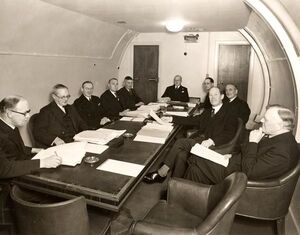
Meeting of the LT Executive in a room in the disused Down Street Underground station
Meeting of the LT Executive in a room in the disused Down Street Underground station. Frank Pick sits nearest to camera on right. -
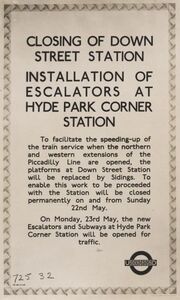
Closing of Down Street station
A magazine advertisement column is noting the closing of Down Street station -
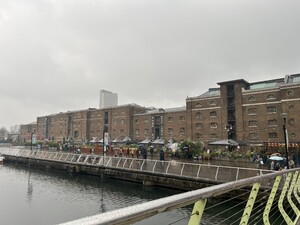
Image of Museum of London, Docklands exterior taken from the bridge.
This is the exterior of the Museum of London, Docklands. -
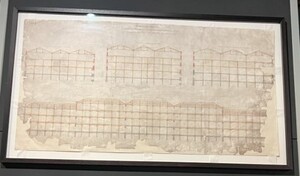
Internal Sections of Nos 1 and 9 Warehouses of Museum of London, Docklands
This helps us to examine what the building looked like before renovation when the Museum of London, Docklands was still a sugar mill in 1827.
-
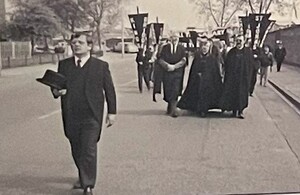
March Led by Peter Wade to the Island of Prince Charles
The march led by Peter Wade was meant to signify the “death of the community” with the development of the Docklands and reflects the feelings of the Community. This was done by the Association of Island Communities. -
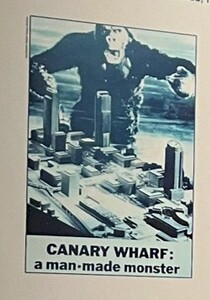
Political Cartoon Made Because of the Proposal to Turn Canary Warf into A Business District
Political Cartoon Made Because of the Proposal to Turn Canary Warf into A Business District Demonstrates the discourse in the community surrounding the new development -
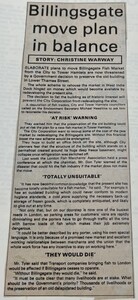
Hackney Advertiser Tower Hamlets
Hackney Advertiser Tower Hamlets: Describing how the development of the Docklands would put the citizens at risk as it is unsuitable. -
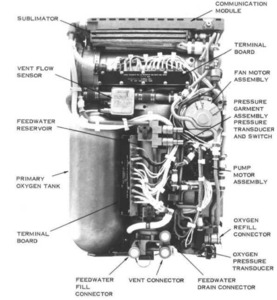
Apollo’s Second Generation PLSS
Sectional Diagram of the Apollo Personal Life Support System. This was the system responsible for maintaining safe atmospheric systems inside of the Apollo Space Suit