
Browse Items (226 total)
Sort by:
-
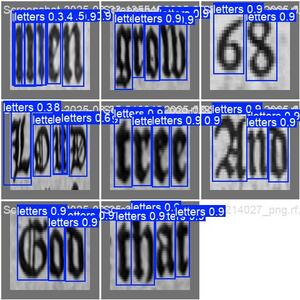
YOLOv12 Object Detection Validation Prediction Results
The results from the validation test set for the YOLOv12 object detection model for the automated transcriber pipeline. -

Mary Shelley - Letter to Percy Bysshe Shelley (Audio)
"Shelley was now financially responsible for Mary and Claire as well as Harriet, who was heavily pregnant with their second child. Godwin refused to see him, but drew on his resources. Mary wrote this impassioned letter to Shelley when he was in hiding from his numerous creditors. They could meet only on Sundays, when it was illegal to make arrests for debt."
-
Mary Shelley - Journal of Sorrow (Audio)
"In the months immediately following Shelley's death Mary lived at Albaro on the outskirts of Genoa. Her only regular companions were her young son, Percy Florence, and the journal she began on 2 October 1822.
To this 'Journal of Sorrow' she confided her innermost thoughts: 'White paper - wilt thou be my confident? I will trust thee fully, for none shall see what I write.' To be sure, Mary would not have shared the entries she wrote immediately after Shelley's death, in which her remorse and despair sometimes approached hysteria. But she left no instructions for the 'Journal of Sorrow' to be destroyed after her death, and was perhaps reconciled to the idea that this, and her other journals, would eventually be seen by other eyes." -
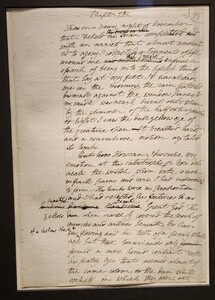
Draft of Mary Shelley's Frankenstein
A picture of a page of a draft of Mary Shelley's Frankenstein. The draft includes annotations from Percy Bysshe Shelley. Never Let Me Go is based on the Frankenstein narrative. -
Percy Bysshe Shelley - Letter to Mary Shelley (Audio)
"'Everybody is in despair and every thing in confusion' writes Shelley in his last letter to Mary. He was in Pisa to discuss a new journal, The Liberal, with Leigh Hunt and Lord Byron.
Shelley had been delayed there by Hunt's personal situation (his wife Marianne had been told she did not have long to live) and by Byron's complicated affairs. He hints that Edward Williams might sail back to the Villa Magni ahead of him. Hurriedly concluding the letter, Shelley hopes that Mary was reconciled to staying at the Villa Magni, where he had never been happier, but where she had been ill and wretchedly depressed. In a PS he tells her that he has found the manuscript of his translation." -
Percy Bysshe Shelley and Mary Shelley - Joint journal entry (Audio)
"Shelley and Mary eloped at 4.15 am on 28 July 1814, accompanied by Mary's step-sister Jane Clairmont. They were pursued by Mrs Godwin (Claire's mother), who caught up with them the following day at Calais, but failed to persuade them to return. On 2 August Shelley, Mary and Claire reached Paris, where they purchased this notebook. Shelley wrote up their dramatic flight from England, the stormy crossing (during which he began 'to reason upon death') and their arrival in France. Mary makes her first contribution to the journal by lightly completing a sentence: 'Mary was there. Shelley was also with me.'" -
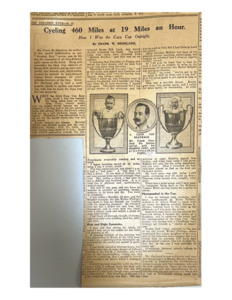
Cycling 460 Miles at 19 Miles an Hour
This is an article from an unknown magazine or newspaper which is authored by Frank Shorland and is about how me won the Cuca Cocoa Challenge Cup. -
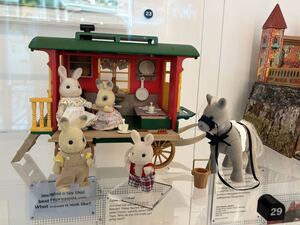
Sylvanian Families Horse-Drawn Caravan
The Sylvanian Families Horse Drawn Caravan offers a charming glimpse into a nomadic lifestyle often romanticized in British culture. Pulled by a gentle grey horse with a harness, the green and red caravan features a cozy interior with windows, a door, and even a small cooking area visible. This playset evokes images of traditional Romani caravans and the history of traveling communities in Britain, representing a sense of freedom and connection to the countryside. It's a sweet miniature portrayal of a mobile home, reminiscent of vintage British fairground or countryside living. -
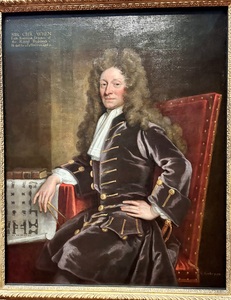
Portrait of Sir Christopher Wren.
At the National Portrait Gallery, there is a painting of Sir Christopher Wren. Wren was the King's Surveyor of Works following the Great Fire of 1666. He was heavily involved in the rebuilding of 51 parishes in London after the fire. -
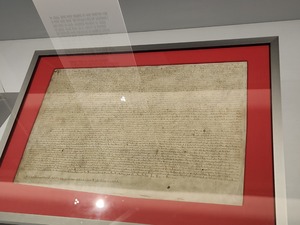
King John Magna Carta of 1215
There are many different versions of the Magna Carta. This is version is the first ever version, signed by King John in Runnymede in 1215. William Marshal had significant influence in the signing of this version. -
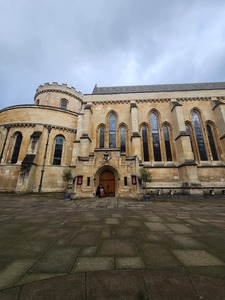
Temple Church in London
Temple Church was opened in 1185, and became the stronghold of the Knights Templar order in England. Today it serves as the final resting place for William Marshal alongside notable Templar leaders. Most of the building remains as it was in the 12th century with significant restoration taking place after "The Blitz" in World War II. -
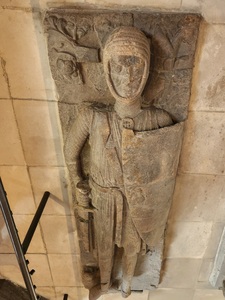
Effigy Tomb of William Marshal
William Marshal, first earl of Pembroke, died in 1219 as King regent. Subsequently, because of his commitment to the Templers cause in the Holy Land, and his loyalty to the English royal family, he was buried in Temple Church with great honor. His effigy tomb, despite being partially destroyed during "The Blitz," remains untouched in Temple Church. -
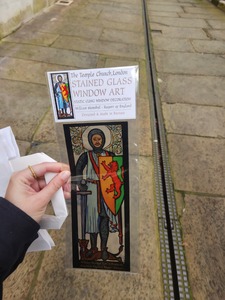
Window Cling Merchandise of William Marshal
William Marshal's legacy is greatly displayed and upheld in Temple Church. The Church often holds history events about William Marshal's life, has William Marshal exhibits, and sells William Marshal merchandise. This window cling is one of the many depictions in merchandise sold of Marshal in Temple Church. -
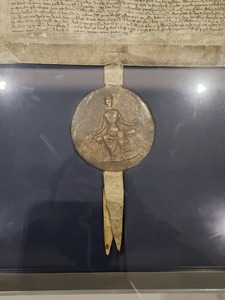
Official Seal of King John
Kings often replaced their signatures with their royal seals on official documents. This particular seal of King John was to certify The Articles of the Barons, the final settlement becoming The Magna Carta. -
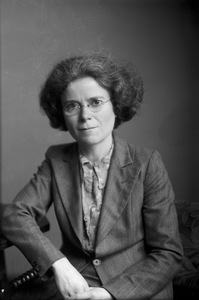
Dame Kathleen Lonsdale (née Yardley)
black and white portrait of Kathleen Lonsdale, half-plate glass negative -
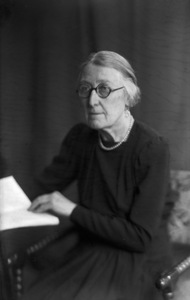
Official Portrait of Marjory Stephenson, 1940
This photo of Marjory Stephenson, taken by Walter Stoneman in 1940, is housed at the National Portrait Gallery in London, UK. It is one of the few photos that exist of her. -
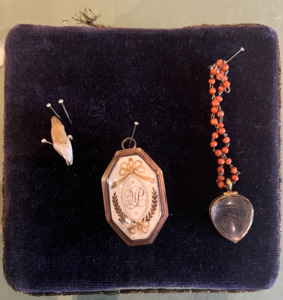
Katherine Parr Grave Robberies
The tooth, necklace, and emblem of Katherine Parr that were stolen from her grave during a violent robbery that destroyed what remained of her body. The items were eventually returned to Sudeley Castle. -
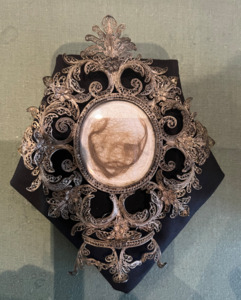
Katherine Parr Locket
Locket belonging to Katherine Parr containing perfectly preserved strands of her hair that have allowed us to confirm her hair texture, type, and color. Although the locket was stolen from her grave during a violent robbery that destroyed what remained of her body, the item was eventually returned to Sudeley Castle. -
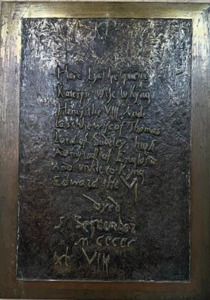
Recreation of Katherine Parr's Tomb Inscription
Recreation of Katherine Parr's tomb inscription. -
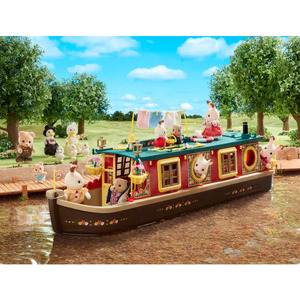
Sylvanian Families River Canal Boat
The Sylvanian Families River Canal Boat offers a delightful miniature scene of leisurely life on the water. This charming boat features living quarters with windows, a deck area with laundry hanging out to dry, and ample space for Sylvanian Families to relax and enjoy a scenic journey. Canal boats are a significant part of British waterways history and culture, originally used for transporting goods and now enjoyed for peaceful holidays. This playset beautifully captures the essence of canal life, reflecting a slower pace and appreciation for the countryside that is often associated with British traditions.