
Browse Items (970 total)
Sort by:
-
"1965 Publications," Materials Division, George C. Marshall Space Flight Center.
This document is a compilation of abstracts of NASA Technical Memorandums and MSFC Internal Notes, written by personnel of the Materials Division and released during 1965. -
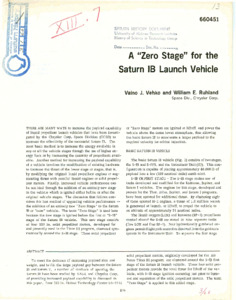
"A 'Zero Stage' for the Saturn IB Launch Vehicle."
To meet the demands of increasing payload size and weight, and to fill the large payload gap between the Saturn IB and Saturn V, a number of methods of uprating the Saturn IB have been studied by NASA and Chrysler Corp. of providing increased payload capability is discussed in this paper. Four 120 in. United Technology Center UA-1205 solid propellant motors, originally developed for the Air Force Titan III program, are clustered around the S-IB first stage of the Saturn IB launch vehicle. These four solid propellant motors provide the total thrust for liftoff of the vehicle, with S-IB stage ignition occurring just prior to burn-out and separation of the solid propellant motors. The term "Zero Stage" is applied to this added stage. -
-
"A Bibliography of Wernher von Braun, 1967."
This official bibliography includes English- and foreign-language books, articles, and interviews. -
"A Bibliography of Wernher von Braun."
The document is designated for internal use only. -
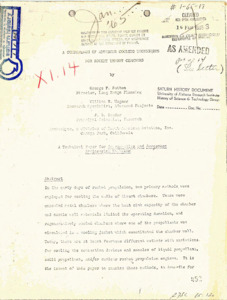
"A Comparison of Advanced Cooling Techniques for Rocket Thrust Chambers".
The document is a technical paper for Astronautics and Aerospace Engineering Magazine.The copy has handwritten notes that appear to be for revisions. The abstract states "In the early days of rocket propulsion, two primary methods were employed for cooling the walls of thrust chambers. These were uncooled metal chambers where the heat sink capacity of the chamber and nozzle wall materials limited the operating duration, and regeneratively cooled chambers where one of the propellants was circulated in a cooling jacket which constituted the chamber wall. Today, there are at least fourteen different methods with variations for cooling the combustion devices and nozzles of liquid propellant, solid propellant, and/or nuclear rocket propulsion engines. It is the intent of this paper to examine these methods, to describe for each the useful range of operating conditions, as well as present and likely future applications, to define their limitations and associated problems. Emphasis is primarily placed on liquid rocket engines." -
"A comparison of four control systems proposed for Saturn V launch vehicles."
Presented are the results of a study comparing four proposed control systems for the first stage flight of Saturn V launch vehicles. The primary basis of comparison is the effect on structural loads, using the bending moments at three stations as load indicators. Two of the systems sense only the vehicle attitude and attitude rate, while the other two systems also sense the lateral acceleration. A yaw plane wind response analysis, including rigid body translation, rigid body rotation, four bending modes, five slosh modes, and a non ideal control system, was performed. The winds used in the study were the Marshall synthetic profile and three selected Jimsphere-measured real wind profiles. Load relief obtained from the addition of accelerometer feedback in the control loop amounted to about 10 percent at maximum bending moment station. In view of predicted structural capabilities of the vehicle, this reduction in loads was not considered sufficient to offset the added complexity and the slight reduction in rigid body stability . -
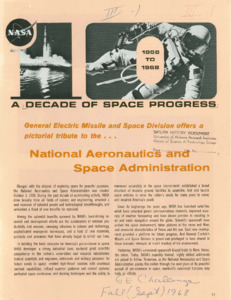
"A decade of space progress, 1958 to 1968: General Electric Missile and Space Division offers a pictorial tribute to the National Aeronautics and Space Administration."
Excerpt from G.E. Challenge, Fall (Sept.) 1968, pages 13 to 25. -
"A Description of the ST 124-M Inertial Stabilized Platform and its Application to the Saturn V Launch Vehicle."
This report is a description of the ST124-M inertial stabilized platform system and its application to the Saturn V launch vehicle. It is a summary report providing the system concept and not a theoretical presentation. Mathematical equations were included only where necessary to describe the equipment; however, the detail derivations supporting these equations were not presented since this was not the theme of the paper. -
"A description of the ST-124M inertial stabilized platform and its application to the Saturn V launch vehicle."
This report is a description of the ST-124M inertial stabilized platform system and its application to the Saturn V launch vehicle. It is a summary report providing the system concept, and not a theoretical presentation. Mathematical equations were included only where necessary to describe the equipment; however, the detailed derivations supporting these equations were not presented since this was not the theme of the paper. -
"A Discussion of the Lunar Landing Problem."
Digesu worked in the Astrionics Division of MSFC. This paper was presented at the AIAA Guidance & Control Conference, Massachusetts Institute of Technology, Cambridge, Massachusetts, August 12-14, 1963. -
"A Helium Face Seal Application In a Liquid Oxygen Pump."
Presented at the Fourth International Conference on Fluid Sealing held in conjunction with the 24th annual meeting in Philadelphia, May 5-9, 1969. -
"A Hybrid Simulation for Dynamic Verification of Saturn Guidance and Control Subsystems."
This paper presents a discussion of a hybrid simulation used to dynamically verify the Saturn Guidance and Control subsystems. First, the Saturn vehicle is briefly described to provide background information. The Instrument Unit (IU) is considered in more detail to give a proper setting for the Guidance and Flight Control (G and FC) discussion that follows. After a brief description of the actual G and FC System operation, simulation models of the G and FC components are considered in detail. This is followed by a discussion of the model assignment to a particular computer (digital or analog) and justification for making that assignment. Finally, results of the AS-204/LM1 hybrid simulation studies are briefly considered with mention of the actual flight data. -
"A Nation Goes to the Moon."
Written by NASA Office of Manned Space Flight Associate Administrator George E. Mueller, this is an article from G. E. Challenge, Fall 1966, page 26 to 32. -
"A new telemetry technique."
A technique new to telemetry is discussed which promises to alleviate an enigma facing the telemetry engineer : How to adequately transmit the avalanche of vibration and other wideband data desired in the development phase of large missiles and launch vehicles. The data channels are stacked in the frequency spectrum as single sideband subcarriers which frequency modulate the RF carrier. The system design utilizes to advantage the statistical properties of vibration data to achieve maximum data transmission efficiency from the available RF carrier deviation. However, in contrast to proposed statistical predigestion techniques, the data is transmitted in raw form. -
"A Practical Approach to the Optimization of the Saturn V Space Vehicle Control System Under Aerodynamic Loads."
This paper includes the equations for the bending moment of a launch vehicle with the effects of bending and sloshing dynamics. It also includes a comparison between the bending moment response envelope of the measure winds and the bending moment response of the MSFC synthetic wind profile. -
"A Prime Contractor's Reliability Program for Components/Parts for the Douglas S-IVB Stage Project."
This paper, presented at the fifth annual Reliability and Maintainability Conference in New York City, contains a "prime contractor's reliability program for components/parts for the Douglas S-IVB stage project." These parts include special flight critical items and their complementary reliability engineering program plan is outlined in this paper. -
"A Program plan for earth orbital space astronomy."
Manned space flight offers the opportunity to couple the astronaut/scientist's ability to select and process data and to calibrate, modify and repair instruments with the vantage point for astronomical observations provided by a platform located above the Earth's atmosphere. This paper briefly examines the role which manned space flight may play in the 1970-1990 time period in meeting astronomy research needs. The instruments and facilities which appear feasible for that period are described.; Paper presented by J. R. Olivier, National Aeronautics and Space Administration, George C. Marshall Space Flight Center and H. L. Wolbers, Ph.D, McDonnell Douglas Astronautics Company - Western Division, Advance Space and Launch Systems. -
"A real time operating system for the Saturn V launch computer system."
Presentation aimed to encourage a final check on the Saturn V project before its first launch to ensure safety and success. -
"A Review of Cryogenic Technology Aspects of Space Flight."
This paper was presented at the International Cryogenic Engineering Conference in Kyoto, Japan. It details the use of cryogenic technology in rocketry and how its usage created "many new techniques and deeply stimulated many fields of cryogenic technology."